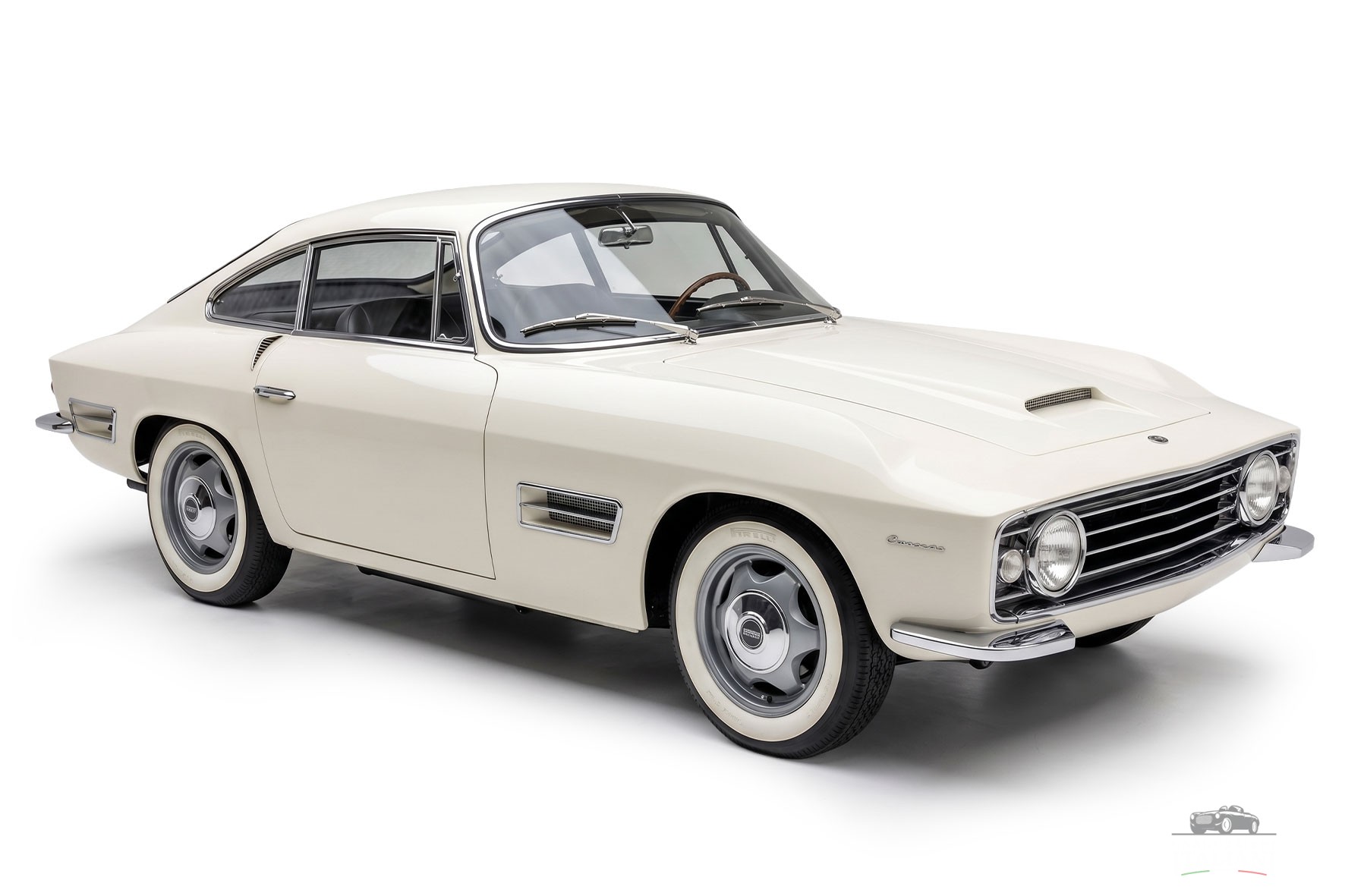

Boneschi
Carrozzeria Boneschi developed from a Lombard coachbuilding business into a specialist producer of individual automobile bodies, commercial conversions and distinctive post-war projects.
Explore record ↗
1961Coachwork by Boneschi
THE VEHICLE AT A GLANCE
THE PEOPLE BEHIND THE CAR
Carrozzeria Boneschi developed from a Lombard coachbuilding business into a specialist producer of individual automobile bodies, commercial conversions and distinctive post-war projects.
Explore record ↗01 / THE STORY
The OSCA 1600 GT Swift was a small series of berlinettas built by Carrozzeria Boneschi to designs by Rodolfo Bonetto. The project applied the Milanese workshop’s experimental Linea Tesa approach to the compact Gran Turismo chassis developed by the Maserati brothers’ OSCA company. Its first form dates from 1961, while subsequent examples and body revisions were documented during 1962 and into 1963. Compared with the softer-bodied Fissore and Zagato versions, Bonetto’s Swift adopted a geometric silhouette, sharp changes of surface and an unusually low, wide front end.
The body design evolved between examples rather than following a single fixed pattern. Contemporary and later photographs show different headlamp treatments, grilles and rear-quarter details. Bonetto also made use of the windscreen employed by the Alfa Romeo Giulia Sprint Speciale, a measure described in an April 2018 history of the OSCA 1600 GT. Photographs of one Swift after further modification must therefore not automatically be interpreted as evidence of another new chassis.
Three Boneschi-bodied 1600 GTs are cited in specialist literature, notably an Auto Italia article from April 2018 identifying chassis 0018, 0072 and 00108. The same account notes that the first body was the most angular and that later cars progressively adopted softer lines. Other historians and owners’ accounts disagree about the roster: a period-factory-register-based account records only two, while a later coachbuilding discussion identifies the dark early car as 0018 and the white car at Geneva 1962 as 0072. A further photographic claim identifies 00108 as another Boneschi body. Without a complete matched set of factory records, the three-car total is retained as the prevailing published account, with the unresolved numerical conflict documented rather than concealed.
Chassis 0018 is associated in the earlier Carrozzieri Italiani dossier with the Swift family, and one enthusiast photographic thread reports that it was subsequently modified for drag racing. However, a separate compiled chassis register lists 0018 as a Fissore coupé, making the body attribution of that serial a matter for further verification. Chassis 0072 has an independent Carrozzieri Italiani vehicle page and a reported 1962 Turin appearance; it must remain separately identified rather than be treated as an additional identity for 0018. Chassis 00108 is reported in the April 2018 article but its original body and current identity require independent corroboration.
The original Boneschi Swift design was publicised during 1961, and the earlier vehicle record associates the model with that year’s Turin Motor Show. The photographic documentation also records an example at the 1961 Paris Motor Show, though an official programme is needed to link that display definitively to chassis 0018. A white Boneschi Swift identified as chassis 0072 was photographed at the 1962 Geneva Motor Show; a later history links the same variant with Turin in 1962. These appearances refer to different dates and potentially different cars, and should be recorded with their own chassis-level evidence rather than merged into a single undifferentiated entry.
The underlying OSCA 1600 GT used a front-mounted, 1,568 cc four-cylinder twin-cam engine, independent suspension and four-wheel disc brakes. The platform was offered in several states of tune, including versions quoted at approximately 95, 105, 125 and 140 hp depending on carburettors and specification. A four-speed manual gearbox was standard for many road cars, while a five-speed was used for some competition applications. The particular output, gearbox and engine numbers of the individual Swift chassis have not been verified; no one power figure can responsibly be applied to all Boneschi examples.
The earlier model account states that two of the three Boneschi cars subsequently reached Australia. That claim requires identification of the individual chassis and dated ownership documentation before those locations can be treated as established provenance. No reliable auction sale price has been matched to a Swift chassis in the reviewed material. In particular, Bonhams’ 2019 sale of OSCA chassis 011 for €379,500 concerns a Zagato-bodied ‘Double Bubble’, and the 2017 and 2026 Gooding Christie’s sales of chassis 0019 concern a Touring-bodied coupé. Neither of those results belongs to the Boneschi Swift.
02 / TECHNICAL IDENTITY
03 / DESIGN, BODY & SUPPLIERS
Coachbuilder / Design studio
Carrozzeria Boneschi developed from a Lombard coachbuilding business into a specialist producer of individual automobile bodies, commercial conversions and distinctive post-war projects.
Explore record ↗Designer
04 / CHRONOLOGY
06 / CHASSIS REGISTER
07 / GALLERY
THE CONVERSATION
Comments 0