
Boneschi
Carrozzeria Boneschi developed from a Lombard coachbuilding business into a specialist producer of individual automobile bodies, commercial conversions and distinctive post-war projects.
Explore record ↗
1931Coachwork by Boneschi
THE VEHICLE AT A GLANCE
THE PEOPLE BEHIND THE CAR
Carrozzeria Boneschi developed from a Lombard coachbuilding business into a specialist producer of individual automobile bodies, commercial conversions and distinctive post-war projects.
Explore record ↗01 / THE STORY
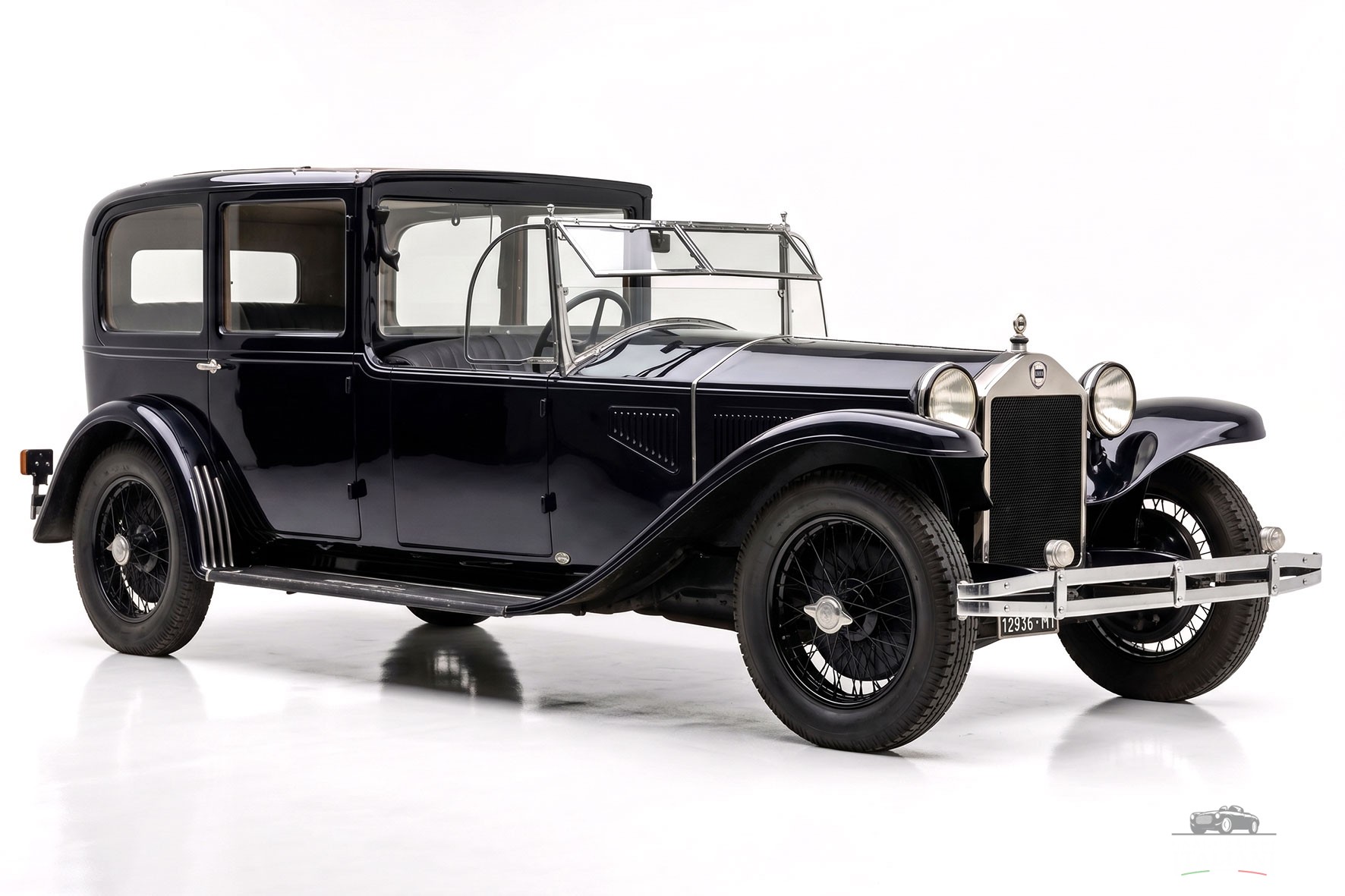
Carrozzeria Boneschi’s involvement with the Lancia Lambda was an important early phase in the Milanese coachbuilder’s history. Founded by Giovanni Boneschi after the First World War, the firm initially found relatively few customers for its special bodies. Its fortunes improved following the launch of the Lancia Lambda in 1922, when Enrico Minetti, the Lancia dealer serving Milan and the surrounding area, encouraged Boneschi to offer individually finished cars to clients seeking more luxurious and personalised coachwork. Historical accounts describe a limited series of Lambda bodies resulting from this collaboration.
The present Carrozzieri Italiani entry, conventionally dated 1931, represents this Boneschi-Lambda coachbuilding family rather than an independently verified single chassis. Although the general attribution to Boneschi is supported by the company’s historical narrative, the available legacy entry provides no original body number, chassis serial, engine serial, factory order or confirmed ownership record. The exact quantity and range of body styles produced through the Minetti relationship remain to be reconstructed from contemporary documents.
Designed under Vincenzo Lancia’s direction, the Lambda introduced a load-bearing body structure and independent sliding-pillar front suspension. This engineering was unconventional in the early 1920s and affected how outside coachbuilders could modify the car. While complete tourers used an integral body, later Lambda generations could also be supplied as chassis for independent coachwork, incorporating structural elements of the original design. The availability of these coachbuilder-specific chassis made it possible for firms such as Boneschi to furnish more individual open and closed bodies without simply cutting away the finished factory torpedo body.
The Lambda’s compact, narrow-angle V4 and four-wheel brakes were additional characteristics of the mechanical family. Its engine evolved over the nine production series, from approximately 2,119 cc in the earliest cars through 2,370 cc in the seventh series to approximately 2,568–2,570 cc in the eighth and ninth series. Therefore no single engine displacement, power figure, gearbox or wheelbase should be assigned to all Boneschi-bodied Lambdas without an individual identification.
The year 1931 corresponds to the final, ninth series of the Lambda, of which approximately 500 examples were produced before the model was discontinued. The ninth-series cars were technically close to the eighth series, retaining the approximately 2.57-litre Tipo 79 V4 and introducing changes to ignition and other details. Specialist sources quote approximately 69 CV for the general ninth-series engine. Those figures are model references only: the Boneschi entry’s date is inherited from the earlier catalogue, and no chassis-level document has been recovered that proves its pictured or described automobile belongs to that precise series.
A separate 2017 classified-photograph record describes a 1931 Lambda ninth-series Coupé de Ville attributed to Boneschi, finished in dark blue, with four doors and six seats. The source reports a 2,570 cc engine, 69 hp and other specifications. However, it does not establish a readable chassis plate or definitive coachbuilder documentation. Some of its structured fields, including the six-speed gearbox and ‘convertible’ classification, are at odds with typical Lambda documentation or not demonstrable from the available photograph. This remains a possible related individual car, not a confirmed identity match to the present listing.
The Boneschi-Lambda link is supported by company histories which describe Minetti’s commercial collaboration and the manufacture of a limited series of custom-bodied Lambdas. These documents establish an early business relationship, but do not by themselves identify an individual surviving vehicle. Likewise, generic Lambda museum or event photographs should not be transferred into this dossier without a chassis or body match. The surviving legacy photograph requires comparison with a dated catalogue image, registration plate or body plate before a more precise body type or attribution can be asserted.
No specific concours entry, prize, ownership chain, auction result or realised sale price has been verified for an individually numbered Boneschi Lambda corresponding to this record. Results from standard Lambda tourers or bodies by other carrozzerie are not evidence of a sale of this particular Boneschi-built car.
02 / TECHNICAL IDENTITY
03 / DESIGN, BODY & SUPPLIERS
Coachbuilder / Design studio
Carrozzeria Boneschi developed from a Lombard coachbuilding business into a specialist producer of individual automobile bodies, commercial conversions and distinctive post-war projects.
Explore record ↗07 / GALLERY
THE CONVERSATION
Comments 0