
Castagna
The Castagna coachbuilding tradition dates to nineteenth-century Milan, when Carlo Castagna took over an established carriage business. Carrozzeria Castagna later became renowned for luxury bespoke automotive bodies.
Explore record ↗
2007Coachwork by Castagna
THE VEHICLE AT A GLANCE
THE PEOPLE BEHIND THE CAR
The Castagna coachbuilding tradition dates to nineteenth-century Milan, when Carlo Castagna took over an established carriage business. Carrozzeria Castagna later became renowned for luxury bespoke automotive bodies.
Explore record ↗Gioacchino Acampora was an Italian architect and automotive designer based in Milan.
Explore record ↗01 / THE STORY
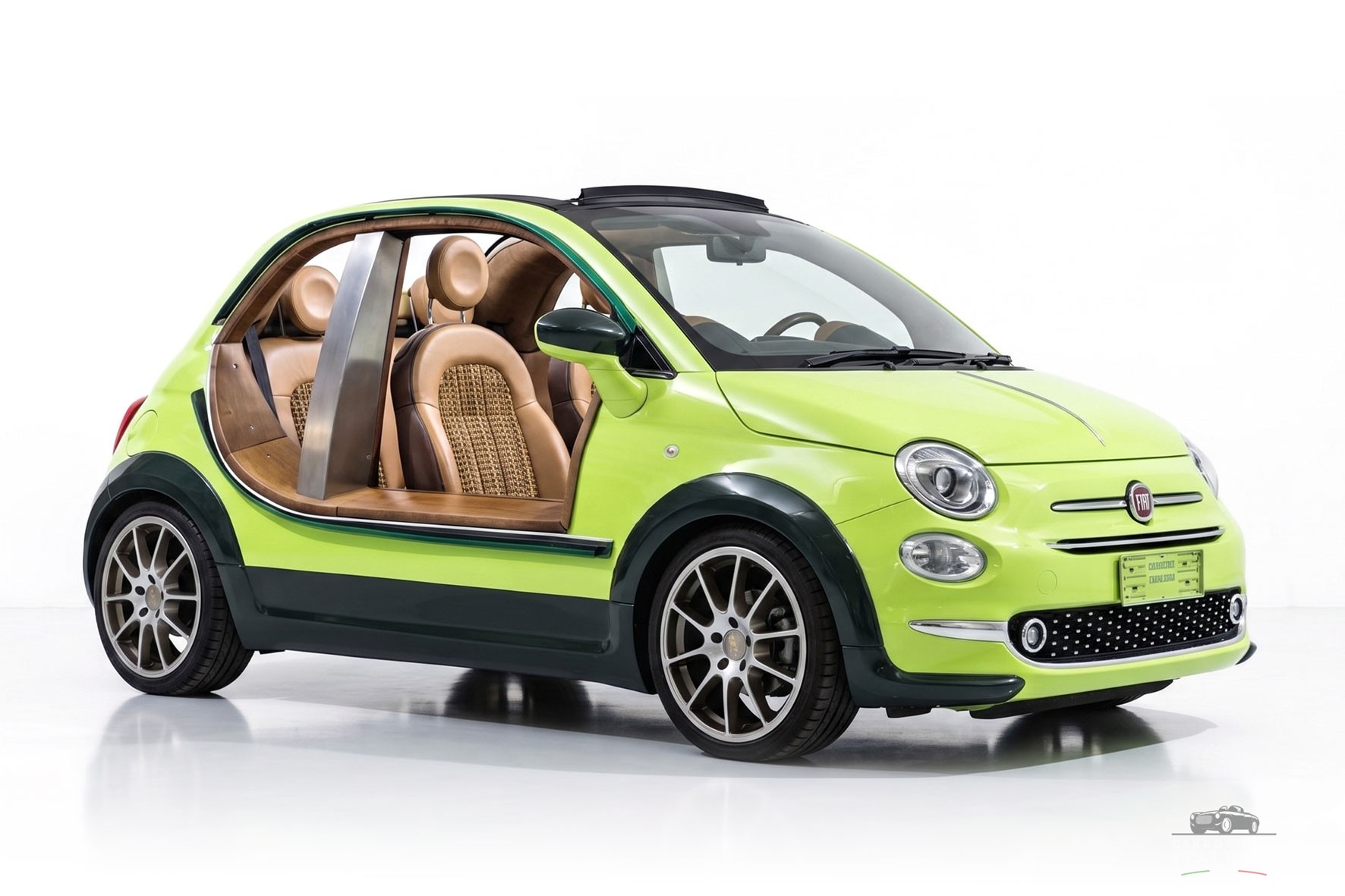
The Fiat 500 Capri, a bespoke iteration of the original Fiat 500, represents an artisanal reinterpretation by Carrozzeria Castagna Milano. This unique vehicle was conceived not as a mass-market automobile, but as a design statement tailored for a niche clientele. Drawing inspiration from the carefree elegance associated with Mediterranean coastal living, the model seeks to evoke the ambiance of Italian seaside resorts, most notably the island of Capri. Originally based on the compact underpinnings of the Fiat 500 city car, the Capri variant departs significantly from its utilitarian origins. The bodywork is extensively modified, frequently resulting in the removal of doors and the introduction of open-air configurations. A hallmark feature is the use of nautical materials, such as polished teak or mahogany, which are integrated into both the exterior and interior surfaces. These elements are complemented by canvas roof coverings and finely tailored upholstery, often in marine-inspired color schemes. The emphasis lies not on performance or practicality, but on aesthetic presence and experiential luxury. The vehicle’s exclusivity is further reinforced by its limited production. Each unit is handcrafted, allowing for a high degree of customization and individuality. Carrozzeria Castagna, whose history dates back to the 19th century, applies traditional coachbuilding techniques, merging modern mechanical platforms with old-world craftsmanship. The Capri model does not adhere to mainstream automotive trends; rather, it aligns with a lineage of leisure vehicles colloquially referred to as “spiaggine,” designed for short-distance travel in sun-drenched locales. Though equipped with modern mechanical systems for reliability, the Fiat 500 Capri eschews technological complexity in favor of simplicity and visual charm. Its appeal resides in the recreation of a bygone lifestyle rather than in contemporary innovation. As such, the vehicle exists more as a cultural artifact than a mode of transport, embodying a deliberate anachronism in an age dominated by efficiency and automation. It remains a rare example of automotive design driven by sentiment and craftsmanship rather than utility or volume production.
02 / TECHNICAL IDENTITY
03 / DESIGN, BODY & SUPPLIERS
Coachbuilder / Design studio
The Castagna coachbuilding tradition dates to nineteenth-century Milan, when Carlo Castagna took over an established carriage business. Carrozzeria Castagna later became renowned for luxury bespoke automotive bodies.
Explore record ↗Attributed designer
Gioacchino Acampora was an Italian architect and automotive designer based in Milan.
Explore record ↗07 / GALLERY
THE CONVERSATION
Comments 0