
Castagna
The Castagna coachbuilding tradition dates to nineteenth-century Milan, when Carlo Castagna took over an established carriage business. Carrozzeria Castagna later became renowned for luxury bespoke automotive bodies.
Explore record ↗
2015Coachwork by Castagna
THE VEHICLE AT A GLANCE
THE PEOPLE BEHIND THE CAR
The Castagna coachbuilding tradition dates to nineteenth-century Milan, when Carlo Castagna took over an established carriage business. Carrozzeria Castagna later became renowned for luxury bespoke automotive bodies.
Explore record ↗Gioacchino Acampora was an Italian architect and automotive designer based in Milan.
Explore record ↗01 / THE STORY
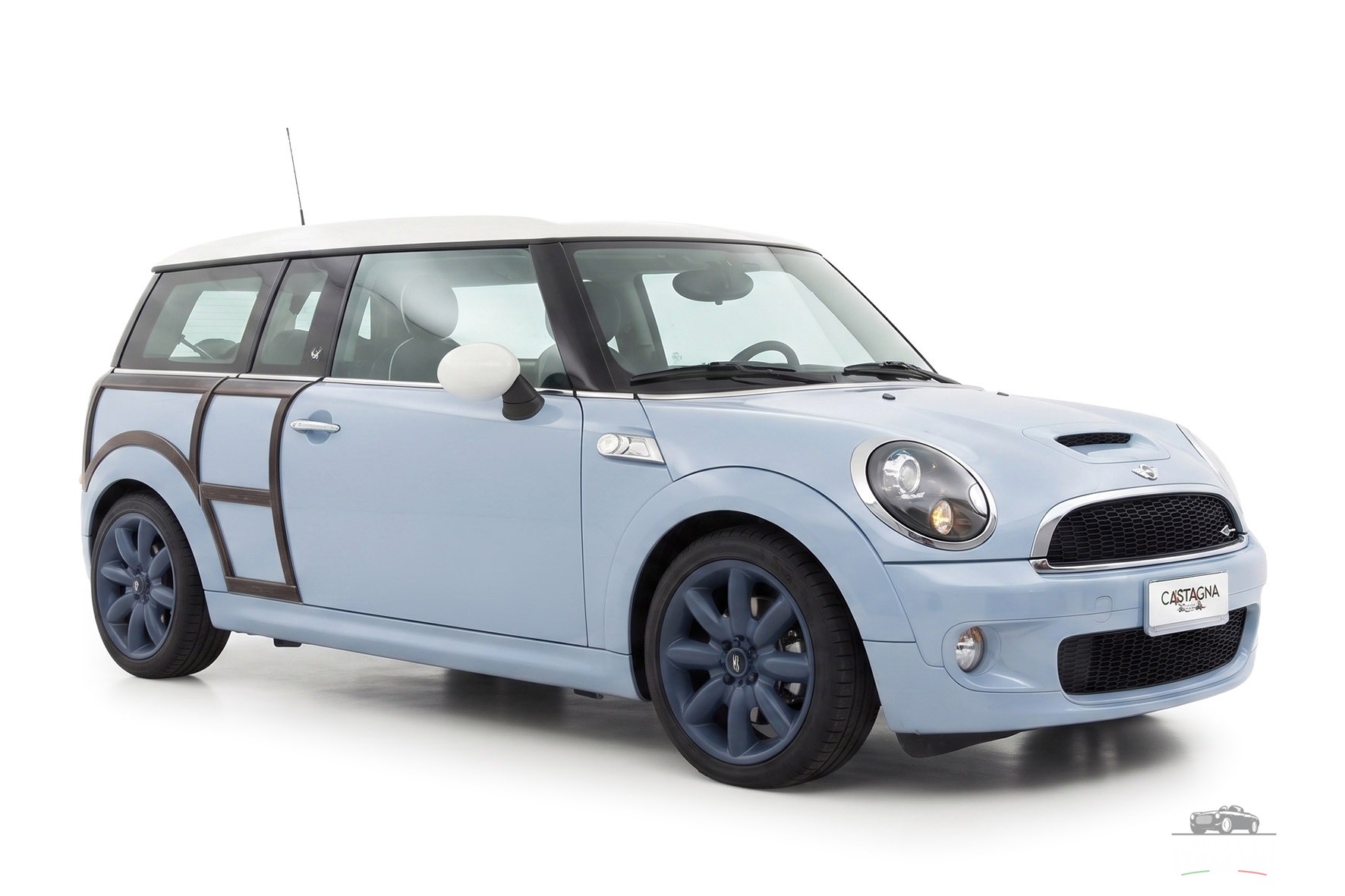
The Mini Clubman Azure Wenge is a one-off coachbuilt automobile produced in 2015 by Carrozzeria Castagna Milano, a Milanese atelier with a long-standing tradition of bespoke automotive design. Developed upon the contemporary Mini Clubman platform, the Azure Wenge exemplifies the application of traditional craftsmanship to a modern production vehicle. The result is a unique creation that bridges industrial engineering and artisanal refinement. Externally, the vehicle is finished in a pale azure blue paint, complemented by decorative elements fashioned to resemble wenge wooda dark, tropical hardwood noted for its rich grain and tonal depth. These wooden inserts are seamlessly integrated into the bodywork, extending along the side panels, roofline, and rear, thereby evoking a stylistic lineage with classic “woody” estate cars. This visual reference, however, is not intended as pastiche but rather as reinterpretation, aligning historical motifs with contemporary form. The underlying mechanical components are retained from the standard Mini Clubman configuration of the period. The powertrain, suspension, and chassis elements remain unaltered, ensuring that the vehicle maintains the reliability and drivability expected of a modern compact estate. As such, the emphasis of the Azure Wenge lies not in performance augmentation but in aesthetic and material differentiation. The interior, though not widely documented in technical literature, is consistent with Castagna’s established practice of customization. It may be inferred that the cabin features bespoke upholstery, possibly incorporating leather, alcantara, and wood veneers, arranged in a manner that corresponds thematically with the exterior treatment. Controls, fittings, and paneling are likely modified to reflect the artisanal objectives of the build. The Mini Clubman Azure Wenge represents a continuation of the coachbuilding tradition in the context of modern automotive manufacturing. By appropriating a mass-produced platform for bespoke reinterpretation, Castagna Milano reaffirms the relevance of individualized craftsmanship. The vehicle exists not as a volume model but as a singular artifactan expression of personal luxury and design discretion. Within the broader landscape of contemporary automotive production, such a creation is both anomaly and statement, underscoring the persistent cultural value of the hand-built automobile.
02 / TECHNICAL IDENTITY
03 / DESIGN, BODY & SUPPLIERS
Coachbuilder / Design studio
The Castagna coachbuilding tradition dates to nineteenth-century Milan, when Carlo Castagna took over an established carriage business. Carrozzeria Castagna later became renowned for luxury bespoke automotive bodies.
Explore record ↗Attributed designer
Gioacchino Acampora was an Italian architect and automotive designer based in Milan.
Explore record ↗07 / GALLERY
THE CONVERSATION
Comments 0