
Coggiola
Founded in Turin in 1966 by Sergio Coggiola after his work at Ghia, Carrozzeria Coggiola built specialist automotive bodies and design prototypes, including projects for Saab.
Explore record ↗
2002Coachwork by Coggiola
THE VEHICLE AT A GLANCE
THE PEOPLE BEHIND THE CAR
Founded in Turin in 1966 by Sergio Coggiola after his work at Ghia, Carrozzeria Coggiola built specialist automotive bodies and design prototypes, including projects for Saab.
Explore record ↗01 / THE STORY
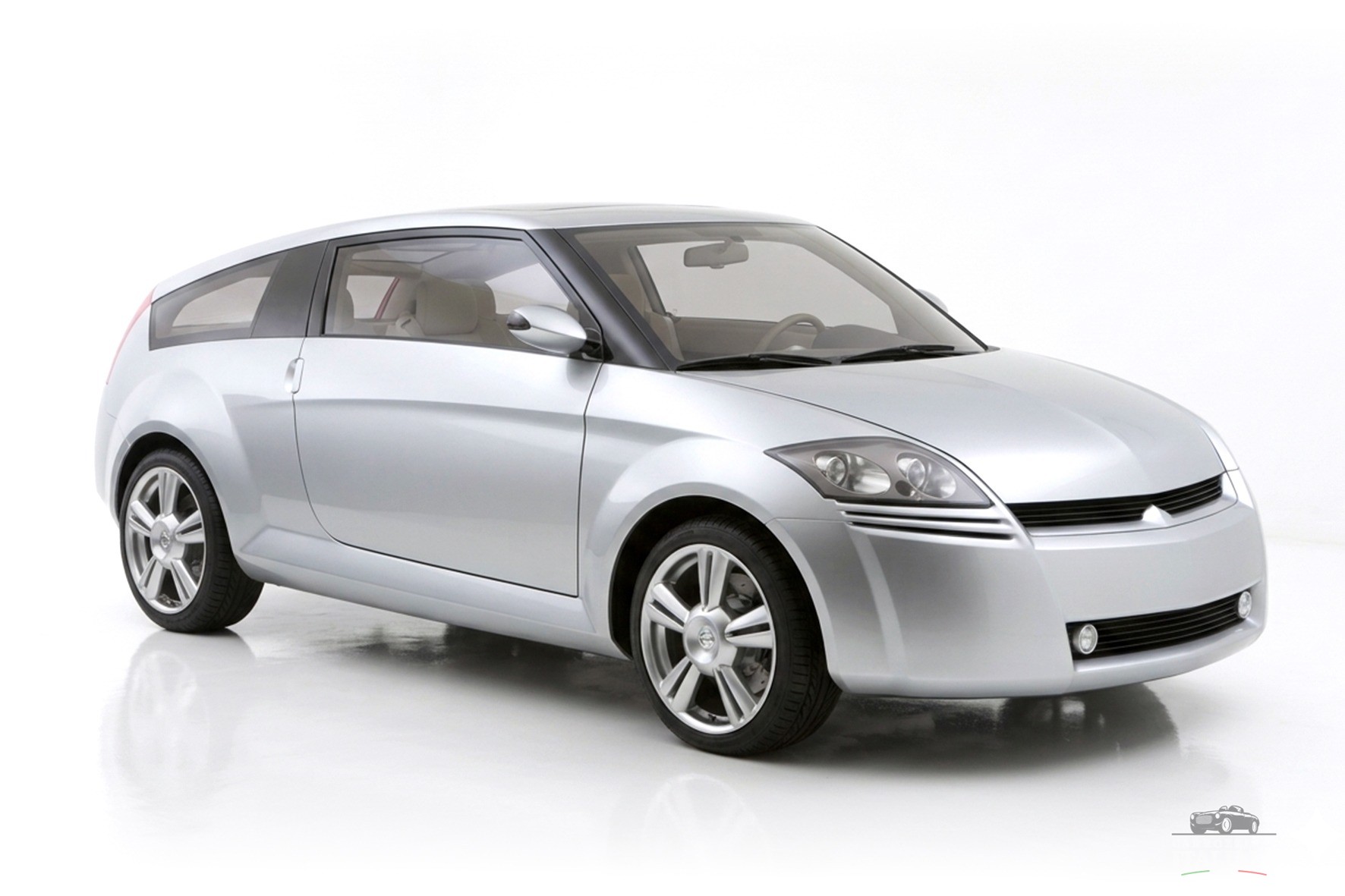
The 2002 Toyota ccX (Concept Coupe Crossover) was a four-seat experimental vehicle combining the form of a sports coupé with the load-carrying functions of a compact crossover. Toyota presented the prototype at the 2002 North American International Auto Show in Detroit, where it made its world debut on 7 January. Intended as a study of the changing preferences of younger North American buyers, the ccX was designed in Japan and physically constructed in Italy by Forum Ricerche E Progetti. Toyota treated the vehicle as an exploratory design rather than announcing a ccX production programme.
The silver body combined pronounced longitudinal character lines with sharp edges, rounded front and rear surfaces, and a high, sloping roof. The coupé-like profile concealed a cabin with room for four occupants and a rear compartment intended for equipment as well as luggage. Two large electrically operated sunroofs extended above the passenger and cargo areas. Each roof incorporated four glass panels that could tilt independently and slide towards the centre of the vehicle, providing several arrangements of open roof space without removing the surrounding body structure.
The nearly vertical rear window consisted of two sections and could retract into the rear bumper. This arrangement opened the load area to unusually tall objects while retaining a closed passenger compartment when required. The concept also employed projector-type headlamps, integrated illuminated direction indicators and a touch-sensitive door-opening system. These features were presented as practical experiments in access and adaptable body construction, not as confirmed equipment for a future series model.
The ccX seated four people in translucent bucket-style seats upholstered with washable blue fabric and mesh. Its front seats incorporated five-point harnesses and storage trays beneath the cushions. The folding rear seatbacks allowed the load area to extend forwards; movable protective dividers separated the front occupants from bulky or sharp cargo. A waterproof floor combining metal and rubber materials included four drainage plugs to simplify cleaning after transporting sporting or outdoor equipment.
A centrally positioned blue instrument display and a seven-inch multifunction screen formed the main dashboard instruments. The screen was intended for navigation, audio and DVD functions, with a separate remote-control interface protected beneath a sliding acrylic cover. Blue interior lighting, concealed load-securing points and a removable electrically powered cooler were further components of the prototype’s proposed multipurpose use.
The front-wheel-drive concept was specified with a 2.4-litre, 16-valve, double-overhead-camshaft inline-four engine and a four-speed automatic transmission. Toyota also specified 18-inch alloy wheels fitted with 225/45 R18 tyres. The figures reported with the vehicle’s 2002 exhibition material included a length of 170.5 inches (approximately 4,331 mm), width of 70.5 inches (1,791 mm), height of 56.9 inches (1,445 mm), wheelbase of 102.4 inches (2,601 mm) and a curb weight of 2,810 lb (approximately 1,275 kg). These figures describe the ccX exhibition configuration and are not specifications of a subsequent production Toyota or Scion model.
Following its Detroit debut, the ccX appeared at the March 2002 New York International Auto Show during the introduction of Toyota’s Scion marque in North America, alongside the bbX concept. The two studies illustrated alternative approaches to compact vehicles for a younger audience, although the ccX itself was not introduced as a production model. The historical importance of the ccX lies in its combination of Japanese design development, Italian prototype manufacture and a highly adaptable interior and roof system at the beginning of Toyota’s Scion initiative.
02 / TECHNICAL IDENTITY
Become a Pro member to see the full details in this section.
Membership is not available yet.
View membership options03 / DESIGN, BODY & SUPPLIERS
Coachbuilder / Design studio
Founded in Turin in 1966 by Sergio Coggiola after his work at Ghia, Carrozzeria Coggiola built specialist automotive bodies and design prototypes, including projects for Saab.
Explore record ↗04 / CHRONOLOGY
07 / GALLERY
THE CONVERSATION
Comments 0