Colli
Founded in Milan in 1931 by Giuseppe Colli and his sons, Carrozzeria Colli specialised in aluminium coachwork on Fiat, Lancia and Alfa Romeo chassis, alongside specialist post-war bodies.
Explore record ↗
1938Coachwork by Colli
THE VEHICLE AT A GLANCE
THE PEOPLE BEHIND THE CAR
Founded in Milan in 1931 by Giuseppe Colli and his sons, Carrozzeria Colli specialised in aluminium coachwork on Fiat, Lancia and Alfa Romeo chassis, alongside specialist post-war bodies.
Explore record ↗01 / THE STORY
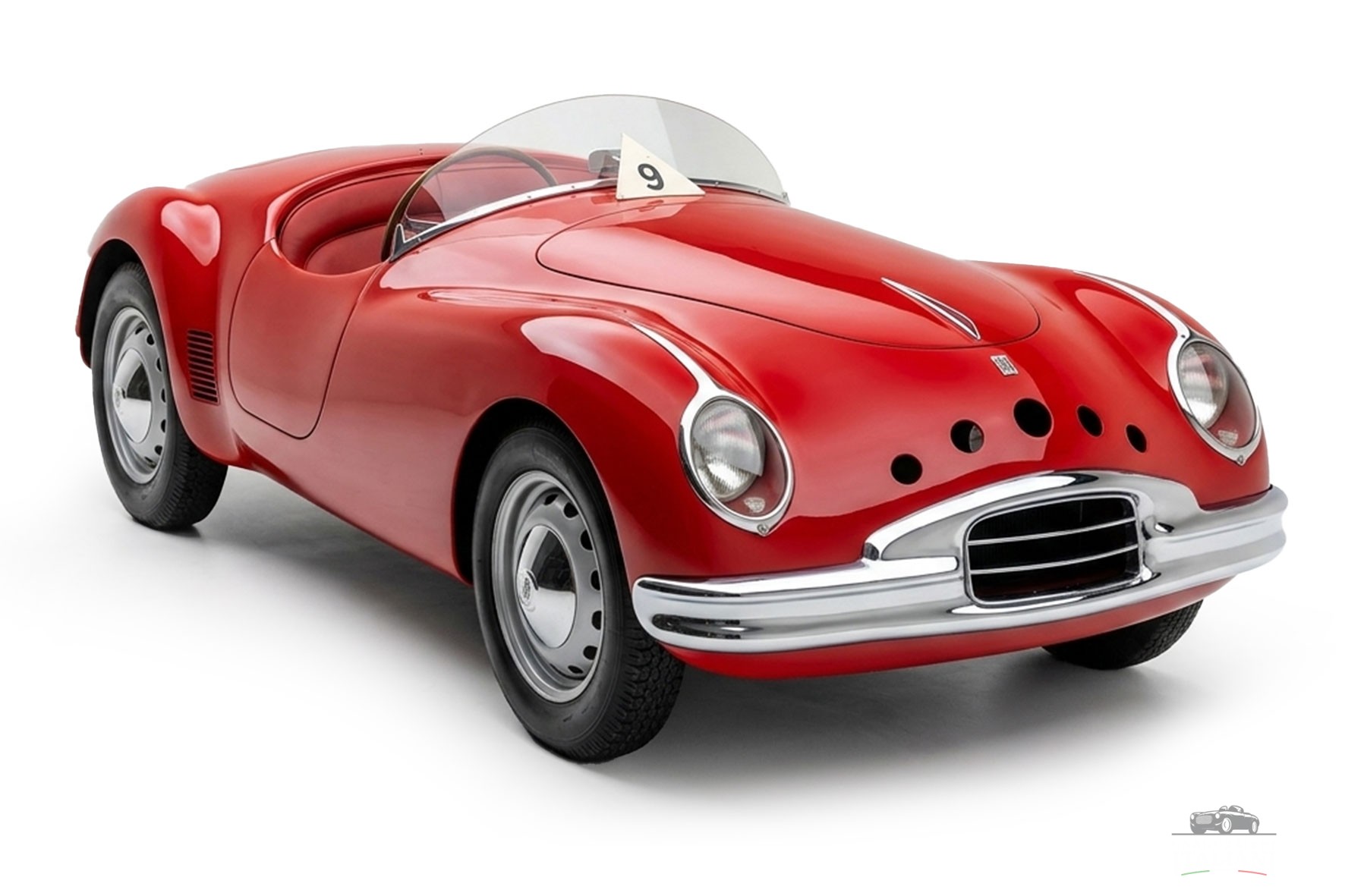
The Fiat 500 Spider of 1938 was a limited-production open sports car derived from the Fiat 500 “Topolino” and coachbuilt by Carrozzeria Colli. It was developed during a period in which Fiat actively encouraged collaborations with independent carrozzerie to explore alternative body styles on its compact mechanical platforms. The Spider configuration reflected contemporary Italian coachbuilding practice, combining compact dimensions with refined proportions and a lightweight open body intended for dual urban and leisure use. The body was constructed using traditional hand-formed techniques, employing light-gauge materials shaped over a wooden framework. Its silhouette followed late-1930s aerodynamic tendencies, with flowing lines, a gently tapered tail, and an uncluttered front profile integrated with the Topolino’s narrow track. The open two-seat layout emphasized visual lightness and balance, while retaining practical features suitable for everyday operation. The design prioritized aesthetic coherence and reduced mass rather than outright sporting intent, aligning with the cultural context of small-displacement Italian automobiles of the prewar era. Mechanically, the Fiat 500 Spider retained the standard Fiat 500 chassis architecture, characterized by a compact layout that contributed to low weight and maneuverability. Power was supplied by a small-displacement inline four-cylinder engine mounted at the front, chosen for its reliability, efficiency, and suitability for mixed-use driving conditions. The drivetrain configuration emphasized smooth power delivery rather than performance, while the suspension system was calibrated to provide acceptable ride comfort and predictable handling on both paved urban roads and secondary rural routes. These characteristics reflected Fiat’s broader engineering philosophy for the Topolino range. From a production standpoint, the Fiat 500 Spider exemplified the late-1930s Italian model of limited-run coachbuilt variants, in which standardized mechanicals were paired with bespoke bodies to appeal to a niche clientele. Surviving documentation indicates that only a small number were constructed, and extant examples are preserved in private collections and institutional archives, where they serve as reference material for the study of prewar Italian coachbuilding practices. The model’s historical profile was reinforced by its postwar recognition as a category winner at the 1947 Concorso d’Eleganza Villa d’Este, highlighting its enduring significance within the context of early Fiat-based special-bodied automobiles.
02 / TECHNICAL IDENTITY
03 / DESIGN, BODY & SUPPLIERS
Coachbuilder / Design studio
Founded in Milan in 1931 by Giuseppe Colli and his sons, Carrozzeria Colli specialised in aluminium coachwork on Fiat, Lancia and Alfa Romeo chassis, alongside specialist post-war bodies.
Explore record ↗04 / CHRONOLOGY
07 / GALLERY
THE CONVERSATION
Comments 0