
Ghia
Founded in Turin in 1916, Carrozzeria Ghia became a major Italian design and coachbuilding house, creating bespoke automobiles, prototypes and international collaborations across the twentieth century.
Explore record ↗
1954Coachwork by Ghia
THE VEHICLE AT A GLANCE
THE PEOPLE BEHIND THE CAR
Founded in Turin in 1916, Carrozzeria Ghia became a major Italian design and coachbuilding house, creating bespoke automobiles, prototypes and international collaborations across the twentieth century.
Explore record ↗Giovanni Savonuzzi was an Italian engineer and automotive designer associated with Cisitalia and Ghia, contributing to influential aerodynamic prototypes and bespoke sports cars.
Explore record ↗01 / THE STORY
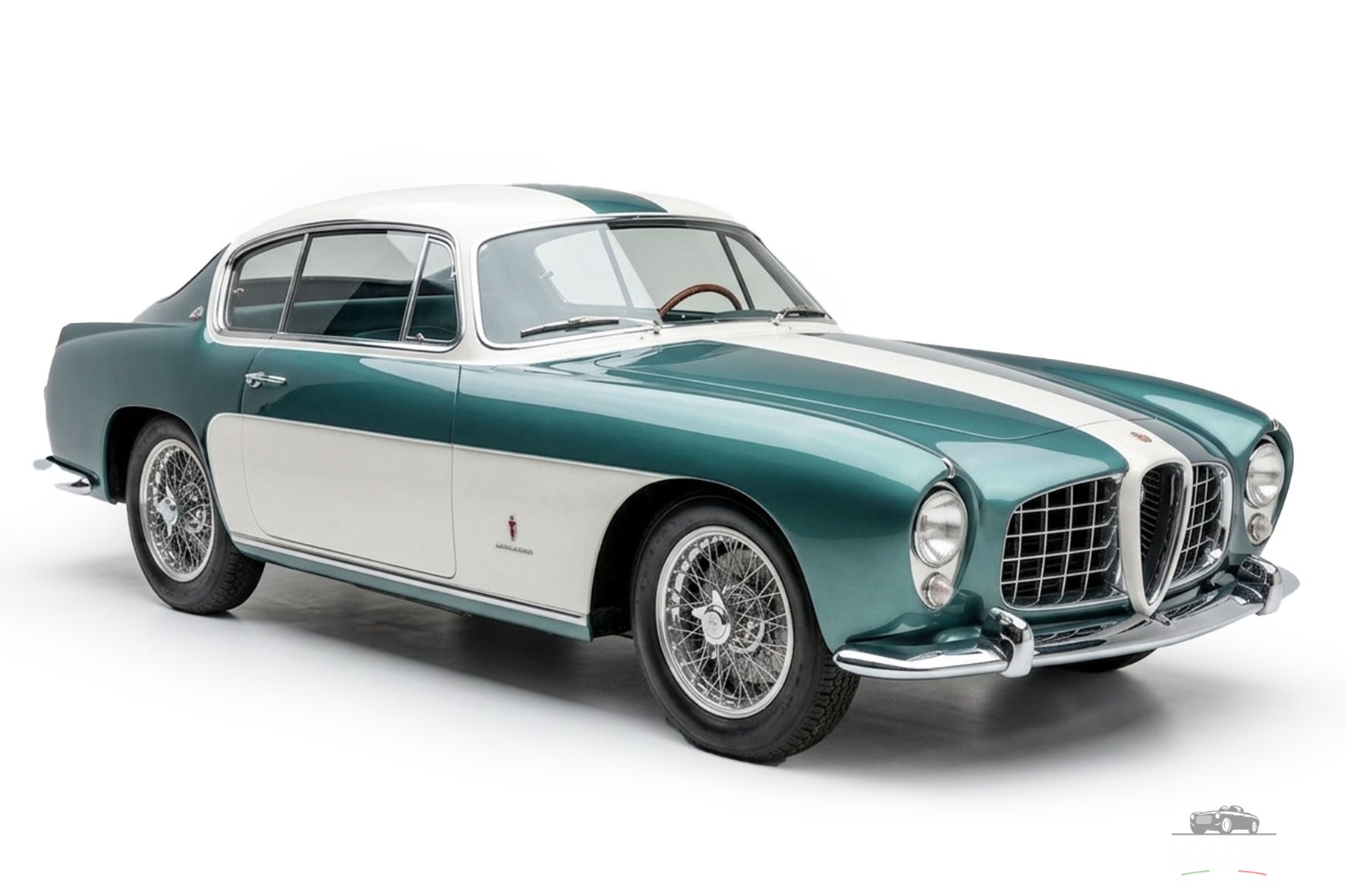
The 1954 Abarth–Alfa Romeo 2000 Coupé is a one-off grand touring show car developed by Abarth with mechanical components from the Alfa Romeo 1900 series and coachwork by Carrozzeria Ghia. It was exhibited at the 1954 Turin Motor Show as a low-bodied berlinetta with light-alloy panels, a four-cylinder engine and a distinctive two-tone exterior. The identity of the project is documented, but an individual chassis serial has not been established.
The coupé belonged to Abarth’s early programme of individually built publicity and exhibition cars. Rather than representing a series-production Alfa Romeo model, it combined an established mechanical basis with substantial changes to the supporting structure and engine installation. Contemporary and historical accounts describe an unusually low chassis made from box-section sheet steel. The Abarth-developed structure supported a lightweight coupé body manufactured by Ghia; the mechanical derivation from Alfa Romeo should not be confused with proof that an unmodified Alfa Romeo 1900 chassis was retained.
The 2000 Coupé followed several experimental projects using other manufacturers’ mechanical units, including a Ghia-bodied Abarth based on Fiat 1100-103 components in 1953. The collaboration placed Abarth in the role of constructor and mechanical developer, Alfa Romeo as supplier of the underlying mechanical design and Ghia as coachbuilder. The exact division of work among individual engineers and outside workshops remains incompletely documented.
The engine was an Alfa Romeo-derived inline four of approximately 1,975 cc. A contemporary description, summarised from a May 1954 Italian motoring publication, identifies a compression ratio of 8.5:1, two horizontal twin-choke carburettors, Abarth intake passages and a separate-pipe exhaust system. A claimed output of 135 bhp was reported. The four-speed manual transmission was operated by a short floor-mounted gear lever rather than the standard steering-column arrangement.
Period technical figures give an overall height of about 1,180 mm, a weight of approximately 890 kg and a claimed maximum speed of 200 km/h. These are historical specifications or performance claims, not independently measured results for a surviving chassis. The body combined a low roof, a long rearward taper, two-tone paint and a front treatment recognisably related to Alfa Romeo’s styling vocabulary.
The Ghia authorship of the body is established by the AISA historical monograph on Abarth. Attribution of its individual stylist is less certain: some later accounts credit Giovanni Savonuzzi, while other comparative histories connect the design with Gian Paolo Boano. A period drawing or Ghia production document identifying the responsible designer has not yet been established, so neither attribution should be regarded as definitive.
The Turin presentation in spring 1954 is documented by the historical Abarth record. Some specialist sources also describe a subsequent appearance at the 1954 Paris Motor Show, but that participation still requires confirmation against the original exhibition catalogue. The coupé’s place in the development of Ghia’s postwar exhibition work can be considered alongside the broader history of Carrozzeria Ghia. Its Alfa Romeo-derived mechanical configuration is distinct from the separate 1900 Super Sprint production programme and from the contemporary Bertone-bodied Alfa Romeo 2000 Sportiva.
02 / TECHNICAL IDENTITY
03 / DESIGN, BODY & SUPPLIERS
Coachbuilder / Design studio
Founded in Turin in 1916, Carrozzeria Ghia became a major Italian design and coachbuilding house, creating bespoke automobiles, prototypes and international collaborations across the twentieth century.
Explore record ↗Attributed designer
Giovanni Savonuzzi was an Italian engineer and automotive designer associated with Cisitalia and Ghia, contributing to influential aerodynamic prototypes and bespoke sports cars.
Explore record ↗04 / CHRONOLOGY
07 / GALLERY
08 / PERIOD ARCHIVE
Become a Pro member to see the full details in this section.
Membership is not available yet.
View membership optionsCONTINUE READING
The revolution by Savonuzzi The succession of prototypes made on behalf of Chrysler undoubtedly influenced the 1951 project by Piero Dusio, patron of Cisitalia, to try to ride the wave of the…
Read storyAlfa Romeo’s 1900 had already proven itself as a jack-of-all-trades—comfortable enough for family road trips yet eager to show its claws on the racetrack. But not everyone was satisfied. Enthusiasts craved more…
Read story

THE CONVERSATION
Comments 0