
Ghia
Founded in Turin in 1916, Carrozzeria Ghia became a major Italian design and coachbuilding house, creating bespoke automobiles, prototypes and international collaborations across the twentieth century.
Explore record ↗
1962Coachwork by Ghia

THE VEHICLE AT A GLANCE
THE PEOPLE BEHIND THE CAR
Founded in Turin in 1916, Carrozzeria Ghia became a major Italian design and coachbuilding house, creating bespoke automobiles, prototypes and international collaborations across the twentieth century.
Explore record ↗Elwood Engel was an American automotive designer associated with the 1961 Lincoln Continental and the Chrysler Turbine Car styled under his direction.
Explore record ↗01 / THE STORY
The Chrysler Turbine Car was an experimental two-door hardtop coupé developed by Chrysler Corporation for an extensive consumer evaluation of gas-turbine propulsion in 1963–1966. Its body was manufactured by Carrozzeria Ghia in Turin, while the mechanical development, engineering and final assembly were carried out by Chrysler in the United States. The design was developed within Chrysler’s styling organisation under Elwood Engel. This record describes the overall programme rather than one identified chassis.
Chrysler had tested turbine-powered road vehicles since 1953, initially using modified production Plymouth cars. The programme subsequently progressed through several generations of engines and experimental vehicles. The 1961 Chrysler TurboFlite, another Ghia-built experimental car, preceded the later consumer-evaluation coupé but was a separate design, associated with Virgil Exner rather than Engel.
Five development prototypes of the final Turbine Car type were built in 1962. They differed in some details and were used to resolve engineering and production problems. Ghia then manufactured the bodies of fifty substantially standardised evaluation cars between October 1963 and October 1964. The complete programme therefore comprised fifty-five vehicles, not fifty-five identical production coupés. It was a controlled technical and consumer trial, not a commercial series offered through Chrysler dealers.
The hardtop body was styled in Detroit with long, uninterrupted side surfaces, circular headlamp surrounds and turbine-inspired detailing at the front and rear. The fifty evaluation cars were finished in the metallic colour known as Turbine Bronze, with matching interior trim. The visual references to aircraft machinery communicated the nature of the powertrain without adopting a separate racing or sports-car body configuration.
Ghia’s role was the specialist construction and finishing of the bodywork. The Italian workshop hand-formed the panels, assembled and trimmed the bodies, and shipped them to Chrysler. At the Detroit facility, Chrysler fitted the turbine engines, transmissions and other mechanical and electrical equipment. The engineering programme was directed by Chrysler personnel, notably George Huebner; Ghia’s manufacturing participation should not be confused with authorship of the engine or overall styling.
The A-831 regenerative gas turbine delivered a rated 130 horsepower. Rather than using conventional reciprocating pistons, its rotating assembly drove the rear wheels through reduction gearing and an adapted three-speed TorqueFlite automatic transmission. Contemporary descriptions specify approximately 425 lb-ft of torque at stall, a condition that is not directly equivalent to the usual peak-torque rating of a piston engine. The evaluation cars used a 110-inch (2,794 mm) wheelbase and were equipped with power steering and assisted brakes.
A pair of rotating regenerators recovered heat from the exhaust stream, improving efficiency over earlier turbine arrangements. The engine could operate on several liquid fuels, although fuel composition and deposits still mattered in service. Smooth running, a comparatively small number of moving parts and the absence of conventional engine vibration were important development objectives. Fuel consumption, exhaust emissions, manufacturing expense and the delay in power response remained practical obstacles.
Chrysler announced the public programme in May 1963 and began assigning cars to selected drivers in October of that year. Over the trial, 203 participants used the cars in ordinary traffic, typically for periods of about three months. The programme continued into January 1966 and generated extensive information on maintenance, reliability, driving characteristics and public acceptance. It did not lead to series production of a turbine-powered passenger car.
Most of the fifty-five vehicles were subsequently dismantled or destroyed. Nine survivors are generally recorded in museum and specialist histories; their precise present-day custody and individual chassis histories require separate identification. The surviving Turbine Cars represent the engineering and industrial partnership between Chrysler and Ghia, distinct from earlier Chrysler-Ghia styling exercises. The broader experimental development is documented in the Chrysler Turbine Car historical article.
02 / TECHNICAL IDENTITY
03 / DESIGN, BODY & SUPPLIERS
Coachbuilder / Design studio
Founded in Turin in 1916, Carrozzeria Ghia became a major Italian design and coachbuilding house, creating bespoke automobiles, prototypes and international collaborations across the twentieth century.
Explore record ↗Attributed designer
Elwood Engel was an American automotive designer associated with the 1961 Lincoln Continental and the Chrysler Turbine Car styled under his direction.
Explore record ↗04 / CHRONOLOGY
07 / GALLERY
08 / PERIOD ARCHIVE
Become a Pro member to see the full details in this section.
Membership is not available yet.
View membership optionsCONTINUE EXPLORING
CONTINUE READING
The Chrysler Turbine Car: A symbol of automotive innovation, from its groundbreaking experiments to the challenges of emission testing. This is the captivating story of a vehicle that pushed boundaries, leaving a…
Read story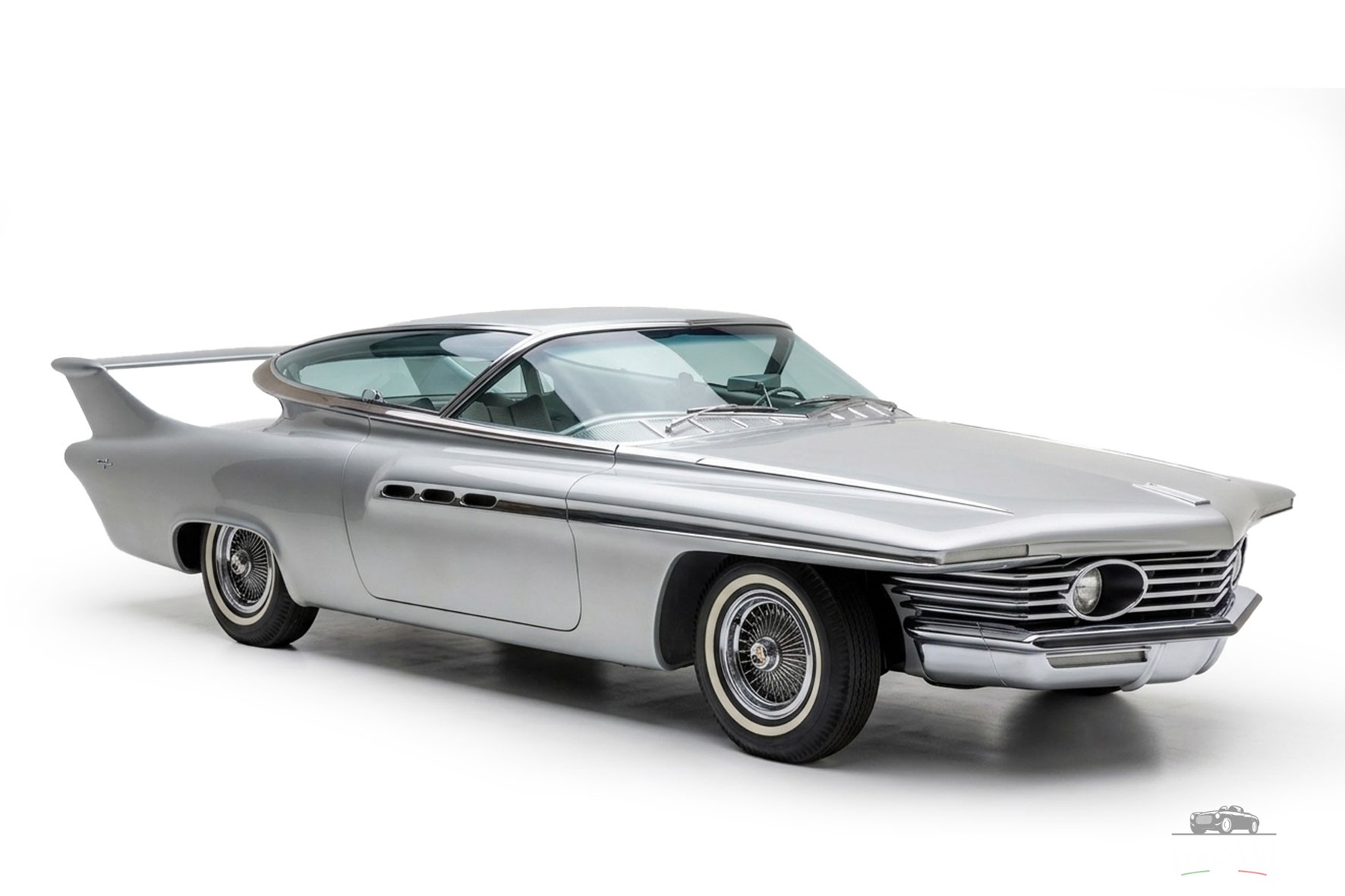

THE CONVERSATION
Comments 0