
Ghia
Founded in Turin in 1916, Carrozzeria Ghia became a major Italian design and coachbuilding house, creating bespoke automobiles, prototypes and international collaborations across the twentieth century.
Explore record ↗
1961Coachwork by Ghia
THE VEHICLE AT A GLANCE
THE PEOPLE BEHIND THE CAR
Founded in Turin in 1916, Carrozzeria Ghia became a major Italian design and coachbuilding house, creating bespoke automobiles, prototypes and international collaborations across the twentieth century.
Explore record ↗01 / THE STORY
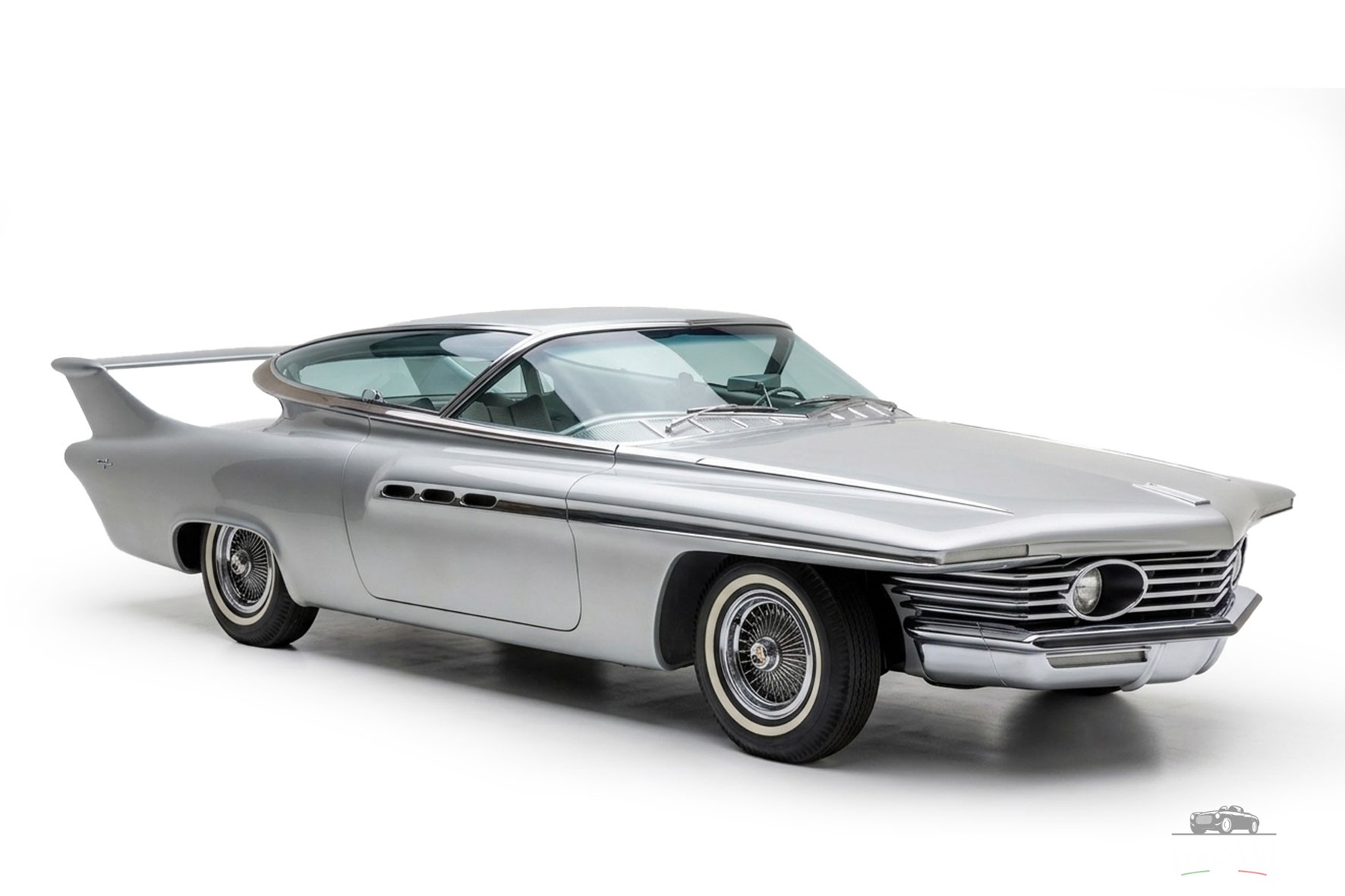
The 1961 Chrysler TurboFlite was a one-off experimental show car developed by Chrysler Corporation and bodied by Carrozzeria Ghia in Turin. The coupé combined aircraft-influenced styling with Chrysler’s research into automotive gas turbines. Maury Baldwin was responsible for the show car’s design within the Chrysler styling organisation led by Virgil Exner. Its coachwork and demonstration features presented possible future automotive technologies rather than a production model.
Chrysler presented the TurboFlite in 1961 as one of the final concept cars produced under Exner’s styling direction. In a recollection quoted by automotive historian Robert Tate, Baldwin described the preparation of a three-eighths-scale model followed by full-size drawings for Ghia to execute. The Italian coachbuilder translated Chrysler’s design into a low two-door body with extensive glazing and pronounced rear fins. The prototype was subsequently shown at the 1962 Chicago Auto Show. Earlier appearances in London, Paris and Turin appear in the legacy exhibition register, but their exact editions and dates require separate documentary confirmation.
The project belonged to a longer collaboration in which Chrysler supplied design and engineering direction and Ghia supplied specialist prototype body construction. The relationship had produced several earlier American-Italian show cars, discussed in the archive’s history of the Chrysler–Ghia partnership. The TurboFlite remained a single experimental body, not the first example of a planned road-car series.
The front end was kept low and the headlamps retracted into the front-fender treatment. Above the passenger compartment, the windscreen and glazed roof formed a canopy that lifted as the doors opened, allowing access to the seats. The arrangement replaced a conventional fixed roof and side-window structure with a coordinated demonstration mechanism. The show car’s narrow nose, sculpted surfaces and high fins reflected the aerodynamic language of contemporary American aircraft and experimental automobiles.
Between the rear fins was a horizontal deceleration flap intended to act as an aerodynamic brake, a feature associated with the limited engine-braking characteristics of gas turbines. The rear spoiler and fins were experimental styling and airflow devices, not evidence of measured road performance. Inside, the instrument panel resembled an aircraft cockpit, with prominent turbine instrumentation and a pyrometer for exhaust temperature. Electroluminescent illumination was incorporated into the cabin. Contemporary demonstrations of the canopy and lighting could be operated from an external electrical supply.
The TurboFlite represented Chrysler’s third-generation CR2A turbine research programme. Published technical figures for that turbine, including a nominal output of approximately 140 hp, refer to the engine programme and must not be treated as dynamometer or road-test results for this particular show car. Historical accounts based on Chrysler archive material state that the displayed TurboFlite did not have a functional drivetrain. The use of an external 110-volt electrical connection for demonstration equipment reinforces the distinction between a working display mechanism and a self-propelled vehicle.
Chrysler’s variable-nozzle turbine work sought to reduce throttle-response delay compared with earlier units, but those engineering results were obtained through separate development engines and test vehicles. The TurboFlite itself has no verified production-engine number, road-performance record or individually documented chassis serial in the available sources. These limitations are important when comparing the vehicle with the later operational experimental fleet.
The subsequent Chrysler Turbine Car programme, associated with the styling direction of Elwood Engel, adopted a different, more conventional coupé body. Fifty evaluation cars followed five prototypes, and these were built for practical turbine-engine trials rather than as direct production versions of the TurboFlite. The archive’s historical account of Chrysler’s turbine development places both projects within the company’s longer engineering programme. The TurboFlite remains a separate 1961 Ghia show car whose principal documented significance is its design and experimental presentation.
02 / TECHNICAL IDENTITY
03 / DESIGN, BODY & SUPPLIERS
Coachbuilder / Design studio
Founded in Turin in 1916, Carrozzeria Ghia became a major Italian design and coachbuilding house, creating bespoke automobiles, prototypes and international collaborations across the twentieth century.
Explore record ↗Designer
04 / CHRONOLOGY
07 / GALLERY
CONTINUE READING
There are in the history of companies, just as in the history of nations, certain fateful episodes, which have an influence on the course of events well in excess of their actual…
Read storyThe Chrysler Turbine Car: A symbol of automotive innovation, from its groundbreaking experiments to the challenges of emission testing. This is the captivating story of a vehicle that pushed boundaries, leaving a…
Read story

THE CONVERSATION
Comments 0