
Elio Zagato
AT A GLANCE
- Born
- 1921-02-27
- Birthplace
- Milan
- Died
- 2009-09-14
- Nationality
- Italian
- Occupation
- Automotive designer, racing driver and coachbuilding executive
- Active from
- 1949
- Studio
- Zagato
- Based in
- Milan, Italy
THE STORY
Overview
Elio Zagato (27 February 1921 – 14 September 2009) was an Italian coachbuilding entrepreneur, contributor to automotive design and competition driver. The elder son of Ugo Zagato, founder of the Milanese Carrozzeria Zagato, he helped develop the firm’s post-war Gran Turismo programme and subsequently directed its operations with his brother Gianni. His work connected the practical requirements of racing drivers with lightweight body construction, aerodynamics and the management of small-series coachbuilding. His responsibilities in vehicle development should be distinguished from the drawings of the individual stylists employed by Zagato.
Family and entry into coachbuilding
Elio was born in Milan and grew up as the family company established its reputation for light aluminium coachwork. His father had founded the business in 1919 after experience in aircraft manufacture. The Milan workshop had worked with manufacturers including Alfa Romeo well before Elio’s entry into the firm. After wartime disruption, the business resumed its activities in the mid-1940s. Accounts of Elio’s career record that he joined the company in 1946, initially following commercial studies rather than a formal career in automotive styling.
The first post-war years also saw the development of the Panoramica bodies, characterised by an unusually large glazed area and the use of transparent materials above the conventional window line. These projects formed part of Zagato’s wider experimentation with visibility, weight and streamlined coachwork. Their conception involved technical and design contributors other than Elio, and the family company’s name alone cannot establish an individual design credit. Elio increasingly brought the perspective of an active competition driver to discussions of vehicle performance, body construction and the needs of clients.
Competition driving and technical development
Elio began competing in 1947 at Piacenza in a Fiat-bodied special prepared by the family firm. The experience initiated a racing career closely associated with small-displacement sports cars and later Gran Turismo berlinettas. In the following decade he drove a succession of Zagato-bodied cars, notably the Fiat 8V, combining race participation with his work at the factory. His involvement with the cars during their development and their use in competition created a direct connection between the coachbuilder and its customers on the circuits and road courses of the period.
Contemporary racing histories and later accounts credit him with important successes in Italian GT competition, the Coppa Inter-Europa and at the Avus circuit in Berlin in 1955. The Zagato Car Club reports 82 victories from 150 starts, although such totals and the reported number or status of championships require reconciliation with individual event classifications. His results are significant to the company’s history but do not, by themselves, establish a claim of sole authorship for the cars he raced. The precise competition history of an individual Fiat 8V or other chassis must be recorded in that vehicle’s own file.
Gran Turismo coachwork in the 1950s
During the 1950s Elio participated in the development of Zagato’s lightweight Gran Turismo berlinettas. The Zagato atelier supplied sporting bodies for cars produced by Fiat, Alfa Romeo, Maserati, Ferrari and other manufacturers. The Fiat 8V Zagato and Alfa Romeo 1900 Super Sprint Zagato were closely associated with the firm’s sporting reputation; other projects included the Maserati A6G/54 and Ferrari 250 GT competition berlinettas. Elio’s involvement lay in the development and testing of the cars and in the direction of the family operation. It would be inaccurate to attribute every Zagato-bodied variant or every chassis in these programmes to his individual drawing work.
During this period the atelier developed a characteristic approach to bodywork in which compact proportions and restrained ornament were combined with competition-oriented solutions. The roof with two raised sections, commonly termed the double bubble, became a recognisable Zagato feature, while the later adoption of truncated tail forms was guided by aerodynamic considerations. The development of these forms was a collective, evolving process involving Ugo, Elio, Gianni and the firm’s technical and creative staff. The credit for a particular sketch or completed body depends on model-specific documentation.
Collaboration with Ercole Spada
In 1960 the stylist Ercole Spada joined Zagato and became a central figure in its design work during the decade. Elio and Gianni participated in programme management and development, while Spada carried responsibility for the styling of many of the period’s best-known bodies. Their collaboration encompassed the Aston Martin DB4 GT Zagato, the Alfa Romeo Giulietta SZ and Giulia TZ families, and the Lancia Flaminia, Flavia and Fulvia Sport programmes. The relationships between design direction, individual styling, engineering and body manufacture differ by car and should be identified separately.
First-person testimony by Spada also documents the Fiat 500-based Zanzara project. Spada designed and constructed the initial car for his own use. After seeing it, Elio Zagato arranged a second, modified example to investigate the feasibility of production. The project was exhibited at the 1969 Turin Motor Show but did not develop into a series. The two physical examples and their respective design and development histories must not be merged; Spada’s original design credit remains distinct from Elio’s role in the second car and the proposed manufacture.
Leadership of the family company
Elio progressively assumed greater responsibilities as Ugo Zagato’s health declined. After Ugo’s death in 1968, the second generation continued the firm under Elio and Gianni. The company moved further beyond individual hand-built commissions toward limited-series contracts and the organisation of specialist production. Its activities nevertheless remained closely identified with lightweight sports cars, aerodynamic experimentation and commissioned projects for major manufacturers. The brothers’ functions in management and vehicle development were complementary, but should not be reduced to a claim that either personally styled every vehicle built during their tenure.
Electric mobility and new body programmes
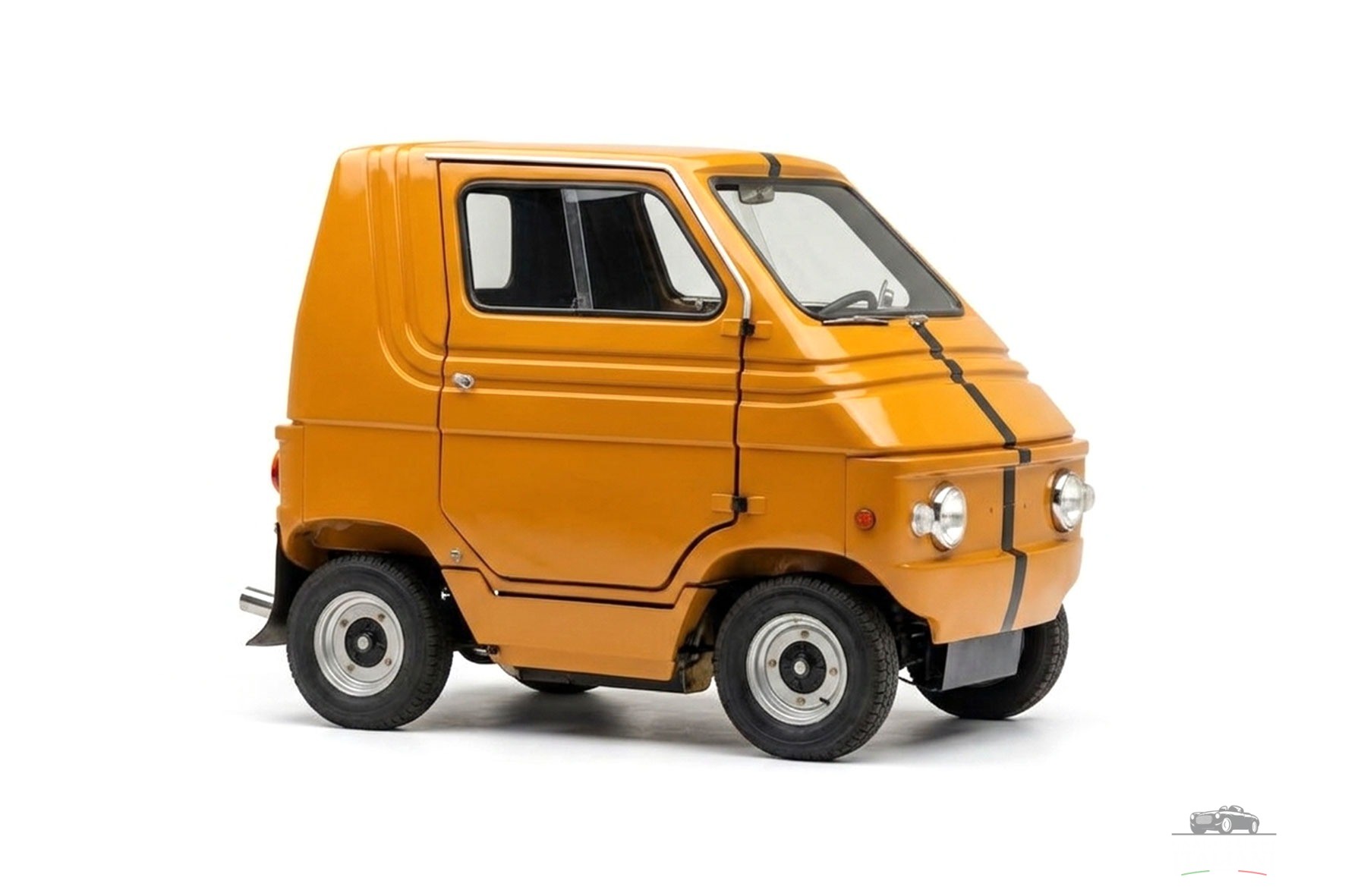
The early 1970s marked an extension of Zagato’s work into urban transport and electricity-powered vehicles. In 1972 the Fiera di Milano commissioned an electric service vehicle known as the Zagato Milanina, with the commission associated with Elio. The initiative was followed by the Zagato Zele, a compact, two-seat electric car presented as a prototype in 1972 and produced in small series from 1974 to 1976. These programmes differed in purpose and construction from the company’s competition berlinettas. The dates of exhibition and production, technical specifications and individual examples are recorded separately in their vehicle entries.
Period reporting from September 1974 identifies both Elio and Gianni with the firm’s small-series electric-vehicle activity. Elio is credited with styling responsibility for the Zele in some published histories, while other institutional and contemporary records document the company programme rather than the author of every drawing. The currently recorded designer relationship for the Zele should therefore be understood in the context of this broader documented role, pending any surviving signed sketches or design-office records.
Later years and the continuation of Zagato
During the 1980s the company developed new partnerships and production contracts, including the revival of the association with Aston Martin through the V8 Zagato and the later Alfa Romeo SZ project. These assignments brought together external manufacturers, in-house design personnel, engineering suppliers and the Zagato works. Elio’s role was principally in the leadership and strategic development of the enterprise, not necessarily the execution of each design. He and Gianni withdrew from active leadership in 1993 as the firm changed its scale and business model.
Elio Zagato died in Milan on 14 September 2009. His recollections of racing and coachbuilding were recorded in his autobiographical volume Storie di corse e non solo, published in 2002, and in historical discussions of the Milanese coachbuilding industry, including the 1998 AISA round table on Zagato. His son Andrea Zagato continued the family connection with the atelier. The historical importance of Elio’s work rests on his combined involvement in competition driving, vehicle development and the direction of the family company, alongside the documented contributions of its individual designers and craftsmen.
THE NETWORK
Shared vehicle credits

KEY MOMENTS
Timeline
-
Birth of Elio Zagato
Milan, Italy
-
Career begins
-
Career ends
-
Death of Elio Zagato
Milan, Italy
CONTINUE EXPLORING

THE CONVERSATION
Comments 0