
Zagato
Founded in Milan in 1919 by Ugo Zagato, the coachbuilding house developed lightweight aerodynamic bodies inspired by aircraft construction, creating distinctive racing and grand touring automobiles.
Explore record ↗
1972Coachwork by Zagato
THE VEHICLE AT A GLANCE
THE PEOPLE BEHIND THE CAR
Founded in Milan in 1919 by Ugo Zagato, the coachbuilding house developed lightweight aerodynamic bodies inspired by aircraft construction, creating distinctive racing and grand touring automobiles.
Explore record ↗Elio Zagato (1921–2009) was an Italian racing driver and coachbuilding executive involved in Zagato's lightweight GT and electric-vehicle development.
Explore record ↗01 / THE STORY
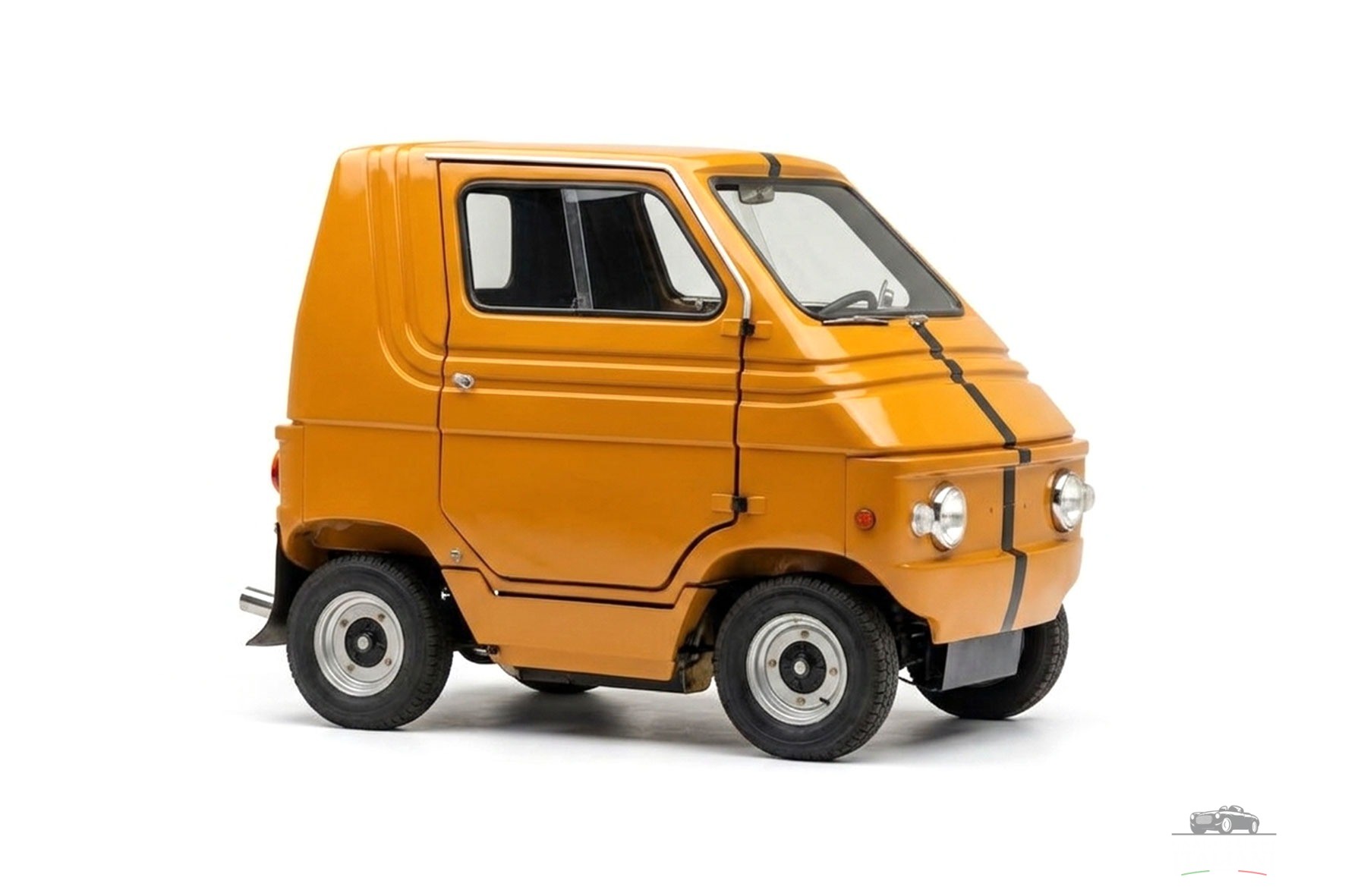
Zagato Zele is a two-seat battery-electric microcar developed and manufactured by the Milanese coachbuilder Zagato. The project was publicly presented in 1972, while the regular production series was built mainly between 1974 and 1976. Its small, upright fibreglass body and Fiat-derived steel structure were intended for short urban journeys. The name identifies a family of Zele 1000, 1500 and 2000 versions, rather than a single chassis or engine specification.
The Zele followed Zagato’s earlier Milanina electric city-vehicle programme. Museum and auction histories record a presentation at the Geneva Motor Show in 1972; Italian accounts also document the Zele 1000 prototype at the Turin Motor Show later that year. These early presentations should be distinguished from series production, which is generally dated to 1974–1976. The oil crisis of 1973 increased attention to alternative urban transport, but the Zele remained a small-series product. The Technisches Museum Wien estimates approximately 500 examples built across the complete family, not 500 of each power variant.
Zagato used a compact, nearly rectangular two-door body in glass-fibre-reinforced plastic mounted on a steel structure with elements derived from the Fiat 500 and Fiat 124. Its high roof, short overhangs and two-seat arrangement made unusually intensive use of a very small parking footprint. The lower structure accommodated the batteries and electric-drive components, leaving a plain passenger compartment with limited instruments. Historical descriptions list orange-red, brown, dark blue, pastel blue, white, green and metallic blue among the available finishes. Those colours describe the production range and do not establish the original colour of every surviving example.
The designations Zele 1000, 1500 and 2000 refer to nominal electric-motor output in watts. Equipment, battery arrangements and performance varied by version and period, so a single numerical power, voltage or range must not be imposed on the whole family. Auction documentation identifies a Marelli electric motor and four 12-volt batteries in a 1974 Zele 1000. The Technisches Museum Wien likewise records four 12-volt batteries in its own 1974 Zele 1000, with charging through a rear connection and a controller selecting reverse, neutral and forward ranges. Some published accounts describe a multi-position selector combined with a stepped accelerator, providing additional effective drive ratios. A range of approximately 80 km and a top speed near 40 km/h are documented as contemporary claims for the 1000 version, not verified performance for every derivative. Later descriptions attribute a field-weakening boost function to the Zele 2000, allowing somewhat higher speed at reduced torque.
The Zele was offered in the United States under the Elcar name through the American importer Elcar Corporation. That company developed a longer four-seat prototype known as the Elcar Wagonette; it should not be counted as a standard two-seat Zele. The later Zagato Zele Minivan belongs to a separate electric-vehicle study. The Zele’s place among other Italian experiments in compact transport is discussed in Italian Coachbuilt City Car Concepts.
The Technisches Museum Wien preserves a Zele 1000 first registered in Austria on 20 November 1974 and acquired by the museum in 2022. The museum documents an original metallic-blue finish with a central black stripe for that particular vehicle. The Petersen Automotive Museum also documents an early 1973 Zele 1000 in its collection context. Among separately identified cars, the 1974 Zele 1000 with chassis Z10 00139 appeared at a London auction in 2018. Its chassis number, sale and restoration history belong specifically to that example and not to the production-family record. The present entry therefore distinguishes the 1972 introduction, the 1974–1976 production period and the identities of surviving cars.
02 / TECHNICAL IDENTITY
03 / DESIGN, BODY & SUPPLIERS
Coachbuilder / Design studio
Founded in Milan in 1919 by Ugo Zagato, the coachbuilding house developed lightweight aerodynamic bodies inspired by aircraft construction, creating distinctive racing and grand touring automobiles.
Explore record ↗Attributed designer
Elio Zagato (1921–2009) was an Italian racing driver and coachbuilding executive involved in Zagato's lightweight GT and electric-vehicle development.
Explore record ↗05 / PEOPLE, COLLECTIONS & MUSEUMS
07 / CHASSIS REGISTER
08 / GALLERY
THE CONVERSATION
Comments 0