
Pininfarina
Founded by Battista Pinin Farina in Turin in 1930, Pininfarina became one of the most influential Italian styling and coachbuilding houses, particularly through its work for Ferrari and other international manufacturers.
Explore record ↗
1962Coachwork by Pininfarina
THE VEHICLE AT A GLANCE
THE PEOPLE BEHIND THE CAR
Founded by Battista Pinin Farina in Turin in 1930, Pininfarina became one of the most influential Italian styling and coachbuilding houses, particularly through its work for Ferrari and other international manufacturers.
Explore record ↗01 / THE STORY
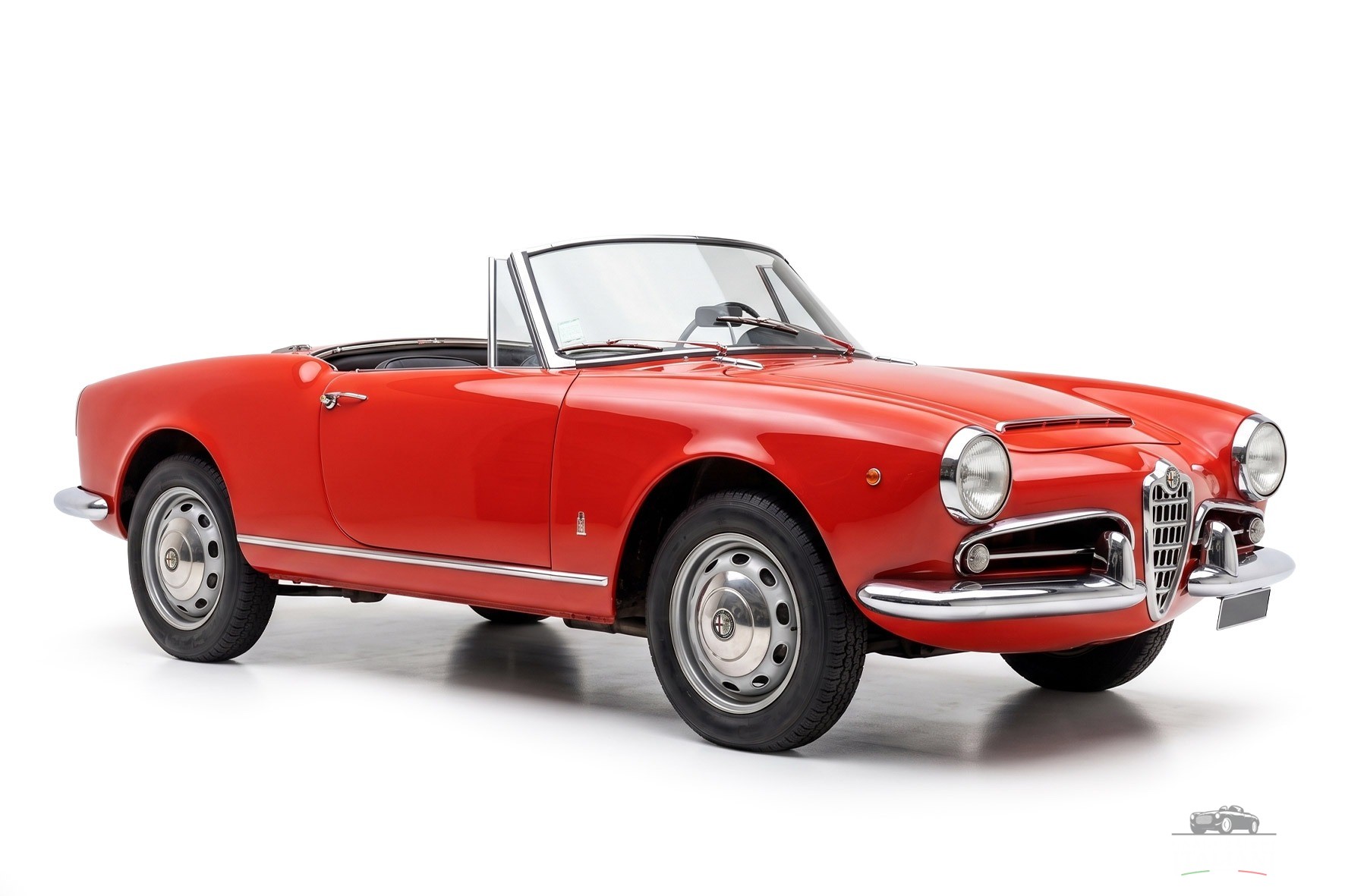
The Alfa Romeo Giulia Spider was a two-seat open automobile produced from 1962 to 1965, built upon the mechanical platform of the Giulia 1600 series and bodied by Carrozzeria Pininfarina. It served as the direct successor to the Giulietta Spider (1955–1962), from which it retained the fundamental styling and dimensions, while incorporating mechanical and structural revisions derived from the Giulia sedan and Sprint coupé. The chassis, designated 101.23, supported a front-mounted, 1,570 cc twin-cam inline-four engine, derived from Alfa Romeo’s existing alloy-block architecture. In standard configuration, the engine produced approximately 92 horsepower at 6,000 rpm, transmitted to the rear axle via a five-speed manual gearbox. A higher-performance Veloce version, introduced in 1964 and known under chassis type 101.18, employed twin Weber carburetors and revised cam profiles, yielding 112 horsepower. Top speeds were recorded at 170 km/h for the Veloce and approximately 165 km/h for the base model. Drum brakes were fitted to all four wheels. The body was designed and constructed by Pininfarina, under the direction of Battista Farina and project supervision by Franco Martinengo. While preserving the proportions of the Giulietta Spider, the Giulia variant introduced a functional bonnet bulge to accommodate the taller engine block, alongside detail changes to lighting, trim, and instrumentation. The result was a restrained, functional design in keeping with Alfa Romeo’s engineering-led aesthetic of the period. Production totaled approximately 6,324 units of the standard Giulia Spider and between 1,650 and 1,900 examples of the Spider Veloce, with variation depending on source. Notable chassis include AR10123.171805, sold at auction in Monterey in 2015, and AR379814, offered publicly in 2014 in Scottsdale. Both vehicles were restored examples exported to North America. Original Italian registrations for Giulia Spiders of this period are largely untraced, owing to incomplete archival preservation. The Giulia Spider occupies a transitional position in Alfa Romeo’s model lineage, bridging the late 1950s Giulietta platform and the 105-series Duetto introduced in 1966. Though modest in displacement and dimensions, the model served as a commercially significant and stylistically conservative roadster offering, constructed during the final phase of Pininfarina’s classical body-on-frame production methods.
02 / TECHNICAL IDENTITY
Become a Pro member to see the full details in this section.
Membership is not available yet.
View membership options03 / DESIGN, BODY & SUPPLIERS
Coachbuilder / Design studio
Founded by Battista Pinin Farina in Turin in 1930, Pininfarina became one of the most influential Italian styling and coachbuilding houses, particularly through its work for Ferrari and other international manufacturers.
Explore record ↗04 / CHRONOLOGY
07 / GALLERY
THE CONVERSATION
Comments 0