
Pininfarina
Founded by Battista Pinin Farina in Turin in 1930, Pininfarina became one of the most influential Italian styling and coachbuilding houses, particularly through its work for Ferrari and other international manufacturers.
Explore record ↗
1992
THE VEHICLE AT A GLANCE
THE PEOPLE BEHIND THE CAR
Founded by Battista Pinin Farina in Turin in 1930, Pininfarina became one of the most influential Italian styling and coachbuilding houses, particularly through its work for Ferrari and other international manufacturers.
Explore record ↗Pietro Camardella is an Italian automotive designer known for his work at Pininfarina, including his contribution to the Ferrari F40.
Explore record ↗PRICE & SALES RECORD
01 / THE STORY
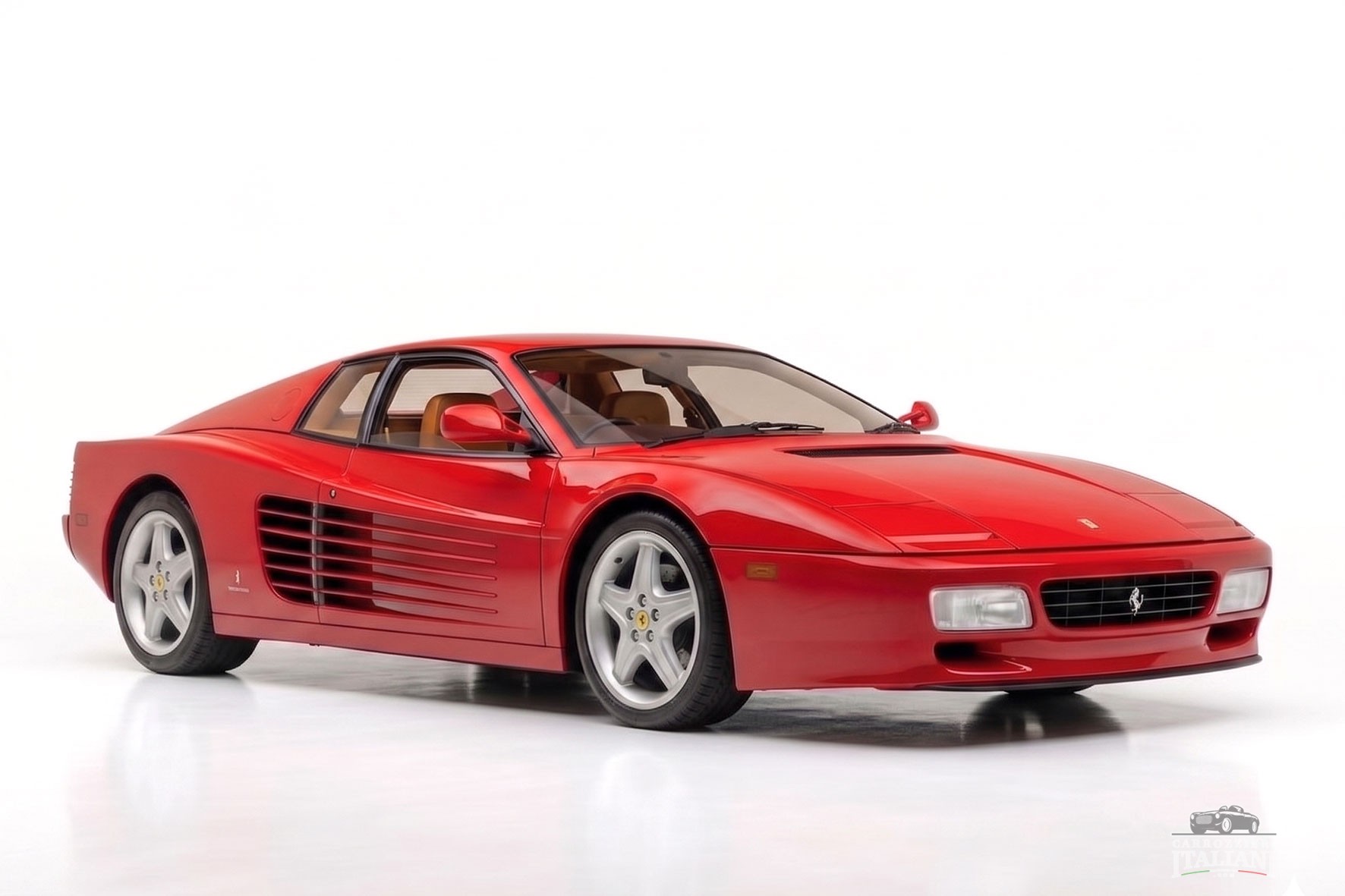
The 1992 Los Angeles Auto Show witnessed the grand unveiling of the Ferrari 512 TR, a noteworthy evolution of its predecessor, the iconic Testarossa. Official production of the 512 TR commenced with chassis number 89100 in 1992, but intriguingly, the initial steps were taken earlier, as early as May 1991. Two examples, chassis 86815 and chassis 87440, emerged during the Testarossa’s ongoing production, serving as pre-series examples or definitive prototypes for the forthcoming TR model. While the aesthetic alterations on the Ferrari 512 TR were subtle (the restyling was made by Pietro Camardella at Pininfarina), they proved to be remarkably effective. Notable changes included a fresh front end with a distinctive grille, updated bumpers, redesigned wheels, and a refined rear trunk. The interior underwent a comprehensive overhaul, boasting an entirely new design that elevated the overall driving experience. Under the hood, the mechanical modifications were substantial. The engine, a masterpiece in itself, saw enhancements in pistons, crankshaft, and intake and exhaust ports. Furthermore, a new Bosch fuel injection system was integrated, propelling the power output to an impressive 428 horsepower. The result of these enhancements was a remarkable increase in the top speed, now reaching 314 km/h. The 512 TR could accelerate from 0 to 100 km/h in a swift 4.8 seconds, showcasing the prowess of its performance capabilities. Beyond the aesthetic and mechanical upgrades, the Ferrari 512 TR underwent significant chassis enhancements. The adoption of larger-section steel tubes was a notable change aimed at enhancing the car’s torsional rigidity and crashworthiness. These modifications underscored Ferrari’s commitment to not only delivering a vehicle with stunning performance but also ensuring structural integrity and safety. As the 512 TR evolved, so did the available features. In 1993, Ferrari offered the switchable ABS anti-lock braking system as an optional feature. This addition allowed drivers to enhance their driving experience with improved control and safety. In Italy, this optional ABS system came at an additional cost of 10,710,000 Lire, offering enthusiasts the opportunity to tailor their Ferrari 512 TR to their preferences. In summary, the Ferrari 512 TR, born out of the Testarossa lineage, made a grand entrance at the 1992 Los Angeles Auto Show. With subtle yet effective aesthetic changes, substantial mechanical upgrades, and chassis enhancements, the 512 TR solidified its place as a symbol of Ferrari’s commitment to performance, innovation, and driving excellence.
02 / TECHNICAL IDENTITY
Become a Pro member to see the full details in this section.
Membership is not available yet.
View membership options03 / DESIGN, BODY & SUPPLIERS
Coachbuilder / Design studio
Founded by Battista Pinin Farina in Turin in 1930, Pininfarina became one of the most influential Italian styling and coachbuilding houses, particularly through its work for Ferrari and other international manufacturers.
Explore record ↗Attributed designer
Pietro Camardella is an Italian automotive designer known for his work at Pininfarina, including his contribution to the Ferrari F40.
Explore record ↗04 / CHRONOLOGY
05 / PEOPLE, COLLECTIONS & MUSEUMS
06 / MARKET & PRICE HISTORY
EUR · 5 recorded sales
Includes recorded sales pending source verification.
RECORDED SALES
EUR
Each point is a completed sale with its own date, in chronological order. Dates are positioned by calendar time, with approximate placement when only a year or month is documented. The connecting line shows observed sales prices in this currency, not an appreciation index: transactions may concern different chassis and specifications. Factory prices and unsold estimates are excluded.
GBP · 1 recorded sale
Includes recorded sales pending source verification.
RECORDED SALES
GBP
Each point is a completed sale with its own date, in chronological order. Dates are positioned by calendar time, with approximate placement when only a year or month is documented. The connecting line shows observed sales prices in this currency, not an appreciation index: transactions may concern different chassis and specifications. Factory prices and unsold estimates are excluded.
Sign in to see the details of each sale on the chart.
Become a Pro member to explore the full price and sale history.
Membership is not available yet.
View membership optionsMarket observations describe documented transactions, estimates or offers. They are not themselves a current valuation of the vehicle.
07 / CHASSIS REGISTER
08 / GALLERY
THE CONVERSATION
Comments 0