
Pininfarina
Founded by Battista Pinin Farina in Turin in 1930, Pininfarina became one of the most influential Italian styling and coachbuilding houses, particularly through its work for Ferrari and other international manufacturers.
Explore record ↗
1976
THE VEHICLE AT A GLANCE
THE PEOPLE BEHIND THE CAR
Founded by Battista Pinin Farina in Turin in 1930, Pininfarina became one of the most influential Italian styling and coachbuilding houses, particularly through its work for Ferrari and other international manufacturers.
Explore record ↗PRICE & SALES RECORD
01 / THE STORY
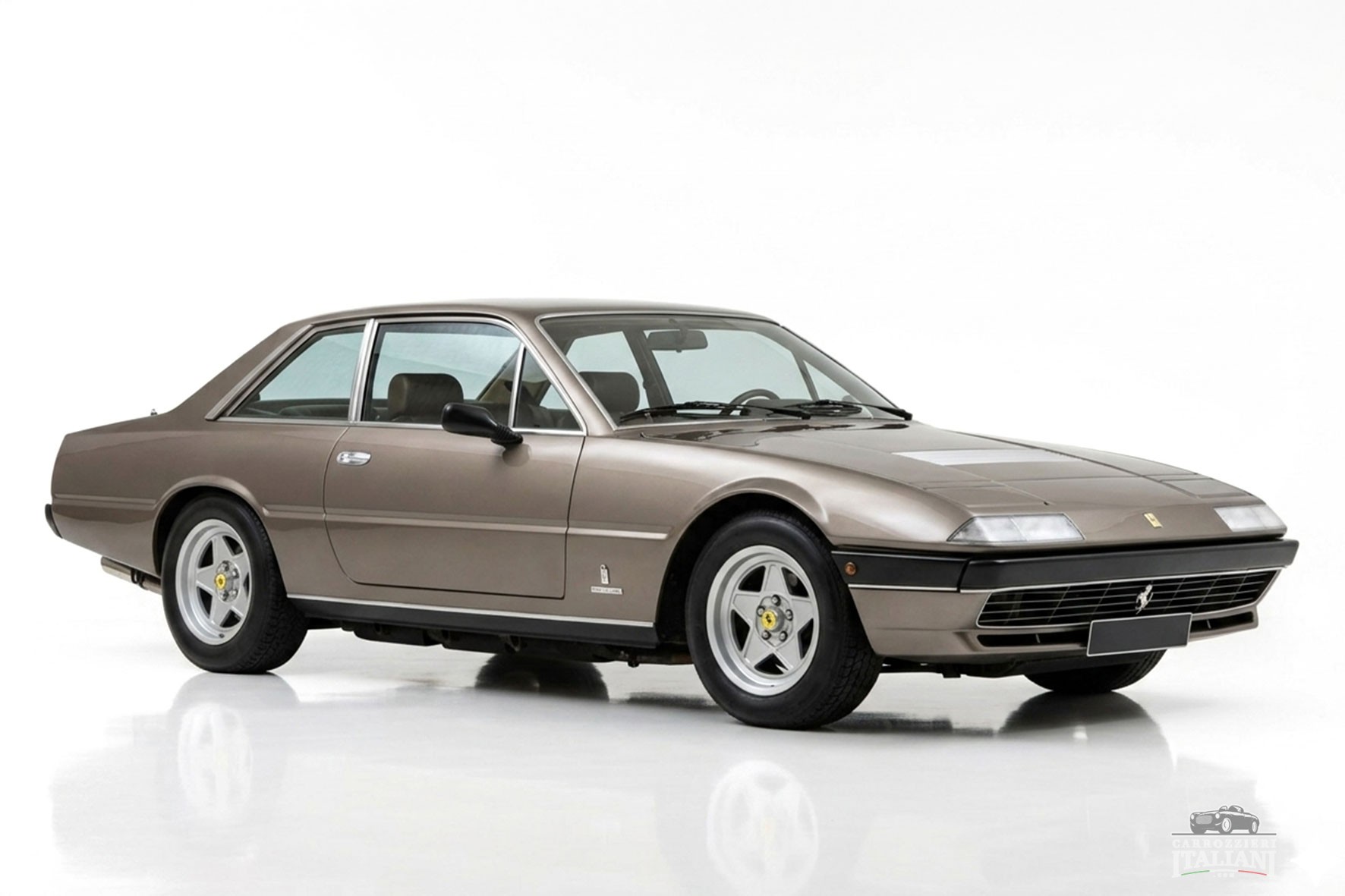
The Ferrari 400 is a 2+2 sports car designed by Pininfarina and produced by Ferrari from 1976 to 1985. It was introduced to replace the Ferrari 365 GT4 2+2, retaining the same body and mechanical layout. The Ferrari 400 made its debut at the 1976 Paris Motor Show and is notable for being the first Ferrari model to feature a standard automatic transmission, with a manual transmission available as an option. From 1976 to 1978, the models were named “Automatic” and “GT” and were equipped with six dual-body Weber carburetors. Starting in 1979, the mechanical Bosch K-Jetronic injection system was adopted, adding an “i” to the model name. The “400” designation, previously used for the Ferrari 400 Superamerica to indicate the engine’s total displacement, now referred to the unit displacement of the engine. Unlike typical Ferrari cars known for their aggressive and racing-inspired lines, the Ferrari 400 positioned itself as a “berlina” or “luxury sedan.” Enzo Ferrari himself described it as “a grand tourer in evening dress.” Due to its elegance and presence, the Ferrari 400 became the car of choice for prominent figures of the time, such as Gianni Agnelli and Sergio Pininfarina. Despite its classic three-box design, the Ferrari 400 boasted a powerful and high-performance engine under the hood: a 4.8-liter V12 with a 60-degree angle between the banks and dual overhead camshafts, designed by Ferrari’s legendary engineer and Enzo Ferrari’s personal friend, Gioachino Colombo. The engine produced 340 horsepower in the carbureted version and 315 horsepower in the injected version. The top speed was 250 km/h (155 mph) for the carbureted version and 245 km/h (152 mph) for the injected version. These were impressive figures for a 1970s car weighing around 2 tons. In 1985, the Ferrari 400 was succeeded by the Ferrari 412, which was nearly identical in appearance but featured an enlarged 4.9-liter engine. The Ferrari 412 remained in production until 1989, marking the end of one of Ferrari’s longest-running model lines, which began with the 365 GT4 2+2 in 1972. The Ferrari 400 inspired the design of the Bitter SC Coupé.
02 / TECHNICAL IDENTITY
Become a Pro member to see the full details in this section.
Membership is not available yet.
View membership options03 / DESIGN, BODY & SUPPLIERS
Coachbuilder / Design studio
Founded by Battista Pinin Farina in Turin in 1930, Pininfarina became one of the most influential Italian styling and coachbuilding houses, particularly through its work for Ferrari and other international manufacturers.
Explore record ↗04 / CHRONOLOGY
05 / MARKET & PRICE HISTORY
EUR · 4 recorded sales
RECORDED SALES
EUR
Each point is a completed sale with its own date, in chronological order. Dates are positioned by calendar time, with approximate placement when only a year or month is documented. The connecting line shows observed sales prices in this currency, not an appreciation index: transactions may concern different chassis and specifications. Factory prices and unsold estimates are excluded.
CHF · 1 recorded sale
RECORDED SALES
CHF
Each point is a completed sale with its own date, in chronological order. Dates are positioned by calendar time, with approximate placement when only a year or month is documented. The connecting line shows observed sales prices in this currency, not an appreciation index: transactions may concern different chassis and specifications. Factory prices and unsold estimates are excluded.
USD · 1 recorded sale
RECORDED SALES
USD
Each point is a completed sale with its own date, in chronological order. Dates are positioned by calendar time, with approximate placement when only a year or month is documented. The connecting line shows observed sales prices in this currency, not an appreciation index: transactions may concern different chassis and specifications. Factory prices and unsold estimates are excluded.
Sign in to see the details of each sale on the chart.
Become a Pro member to explore the full price and sale history.
Membership is not available yet.
View membership optionsMarket observations describe documented transactions, estimates or offers. They are not themselves a current valuation of the vehicle.
06 / CHASSIS REGISTER
6 chassis numbers in the register
1 recorded sale · 2025
1 recorded sale · 2016
1 recorded sale · 2017
1 recorded sale · 2026
View full chassis register · Pro membership
07 / GALLERY
THE CONVERSATION
Comments 0