
Pininfarina
Founded by Battista Pinin Farina in Turin in 1930, Pininfarina became one of the most influential Italian styling and coachbuilding houses, particularly through its work for Ferrari and other international manufacturers.
Explore record ↗
2010Coachwork by Pininfarina
THE VEHICLE AT A GLANCE
THE PEOPLE BEHIND THE CAR
Founded by Battista Pinin Farina in Turin in 1930, Pininfarina became one of the most influential Italian styling and coachbuilding houses, particularly through its work for Ferrari and other international manufacturers.
Explore record ↗Luca Borgogno worked within Pininfarina\'s automotive design organisation on concept and production-car programmes. As chief designer at Pininfarina, he contributed to the Battista electric hypercar, combining the company\'s established Italian styling language with a new electric-vehicle platform.
Explore record ↗01 / THE STORY
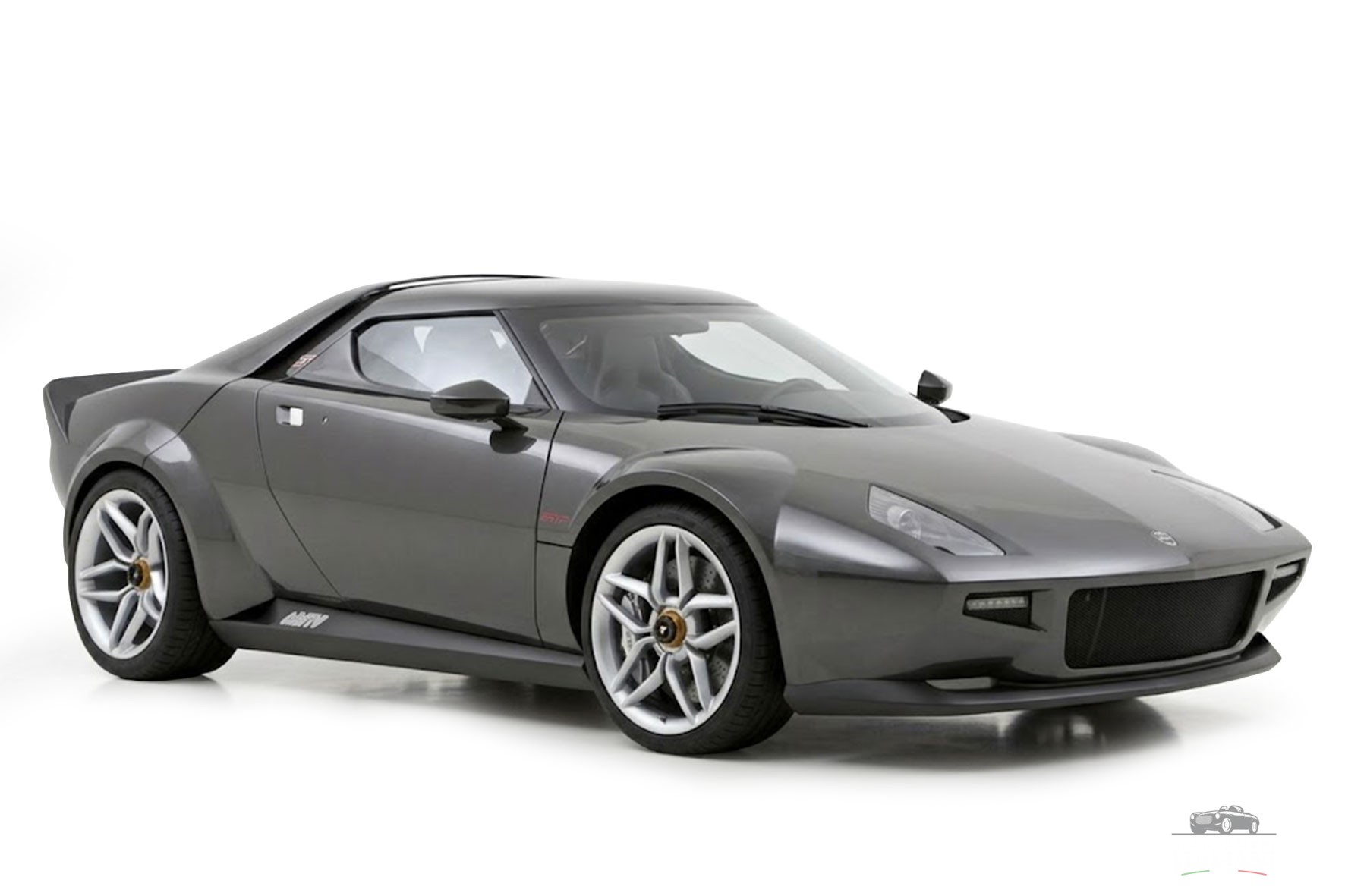
The Lancia New Stratos was commissioned by German businessman Michael Stoschek and developed by Pininfarina as a modern interpretation of the 1970s Lancia Stratos HF. The project was conceived as a single, fully functional prototype combining contemporary Ferrari technology with the proportions and dynamic character of the original Bertone design. Pininfarina’s team translated Gandini’s compact wedge-shaped architecture into a modern carbon-fibre structure, preserving the short wheelbase and wide stance that defined the Stratos lineage. The chassis was derived from the Ferrari F430, re-engineered and shortened by 200 mm to achieve a 2,400 mm wheelbase. The bodywork was made entirely of carbon fibre with integrated roll-over protection. The car measured 4,181 mm in length, 1,971 mm in width, and 1,240 mm in height, with a dry weight of 1,247 kg. The powertrain was based on Ferrari’s 4.3-litre naturally aspirated V8 engine, developing 540 hp (397 kW) at 8,200 rpm and 519 Nm of torque at 3,750 rpm. Power was transmitted to the rear wheels through a six-speed sequential manual gearbox. Acceleration from 0–100 km/h took 3.3 seconds, and 0–200 km/h was reached in less than 10 seconds. Top speed was approximately 274 km/h. The suspension layout featured double wishbones with coil springs and dampers at both axles, complemented by carbon-ceramic braking discs. The design integrated the original Stratos visual language through compact overhangs, a truncated tail, and a wraparound windshield forming the front canopy. The rear hatch housed a visible engine bay beneath louvered vents. Interior elements used lightweight materials, Alcantara trim, and competition-style seating with harnesses. Following the success of the one-off prototype, Manifattura Automobili Torino (MAT) acquired production rights and announced a limited run of 25 units. Bertone also proposed an independent design study for a new Stratos, though only the Pininfarina version entered production.
02 / TECHNICAL IDENTITY
Become a Pro member to see the full details in this section.
Membership is not available yet.
View membership options03 / DESIGN, BODY & SUPPLIERS
Coachbuilder / Design studio
Founded by Battista Pinin Farina in Turin in 1930, Pininfarina became one of the most influential Italian styling and coachbuilding houses, particularly through its work for Ferrari and other international manufacturers.
Explore record ↗Designer
Luca Borgogno worked within Pininfarina\'s automotive design organisation on concept and production-car programmes. As chief designer at Pininfarina, he contributed to the Battista electric hypercar, combining the company\'s established Italian styling language with a new electric-vehicle platform.
Explore record ↗Become a Pro member to see the full details in this section.
Membership is not available yet.
View membership options05 / PEOPLE, COLLECTIONS & MUSEUMS
08 / GALLERY
THE CONVERSATION
Comments 0