
Pininfarina
Founded by Battista Pinin Farina in Turin in 1930, Pininfarina became one of the most influential Italian styling and coachbuilding houses, particularly through its work for Ferrari and other international manufacturers.
Explore record ↗
1981Coachwork by Pininfarina
THE VEHICLE AT A GLANCE
THE PEOPLE BEHIND THE CAR
Founded by Battista Pinin Farina in Turin in 1930, Pininfarina became one of the most influential Italian styling and coachbuilding houses, particularly through its work for Ferrari and other international manufacturers.
Explore record ↗Enrico Fumia is an Italian automotive designer associated with Pininfarina, the Alfa Romeo 164 and 916 GTV/Spider, Ferrari F90 and Lancia.
Explore record ↗01 / THE STORY
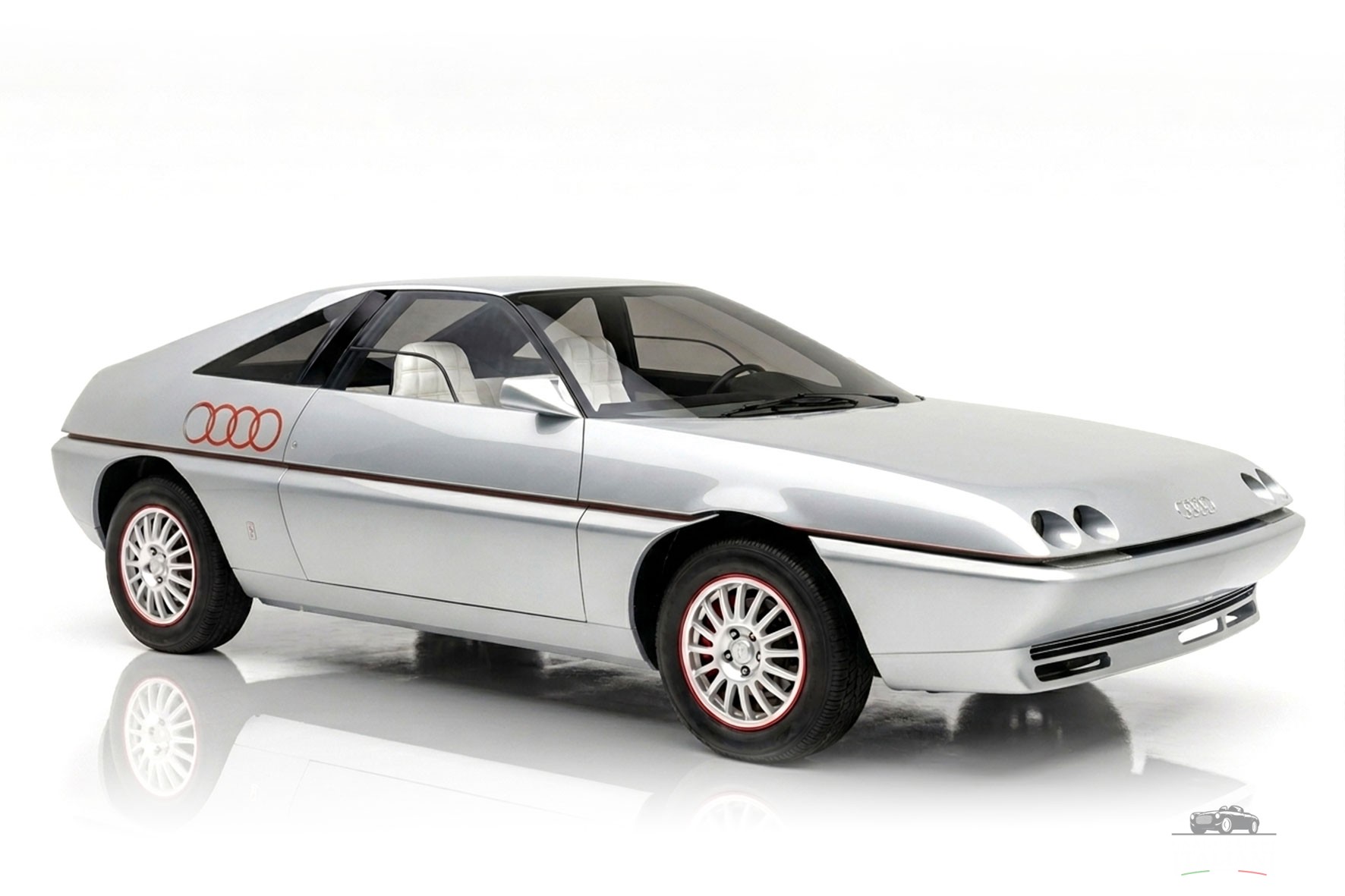
The Audi Quartz emerged as a tribute to innovation and collaboration in 1980. It all began with the Swiss magazine Automobil Revue marking its 75th anniversary. Sergio Pininfarina, a trusted ally of the magazine’s director, envisioned a distinct concept for the milestone celebration, aptly named the Quartz. Recognizing the potential synergy, Audi readily embraced the idea. At the 1980 Geneva International Motor Show, as the Audi Quattro took center stage, Pininfarina saw an opportunity to elevate his concept. With Audi’s generous support, Pininfarina was provided with a bare car frame to work his magic. Throughout the project, Audi remained closely involved, ensuring the realization aligned with their shared vision. Under Pininfarina’s creative direction, Enrico Fumia meticulously designed a new body, reducing the vehicle’s length by 30 centimeters and shedding 90 kilograms while enhancing its aerodynamic prowess. This marked Fumia’s inaugural independent design venture for Pininfarina. Interestingly, the Quattro Quartz deviated from stylistic cues of contemporary Audi models. Instead, Fumia opted for a distinctive aesthetic devoid of direct Audi influences. However, subtle nods were incorporated to establish a connection with the Audi brand. For instance, four intertwined rings adorned various parts of the vehicle, while the exhaust featured an embellishment creating the illusion of four tailpipes. Despite these efforts, attempts to establish a familial resemblance were perceived as somewhat lackluster. The silhouette of the Quattro Quartz closely follows the line of the Audi Quattro. Both vehicles sport two-door hatchback coupé configurations. However, the C-pillar of the Quattro Quartz exhibits a more pronounced incline compared to the standard model, seamlessly merging with the B-pillar in the upper section, resulting in a notably compact roofline. Smooth surfaces characterize the Quattro Quartz, with rounded edges and minimal protrusions. For instance, door handles are discreetly concealed behind the windows, and the windows themselves are seamlessly bonded flush with the body. Additionally, the door windows only feature small retractable sections, limiting their opening. A horizontal crease runs along the vehicle’s flanks, reminiscent of a design feature seen on the Ferrari 512 S Modulo, designed by Paolo Martin for Pininfarina and unveiled as early as 1970. This crease visually divides the body into upper and lower sections, accentuated by a two-tone paint scheme that the car occasionally sported. Furthermore, in the front section, the crease conceals openings for engine bay ventilation. The entire front fascia comprises a large one-piece hood crafted from plastic, extending seamlessly to the front and sides, encompassing the flanks. Within the hood, there are cylindrical recesses on each side housing a total of four round projection headlights by Carello. This design choice emerged later in the development process; initial sketches from 1980 depicted narrow horizontally arranged headlights. There are no air intake openings in the upper part of the front; it’s fully enclosed. Instead, a narrow slit between the hood and the bumper allows for air intake, while additional intake vents are located below the bumper, unevenly distributed with four narrow openings on the driver’s side and two on the passenger’s side. The rear window is hinged at the roof’s edge, serving as a hatchback. The taillights consist of a continuous strip spanning the width of the car, mounted above the bumper. The bumper features a recess for the license plate. Inside, Pininfarina’s innovative touch extended to a completely redesigned dashboard. n line with the groundbreaking Quattro’s pioneering drivetrain concept, Pininfarina embarked on crafting a body using innovative materials, predominantly plastics. The aim extended beyond mere weight reduction; it sought to explore novel forms and manufacturing processes. With plastics, “one can mold something from a single part that previously required five separate components,” pushing the boundaries of automotive design and production efficiency. The result was not just a concept on paper but a fully functional Audi Quartz, embodying the essence of automotive excellence. Audi recognized the significance of this collaboration and promptly acquired the Quartz, proudly unveiling it at the 1981 Geneva Motor Show to awe and admiration.
02 / TECHNICAL IDENTITY
03 / DESIGN, BODY & SUPPLIERS
Coachbuilder / Design studio
Founded by Battista Pinin Farina in Turin in 1930, Pininfarina became one of the most influential Italian styling and coachbuilding houses, particularly through its work for Ferrari and other international manufacturers.
Explore record ↗Attributed designer
Enrico Fumia is an Italian automotive designer associated with Pininfarina, the Alfa Romeo 164 and 916 GTV/Spider, Ferrari F90 and Lancia.
Explore record ↗Become a Pro member to see the full details in this section.
Membership is not available yet.
View membership options04 / CHRONOLOGY
07 / GALLERY
THE CONVERSATION
Comments 0