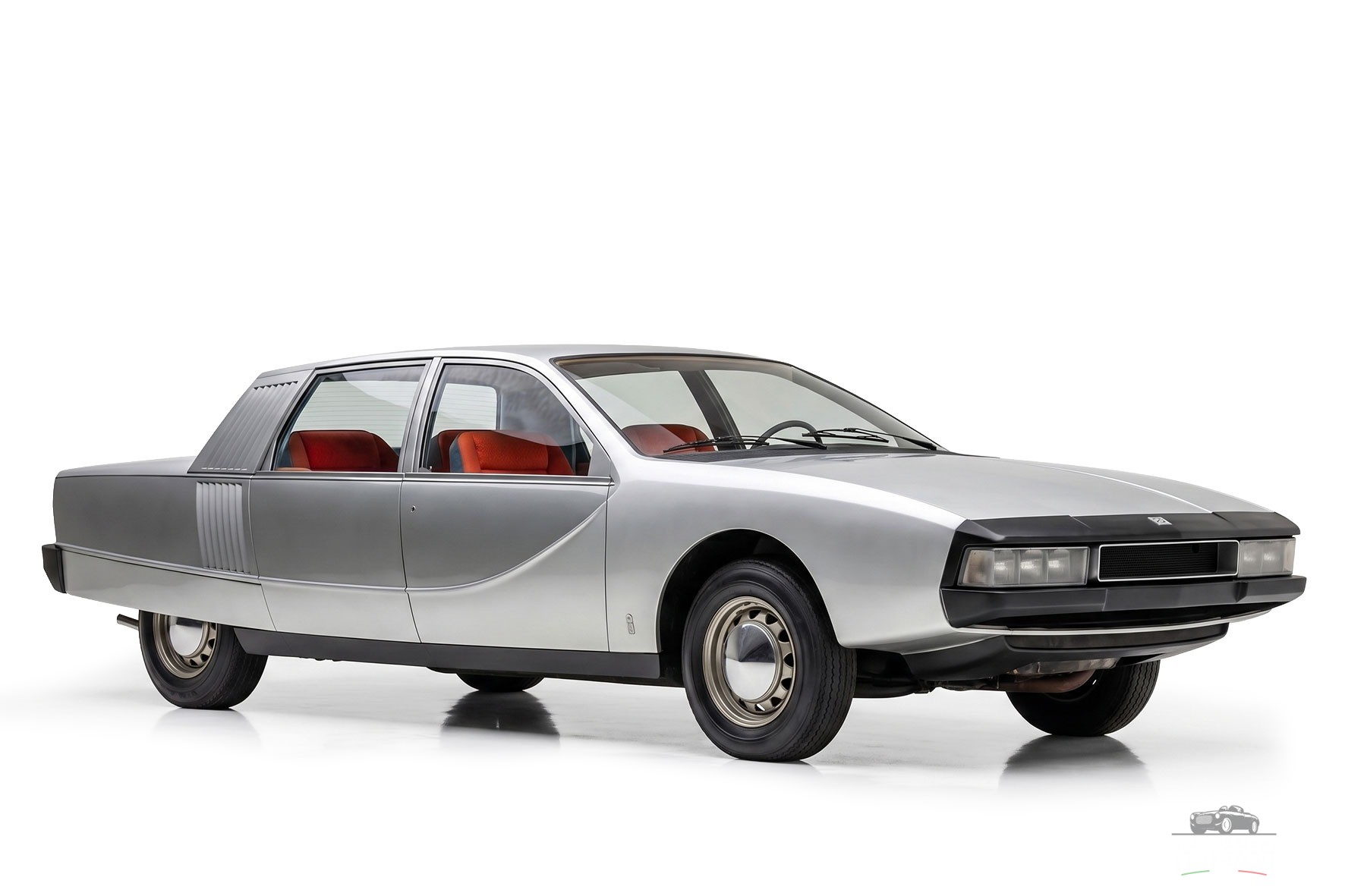

Pininfarina
Founded by Battista Pinin Farina in Turin in 1930, Pininfarina became one of the most influential Italian styling and coachbuilding houses, particularly through its work for Ferrari and other international manufacturers.
Explore record ↗
1971Coachwork by Pininfarina
THE VEHICLE AT A GLANCE
THE PEOPLE BEHIND THE CAR
Founded by Battista Pinin Farina in Turin in 1930, Pininfarina became one of the most influential Italian styling and coachbuilding houses, particularly through its work for Ferrari and other international manufacturers.
Explore record ↗Paolo Martin worked with Giovanni Michelotti before joining Bertone and Pininfarina. At Pininfarina he developed the Ferrari 512 S Modulo and Fiat 130 Coupe, and also worked on the Rolls-Royce Camargue. He later became styling director at Ghia.
Explore record ↗01 / THE STORY
The NSU RO-80 Pininfarina concept car, designed by Paolo Martin, was unveiled at the 1971 Turin Auto Show during a time when there was growing interest in high-end, classic-inspired cars, particularly three-volume models. Pininfarina, aiming to explore this trend, utilized the NSU RO-80’s chassis and its unique Wankel rotary engine—a powertrain that, during that era, was met with a mix of curiosity and skepticism. This led Pininfarina to design a vehicle that blended innovation with restraint, avoiding any excessive eccentricities that could overshadow the car’s unconventional motorization. The concept presented a feasible, yet challenging, vision for production. While innovative, it faced several ergonomic, practical, and construction challenges that hindered its development. Technological limitations of the 1970s meant that components like advanced lighting, modern instrumentation, and unique controls were not yet available, constraining the design to mostly standard, analog elements. Moreover, the platform’s mechanical structure remained largely unchanged, with minimal room for modifications beyond aesthetics. Paolo Martin took a bold step by redesigning part of the car’s structure, notably sawing off a portion of the roof to create an innovative open luggage compartment—essentially crafting the first luxury four-seater pickup sedan. However, during that time, the concept of a “pickup” was unfamiliar to European luxury markets, which viewed such vehicles as practical, utilitarian modes of transport rather than sophisticated lifestyle statements. The external luggage space seemed unnecessary and even unsophisticated, contributing to its complex market positioning. Had the NSU RO-80 been conceived today, with advancements in electronics and new materials, many of its design hurdles would be easily overcome. Modern reinterpretations could elevate it to a niche luxury market, appealing to those desiring a unique blend of practicality and style. Today, luxury automakers are increasingly experimenting with crossover concepts, hinting that a car like the NSU RO-80 could find a second life. Pininfarina’s NSU 2 Porte + 2 show car was based on the NSU RO-80’s factory sedan body, with reinforced sills to support the new coachwork. Though labeled a 2+2, the car intriguingly offered four doors with rear pairs opening from the center—a novel design reflecting the era’s aerodynamic focus. The car featured large air intakes for ventilation, strategically placed around the windshield, roof panels, and doors. A significant portion of the roof could slide backward, allowing an almost convertible experience without compromising luggage space. Inside, the concept car featured a driver-focused dashboard with instruments thoughtfully placed and padded surfaces for enhanced safety. Pininfarina’s innovative approach attracted considerable attention, garnering critical acclaim at various auto shows and featured prominently in media outlets throughout the 1990s. Despite its limited production and niche appeal, the NSU RO-80 Pininfarina remains a striking example of forward-thinking design and remains largely original, embodying a unique chapter in automotive history that continues to captivate enthusiasts today.
02 / TECHNICAL IDENTITY
03 / DESIGN, BODY & SUPPLIERS
Coachbuilder / Design studio
Founded by Battista Pinin Farina in Turin in 1930, Pininfarina became one of the most influential Italian styling and coachbuilding houses, particularly through its work for Ferrari and other international manufacturers.
Explore record ↗Designer
Paolo Martin worked with Giovanni Michelotti before joining Bertone and Pininfarina. At Pininfarina he developed the Ferrari 512 S Modulo and Fiat 130 Coupe, and also worked on the Rolls-Royce Camargue. He later became styling director at Ghia.
Explore record ↗Become a Pro member to see the full details in this section.
Membership is not available yet.
View membership options04 / CHRONOLOGY
07 / GALLERY
THE CONVERSATION
Comments 0