
Pininfarina
Founded by Battista Pinin Farina in Turin in 1930, Pininfarina became one of the most influential Italian styling and coachbuilding houses, particularly through its work for Ferrari and other international manufacturers.
Explore record ↗
1971Coachwork by Pininfarina
THE VEHICLE AT A GLANCE
THE PEOPLE BEHIND THE CAR
Founded by Battista Pinin Farina in Turin in 1930, Pininfarina became one of the most influential Italian styling and coachbuilding houses, particularly through its work for Ferrari and other international manufacturers.
Explore record ↗Leonardo Fioravanti is an Italian automotive designer renowned for his work at Pininfarina, where he contributed to the styling of landmark Ferrari road cars.
Explore record ↗01 / THE STORY
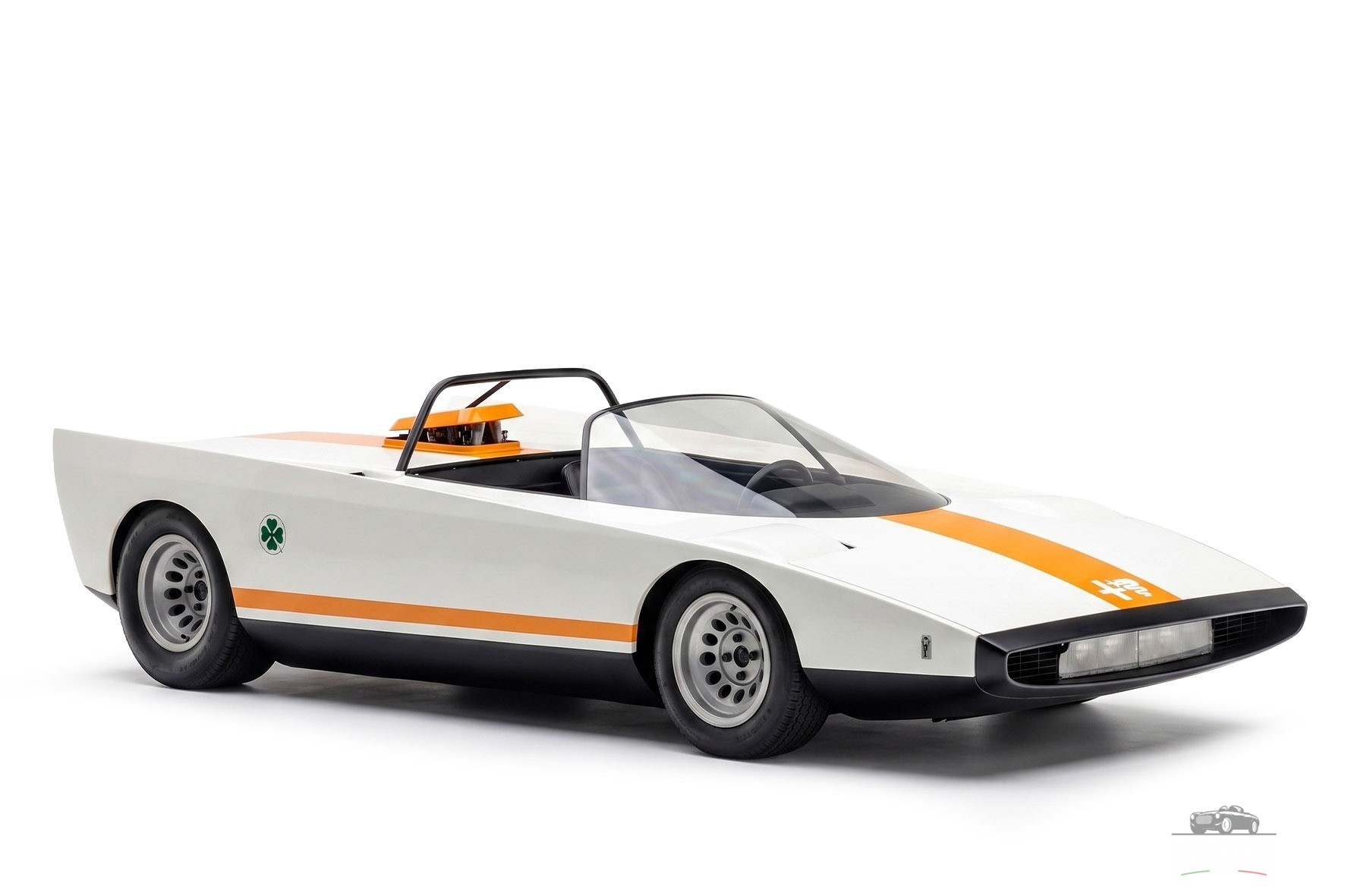
The Alfa Romeo P33 Cuneo is one of the 6 dream cars based on the Alfa Romeo 33 Stradale chassis built by the most famous Italian coachbuilders between the 1960s and 1970s. The 33 Spider, immediately renamed Cuneo in Alfa Romeo, was presented at the 1971 Brussels Motor Show and to build it Pininfarina reused the chassis of the 33 Roadster GS, designed by Paolo Martin and presented at the 1968 Turin Motor Show. whose bodywork was dismantled. The Alfa Romeo P33 Cuneo, with very square lines, as opposed to the rounded ones prevailing in the sixties, strongly impressed the insiders and the public for the low wedge-shaped profile from which only the windscreen and the arched roll-bar rise. The name comes precisely from the shape of its lateral silhouette, an almost perfect wedge. The new Cuneo designed in 1971 taken from the Roadster G.S. several aesthetic features in addition to the chassis itself such as the low and sharp wedge-shaped line (albeit taken to the extreme), the white / orange color combination, the full width bumper and the headlight strip. The very low front is characterized by a large black rubber bumper that completely wraps the nose and includes the strip of headlights placed behind a plate of plexiglass and the air intakes for the split radiators. The side profile is a perfect wedge, also without the doors, with only a narrow orange stripe applied on top that runs from wheel to wheel, the emblem with the four-leaf clover behind the cockpit and that of Pininfarina almost close to the nose, which as it enlarges towards the tail it rises more than the car body, giving rise to two low “fins” integrated into the side with a stabilizing function. From the substantially flat upper part emerge the front wheel arches, the low windscreen, a thin arched roll-bar that also supports the cover of the intake trumpets and two NACA air intakes for the engine (one on each side) placed next to the cockpit; it is crossed longitudinally by a large orange stripe that starts from the front integrating the stylized Alfa Romeo symbol through a Visconti cross and a snake and ends in the rear mirror. The rear contains a rectangular metal panel with the eight individual exhaust manifolds, flanked by three circular taillights on each side. The interior is almost completely black except for the seat of the seats, orange, combined with the bodywork details. The five circular secondary instruments are grouped in the center of the dashboard, while the rev counter is housed behind the four-spoke steering wheel, the same as the 33 Roadster G.S . The Alfa Romeo P33 Cuneo is equipped with the same 1,995 cm³ double-ignition V-shaped 8-cylinder engine as the Alfa Romeo 33 Stradale, capable of delivering 230 hp at 8,800 rpm, centrally positioned and coupled to a 6-speed manual gearbox . Pininfarina’s 33 Spider Cuneo did not have a productive follow-up and like the other dream cars based on the Alfa Romeo 33 Stradale chassis proposed by the best Italian coachbuilders and is kept at the Alfa Romeo Historical Museum in Arese.
02 / TECHNICAL IDENTITY
03 / DESIGN, BODY & SUPPLIERS
Coachbuilder / Design studio
Founded by Battista Pinin Farina in Turin in 1930, Pininfarina became one of the most influential Italian styling and coachbuilding houses, particularly through its work for Ferrari and other international manufacturers.
Explore record ↗Designer
Leonardo Fioravanti is an Italian automotive designer renowned for his work at Pininfarina, where he contributed to the styling of landmark Ferrari road cars.
Explore record ↗04 / CHRONOLOGY
06 / CHASSIS REGISTER
07 / GALLERY
BODY HISTORY / CHASSIS 75033.108
These historical dossiers record distinct body configurations of this chassis. Verify the chronology in the individual dossiers.
THE CONVERSATION
Comments 0