
Pininfarina
Founded by Battista Pinin Farina in Turin in 1930, Pininfarina became one of the most influential Italian styling and coachbuilding houses, particularly through its work for Ferrari and other international manufacturers.
Explore record ↗
1994Coachwork by Pininfarina
THE VEHICLE AT A GLANCE
THE PEOPLE BEHIND THE CAR
Founded by Battista Pinin Farina in Turin in 1930, Pininfarina became one of the most influential Italian styling and coachbuilding houses, particularly through its work for Ferrari and other international manufacturers.
Explore record ↗Chris Bangle (born 1956) is an American automotive designer who designed the Fiat Coupé exterior and led BMW Group design from 1992 to 2009.
Explore record ↗01 / THE STORY
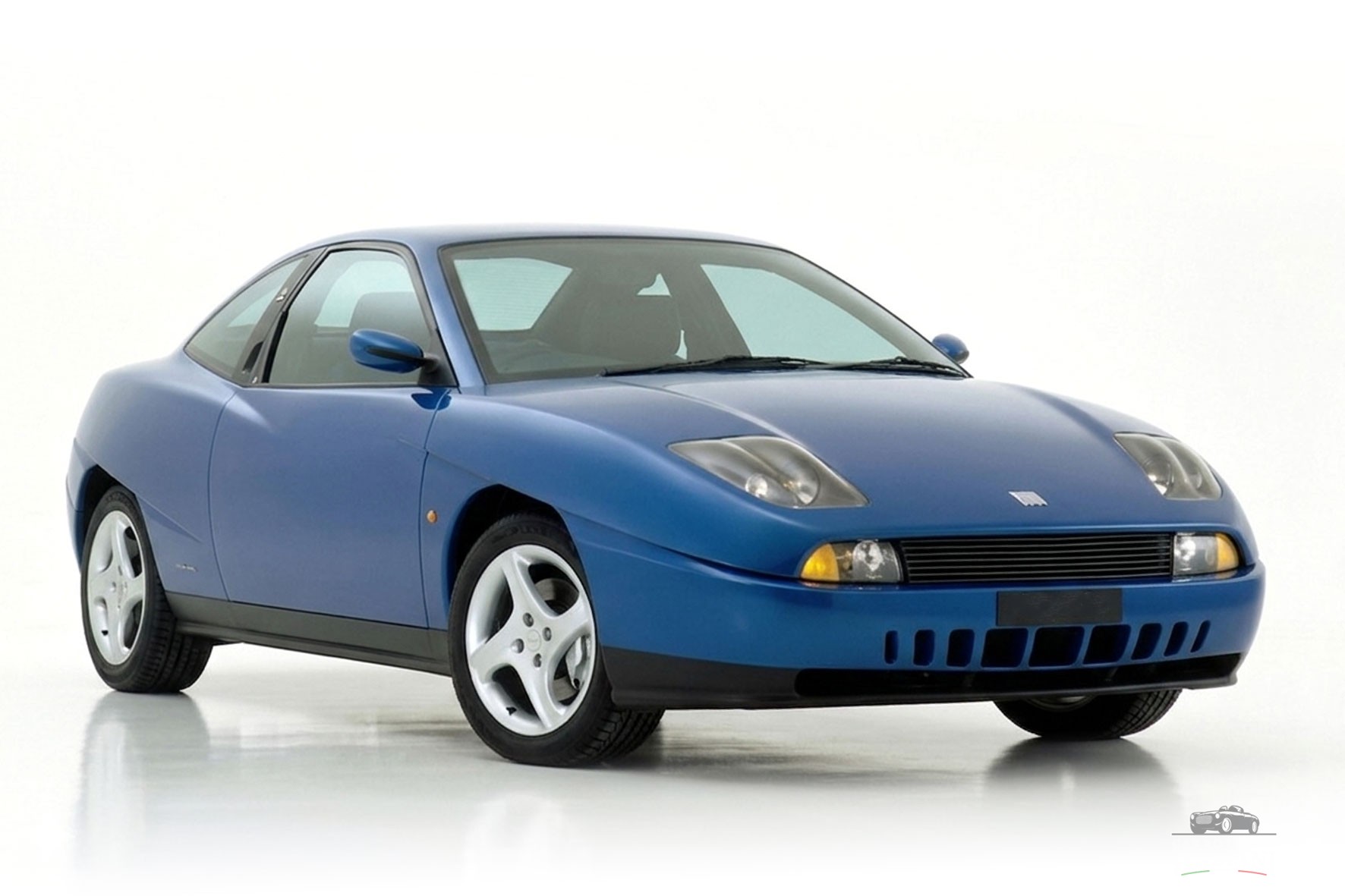
he Fiat Coupé was developed in the early 1990s as Fiat’s return to the compact sports coupé segment and entered production in 1993. The project originated during a period of internal reorganization within the Fiat Group, when Pininfarina’s Grugliasco plant became available following the cancellation of the Cadillac Allanté program around 1990. Fiat elected to proceed with a new coupé derived from existing group mechanicals to control costs and development time. Design responsibility for the exterior was assigned to Centro Stile Fiat, directed by Chris Bangle, whose proposal was selected over a competing design submitted by Pininfarina. The resulting body featured sharp geometries, exposed metal surfaces around the headlamps, and a strong visual separation between panels, departing from traditional Italian coupé styling. Pininfarina was retained to design the interior, which employed curved forms, color-coded body panels extending into the cabin, and integrated instrumentation. Pininfarina’s rejected exterior proposal was later reworked and adopted for the Peugeot 406 Coupé, introduced in 1996. The Fiat Coupé was built on the Tipo 2 (VSS) platform, shared with several Fiat Group models including the Fiat Tipo and Bravo, Alfa Romeo 155 and GTV, and Lancia Delta II. The structure was engineered with increased torsional rigidity to accommodate high-output engines under development. Suspension architecture was shared with platform derivatives: MacPherson struts at the front and longitudinal trailing arms at the rear, mounted on a subframe with separate springs and dampers. The rear anti-roll bar also functioned as a toe-control element. While robust, this layout limited camber recovery under load, affecting ultimate cornering grip. All Fiat Coupé variants were front-wheel drive with transversely mounted petrol engines. Engine options ranged from a 1.8-litre 16-valve unit to 2.0-litre 16-valve and 20-valve engines, including turbocharged versions. Output ranged from approximately 130 hp to 220 hp in the 2.0 20V Turbo. Early models used a 5-speed manual gearbox, later upgraded to a 6-speed on higher-performance versions. Final assembly took place at Pininfarina’s Grugliasco facility. Production ended in 2000, with approximately 72,000 units built.
02 / TECHNICAL IDENTITY
Become a Pro member to see the full details in this section.
Membership is not available yet.
View membership options03 / DESIGN, BODY & SUPPLIERS
Coachbuilder / Design studio
Founded by Battista Pinin Farina in Turin in 1930, Pininfarina became one of the most influential Italian styling and coachbuilding houses, particularly through its work for Ferrari and other international manufacturers.
Explore record ↗Attributed designer
Chris Bangle (born 1956) is an American automotive designer who designed the Fiat Coupé exterior and led BMW Group design from 1992 to 2009.
Explore record ↗Become a Pro member to see the full details in this section.
Membership is not available yet.
View membership options04 / CHRONOLOGY
07 / GALLERY
08 / PERIOD ARCHIVE
Become a Pro member to see the full details in this section.
Membership is not available yet.
View membership options
THE CONVERSATION
Comments 0