
Pininfarina
Founded by Battista Pinin Farina in Turin in 1930, Pininfarina became one of the most influential Italian styling and coachbuilding houses, particularly through its work for Ferrari and other international manufacturers.
Explore record ↗
1969Coachwork by Pininfarina
THE VEHICLE AT A GLANCE
THE PEOPLE BEHIND THE CAR
Founded by Battista Pinin Farina in Turin in 1930, Pininfarina became one of the most influential Italian styling and coachbuilding houses, particularly through its work for Ferrari and other international manufacturers.
Explore record ↗01 / THE STORY
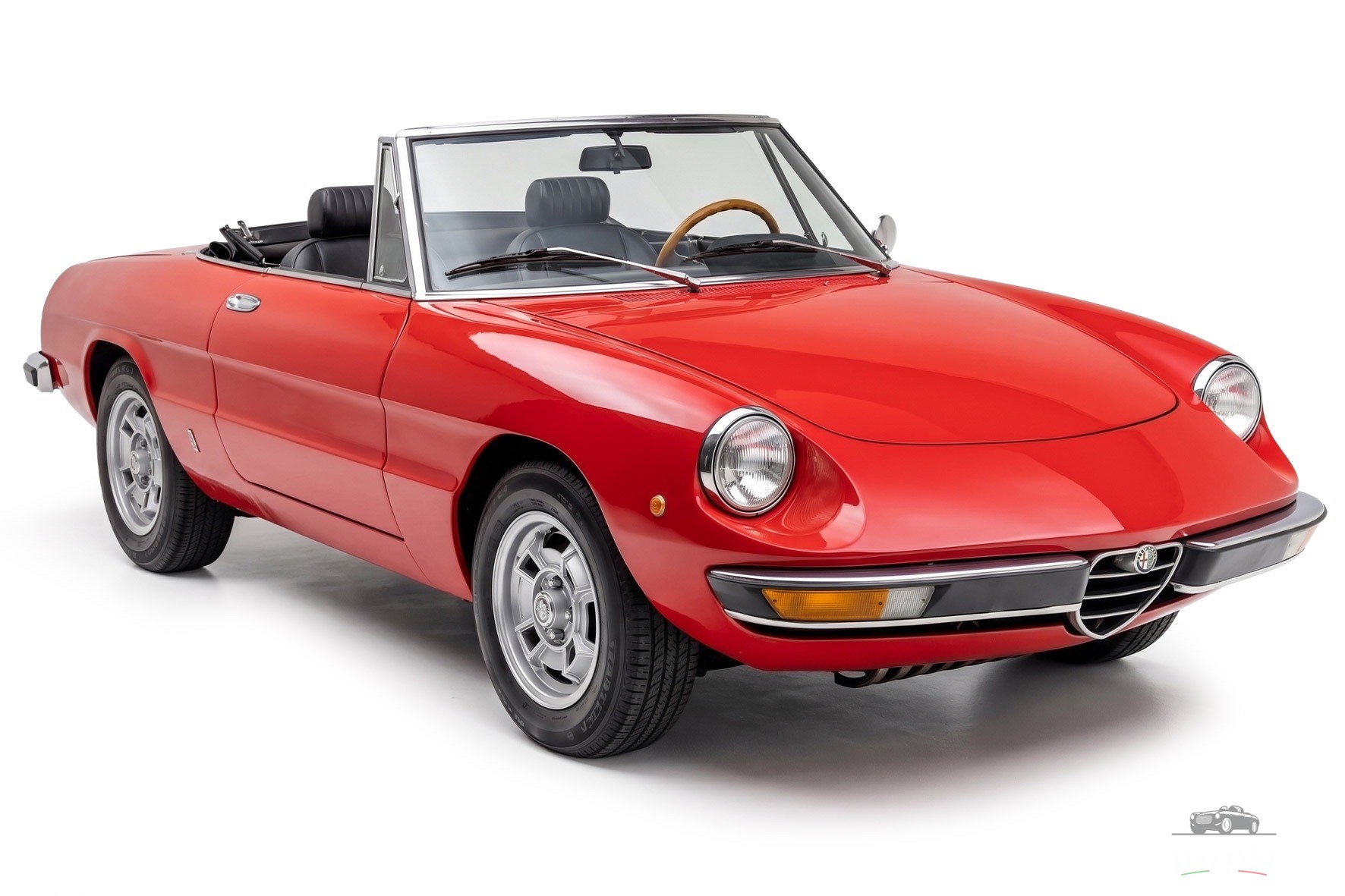
The Alfa Romeo Duetto Spider 1969 marked a turning point in the evolution of the iconic Spider series, with the first significant change to its exterior design. The 1750 Spider Veloce, in particular, saw the original’s signature elongated, round tail revised into a more practical Kamm tail, enhancing luggage space. Along with this major change, numerous subtle updates were introduced both inside and out. The grille was slightly redesigned, new door handles were added, and the windscreen became more raked for improved aerodynamics. Other updates included top-hinged pedals and upgraded interior trim, giving the car a more refined feel. In 1971, the Spider Veloce received a larger, more powerful engine—a 1,962 cc, 132 hp (98 kW) unit. As a result, the model was renamed from the 1750 Spider Veloce to the 2000 Spider Veloce. The 1600 Spider re-entered production a year later, now dubbed the Spider 1600 Junior, which was visually identical to the earlier 1300 model. One of the more unique iterations of the Spider came in 1974 with the introduction of the Spider-Targa. This rare, factory-request model featured a solid rear window and lift-out roof panels, made from black GRP material, echoing the style of Porsche’s Targa models. Fewer than 2,000 Spider-Targas were ever produced, making them highly sought after by collectors. Both the 1300 and 2000 models were modified between 1974 and 1975 to incorporate two small rear seats, transforming them into “2+2” four-seater vehicles. The 1300 model was discontinued in 1977, and between 1974 and 1976, stainless-steel bumpers were replaced with black, rubber-clad units to meet stricter North American crash safety standards. Throughout its production, various models saw differing production numbers, including 4,557 units of the 1300 Junior, 4,848 of the 1600 Junior, 16,320 of the 2000 Spider Veloce, and 22,059 of the 2000 Spider Veloce Iniezione (U.S. version). Only 4,027 units of the 1750 Spider Veloce were made, making it a relatively rare variant.
02 / TECHNICAL IDENTITY
03 / DESIGN, BODY & SUPPLIERS
Coachbuilder / Design studio
Founded by Battista Pinin Farina in Turin in 1930, Pininfarina became one of the most influential Italian styling and coachbuilding houses, particularly through its work for Ferrari and other international manufacturers.
Explore record ↗04 / CHRONOLOGY
07 / GALLERY
THE CONVERSATION
Comments 0