
Pininfarina
Founded by Battista Pinin Farina in Turin in 1930, Pininfarina became one of the most influential Italian styling and coachbuilding houses, particularly through its work for Ferrari and other international manufacturers.
Explore record ↗
1985
THE VEHICLE AT A GLANCE
THE PEOPLE BEHIND THE CAR
Founded by Battista Pinin Farina in Turin in 1930, Pininfarina became one of the most influential Italian styling and coachbuilding houses, particularly through its work for Ferrari and other international manufacturers.
Explore record ↗PRICE & SALES RECORD
01 / THE STORY
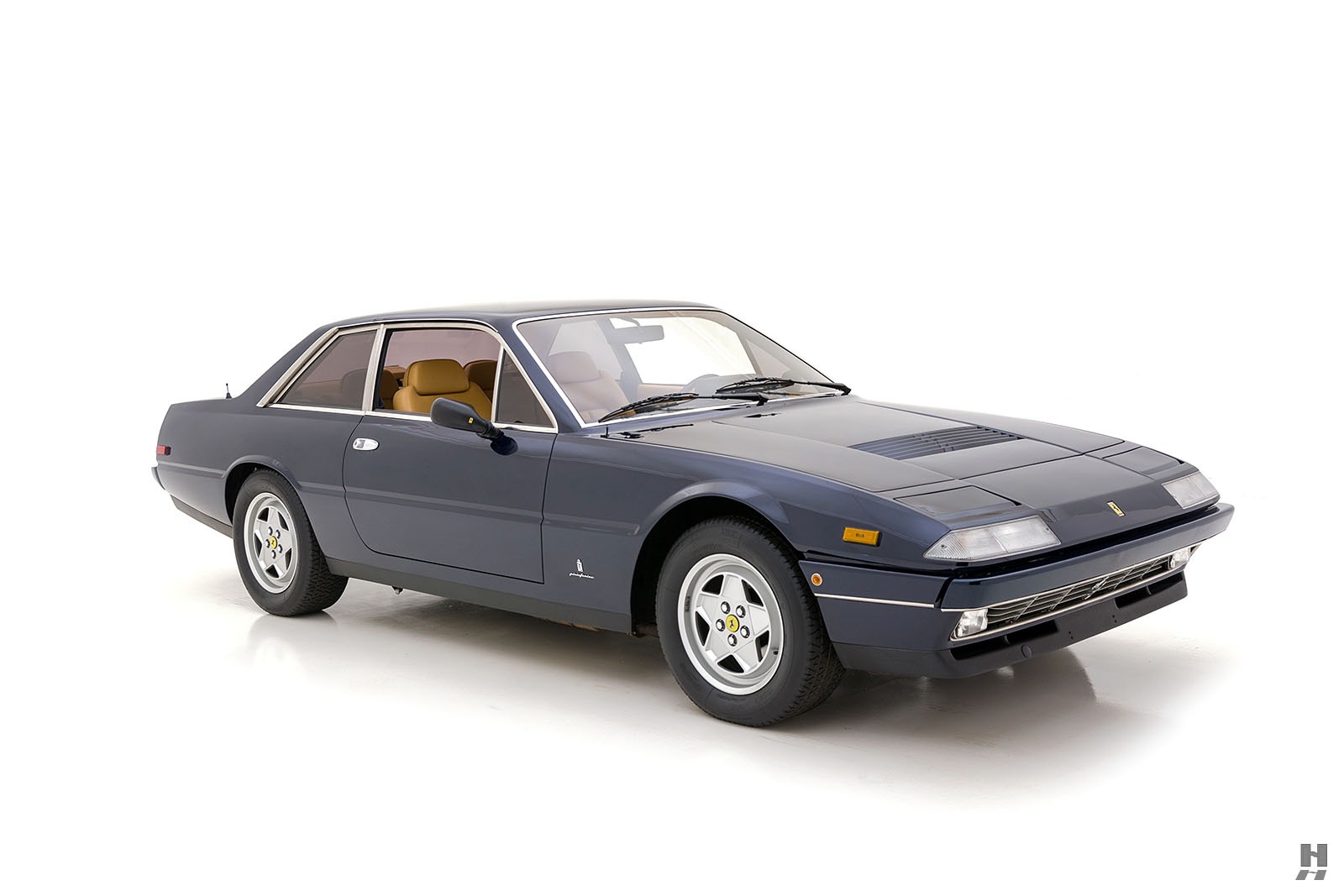
The Ferrari 412 succeeded the Ferrari 400 and introduced several key upgrades that improved both its performance and design. One of the most notable changes was the increase in engine displacement to 4,942 cc (302 cu in), achieved by a 1 mm bore increase, which is reflected in the car’s name, “412,” denoting the single-cylinder displacement in cubic centimeters. The Ferrari 412 retained both manual and automatic transmissions, though exterior badging no longer specified the transmission type. Additionally, Bosch ABS became available for the first time in a Ferrari, adding an extra layer of safety. The exterior of the Ferrari 412 underwent several refinements as well. Pininfarina, responsible for the car’s design, made subtle adjustments that included a raised rear deck for increased luggage space, a more pronounced front spoiler for improved aerodynamics, and body-colored bumpers for a smoother, more integrated appearance. The alloy wheels were upgraded, window frames were painted black, and redesigned turn signals further modernized the car’s look. These changes came at a time when the previous Ferrari 400i was beginning to feel outdated, thanks to its boxy design. The interior of the Ferrari 412 also saw improvements, with modernized features and refined touches to match the car’s updated exterior. Along with the increased engine displacement, the power output of the V12 engine was boosted to 340 hp, enhancing the Ferrari 412’s performance. The car’s production ran from 1985 to 1989, with a total of 303 units built. The Ferrari 412’s successor did not arrive immediately after production ceased in 1989. Instead, Ferrari’s sole 2+2 offering was the mid-engined Mondial, until the launch of the Ferrari 456 in 1992. The 456, designed by Pietro Camardella, marked the return of the front-engine V12 2+2 grand tourer to the Ferrari lineup. In 2019, luxury coachbuilder ARES Design Modena unveiled renders of a Ferrari 412-inspired concept car named “Pony,” intended for limited production based on the Ferrari GTC4 Lusso. Photo courtesy of Hyman Ltd.
02 / TECHNICAL IDENTITY
Become a Pro member to see the full details in this section.
Membership is not available yet.
View membership options03 / DESIGN, BODY & SUPPLIERS
Coachbuilder / Design studio
Founded by Battista Pinin Farina in Turin in 1930, Pininfarina became one of the most influential Italian styling and coachbuilding houses, particularly through its work for Ferrari and other international manufacturers.
Explore record ↗04 / CHRONOLOGY
05 / MARKET & PRICE HISTORY
GBP · 1 recorded sale
RECORDED SALES
GBP
Each point is a completed sale with its own date, in chronological order. Dates are positioned by calendar time, with approximate placement when only a year or month is documented. The connecting line shows observed sales prices in this currency, not an appreciation index: transactions may concern different chassis and specifications. Factory prices and unsold estimates are excluded.
Sign in to see the details of each sale on the chart.
Become a Pro member to explore the full price and sale history.
Membership is not available yet.
View membership optionsMarket observations describe documented transactions, estimates or offers. They are not themselves a current valuation of the vehicle.
06 / CHASSIS REGISTER
1 recorded sale · 2020
View full chassis history · Pro membership
07 / GALLERY
THE CONVERSATION
Comments 0