
Zagato
Founded in Milan in 1919 by Ugo Zagato, the coachbuilding house developed lightweight aerodynamic bodies inspired by aircraft construction, creating distinctive racing and grand touring automobiles.
Explore record ↗
1963Coachwork by Zagato
THE VEHICLE AT A GLANCE
THE PEOPLE BEHIND THE CAR
Founded in Milan in 1919 by Ugo Zagato, the coachbuilding house developed lightweight aerodynamic bodies inspired by aircraft construction, creating distinctive racing and grand touring automobiles.
Explore record ↗Ercole Spada (1937–2025) was an Italian automotive designer associated with Zagato, BMW and I.DE.A Institute and co-founder of Spadaconcept.
Explore record ↗01 / THE STORY
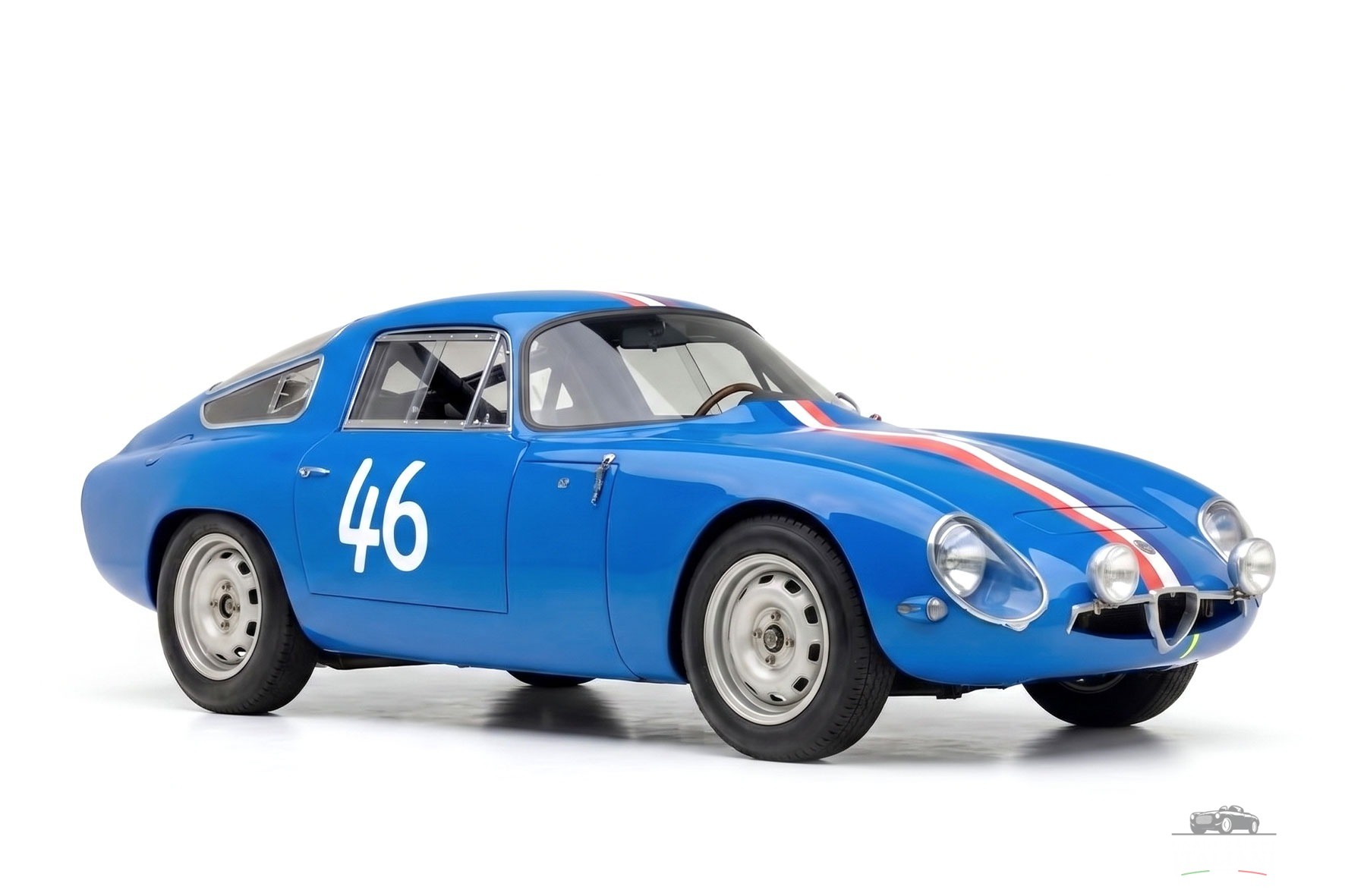
The Alfa Romeo Giulia TZ, sometimes referenced as TZ1 to differ from later TZ2 was presented at the 1962 Turin Auto Show. It featured a 1,570 cc twin cam engine and other mechanical components shared with the Alfa Romeo Giulia and carried a 105 series chassis number, but was a purpose built sports racing car, with a tubular spaceframe chassis built in the province of Perugia by SAI Ambrosini and the light all-aluminium bodywork was made by Zagato, final assembly was made Delta of Udine, with Carlo Chiti initially on board as a consultant before becoming the project leader. The firm soon changed its name to Auto-Delta and relocated to its current site in Settimo Milanese, on the outskirts of Milan, not far from the Alfa Romeo Portello Plant. It has disc brakes and independent suspension. The result was a lightweight coupé of only 650 kilograms (1,430 lb) and top speed of 134 miles per hour (216 km/h). The Alfa Romeo Giulia TZ was built both for street and racing trim, with the latest racing versions producing up to 160 brake horsepower (120 kW). Alfa’s twin-spark cylinder head, as also used in their GTA, contributed to the speed of the TZ; the standard Giulia alloy block with wet steel liners was installed at an angle under the hood of the TZ to improve airflow. Aiding the TZ in its quest for performance was the treatment of the rear bodywork. Incorporating the research of Dr. Wunibald Kamm, the TZ used a style called coda tronca in Italian, meaning “short tail.”, otherwise known as the Kamm tail. The principle is that unless an aircraft-like extended tail is incorporated, which is not practical for an automobile, there is little, if any, increase in drag and a marked decrease in lift or even some downforce by simply chopping off a portion of the tail. Zagato had previously proved the success of this tail treatment in their coda tronca Sprint Zagato sports-racing cars, and it was a natural evolution to adapt this to the Giulia TZ. The Alfa Romeo Giulia TZ debuted at the 1963 FISA Monza Cup, where TZs took the first four places in the prototype category. At the beginning of 1964 the TZ was homologated (100 units were needed for homologation) to the Gran Turismo category. After homologation it started to take more class wins in Europe and North-America. Of the first TZ, 112 units were built between 1963 and 1965.
02 / TECHNICAL IDENTITY
03 / DESIGN, BODY & SUPPLIERS
Coachbuilder / Design studio
Founded in Milan in 1919 by Ugo Zagato, the coachbuilding house developed lightweight aerodynamic bodies inspired by aircraft construction, creating distinctive racing and grand touring automobiles.
Explore record ↗Designer
Ercole Spada (1937–2025) was an Italian automotive designer associated with Zagato, BMW and I.DE.A Institute and co-founder of Spadaconcept.
Explore record ↗04 / CHRONOLOGY
07 / GALLERY
THE CONVERSATION
Comments 0