
Zagato
Founded in Milan in 1919 by Ugo Zagato, the coachbuilding house developed lightweight aerodynamic bodies inspired by aircraft construction, creating distinctive racing and grand touring automobiles.
Explore record ↗
1956Coachwork by Zagato
THE VEHICLE AT A GLANCE
THE PEOPLE BEHIND THE CAR
Founded in Milan in 1919 by Ugo Zagato, the coachbuilding house developed lightweight aerodynamic bodies inspired by aircraft construction, creating distinctive racing and grand touring automobiles.
Explore record ↗01 / THE STORY
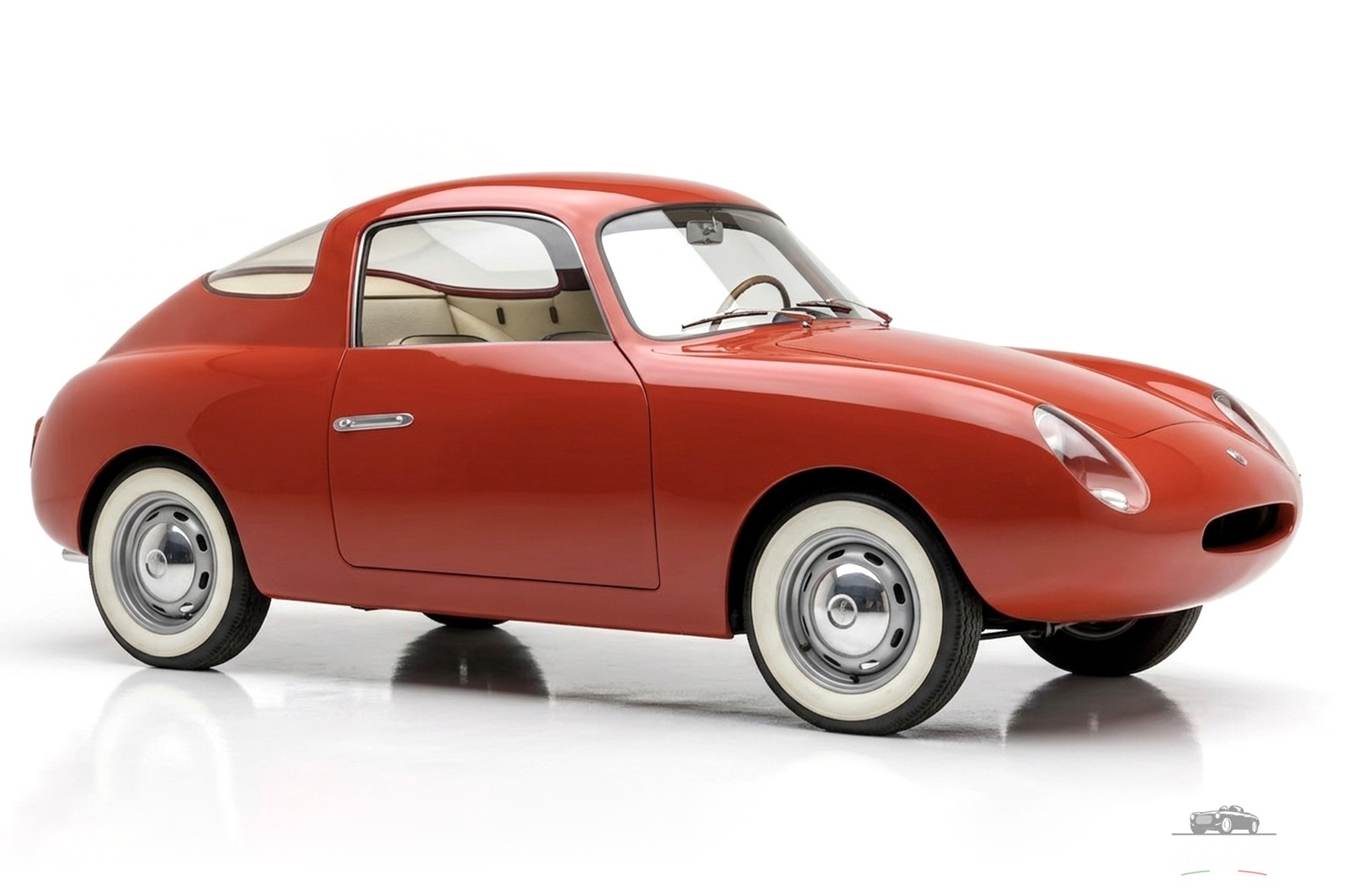
The Abarth 500 GT Coupé Zagato was a small-series grand touring and competition car developed from the Fiat Nuova 500, with coachwork by Carrozzeria Zagato and engine development by Abarth. It had a rear-mounted, air-cooled two-cylinder engine and a compact 2+2 body. Zagato’s historical catalogue places the 500 GT project under 1956, while the model’s presentation at the Turin Motor Show is documented in 1957. The official 2012 Concorso d’Eleganza Villa d’Este programme records a production total of five cars; individual chassis identities are not established by that figure.
The 500 GT belonged to the period of cooperation between Carlo Abarth and Zagato, whose Abarth 750 GT Coupé had already introduced a lightweight competition-oriented body on Fiat mechanical components. The smaller car followed a related design approach but used the Fiat 500’s own rear-engine layout rather than the Fiat 600-based mechanical package of the 750. The Turin presentation in October 1957 is documented independently of the earlier date in Zagato’s catalogue. These records should not be interpreted as fixing the completion date of every individual 500 GT.
The body retained a low bonnet, rounded front wings, a curved rear window and rear-quarter glazing. Its roof did not use the double-bubble profile familiar from many 750 GT Zagato coupés. The rear engine cover also differed from the larger model, reflecting the requirements of the smaller two-cylinder power unit. Period and surviving-car photographs indicate differences in detail between early and later configurations, but the available records do not establish a complete sequence of body changes for all five cars.
Abarth modified the Fiat-derived 479 cc twin-cylinder engine for higher output. Contemporary specifications reproduced in the 2012 Villa d’Este programme give 23 hp, compared with the lower output of the standard small Fiat engine. The programme describes a vehicle weighing 445 kg, capable of exceeding 110 km/h, and measuring approximately 3,200 mm in length, 1,320 mm in width and 1,130 mm in height. These figures describe the car presented in that programme; they are not independently confirmed for each surviving example. Published accounts disagree on some details of carburation, so a precise carburettor count cannot be applied to the entire series without stronger evidence.
The Abarth 500 GT was intended for small-displacement grand touring competition as well as road use. Reports of its period racing activity connect the type with Italian 500 cc GT successes and with driver Ovidio Capelli. The championship attribution requires a separate check against contemporary classification records before it can be treated as an individual award or linked to a particular chassis. The model also appeared in the historical vehicle selection for the Concorso d’Eleganza Villa d’Este held in May 2012. That appearance documents the presence of the type at the event but does not, by itself, identify the chassis or establish any prize result.
02 / TECHNICAL IDENTITY
03 / DESIGN, BODY & SUPPLIERS
Coachbuilder / Design studio
Founded in Milan in 1919 by Ugo Zagato, the coachbuilding house developed lightweight aerodynamic bodies inspired by aircraft construction, creating distinctive racing and grand touring automobiles.
Explore record ↗04 / CHRONOLOGY
05 / PEOPLE, COLLECTIONS & MUSEUMS
08 / GALLERY
THE CONVERSATION
Comments 0