
Zagato
Founded in Milan in 1919 by Ugo Zagato, the coachbuilding house developed lightweight aerodynamic bodies inspired by aircraft construction, creating distinctive racing and grand touring automobiles.
Explore record ↗
1965Coachwork by Zagato
THE VEHICLE AT A GLANCE
THE PEOPLE BEHIND THE CAR
Founded in Milan in 1919 by Ugo Zagato, the coachbuilding house developed lightweight aerodynamic bodies inspired by aircraft construction, creating distinctive racing and grand touring automobiles.
Explore record ↗Ercole Spada (1937–2025) was an Italian automotive designer associated with Zagato, BMW and I.DE.A Institute and co-founder of Spadaconcept.
Explore record ↗01 / THE STORY
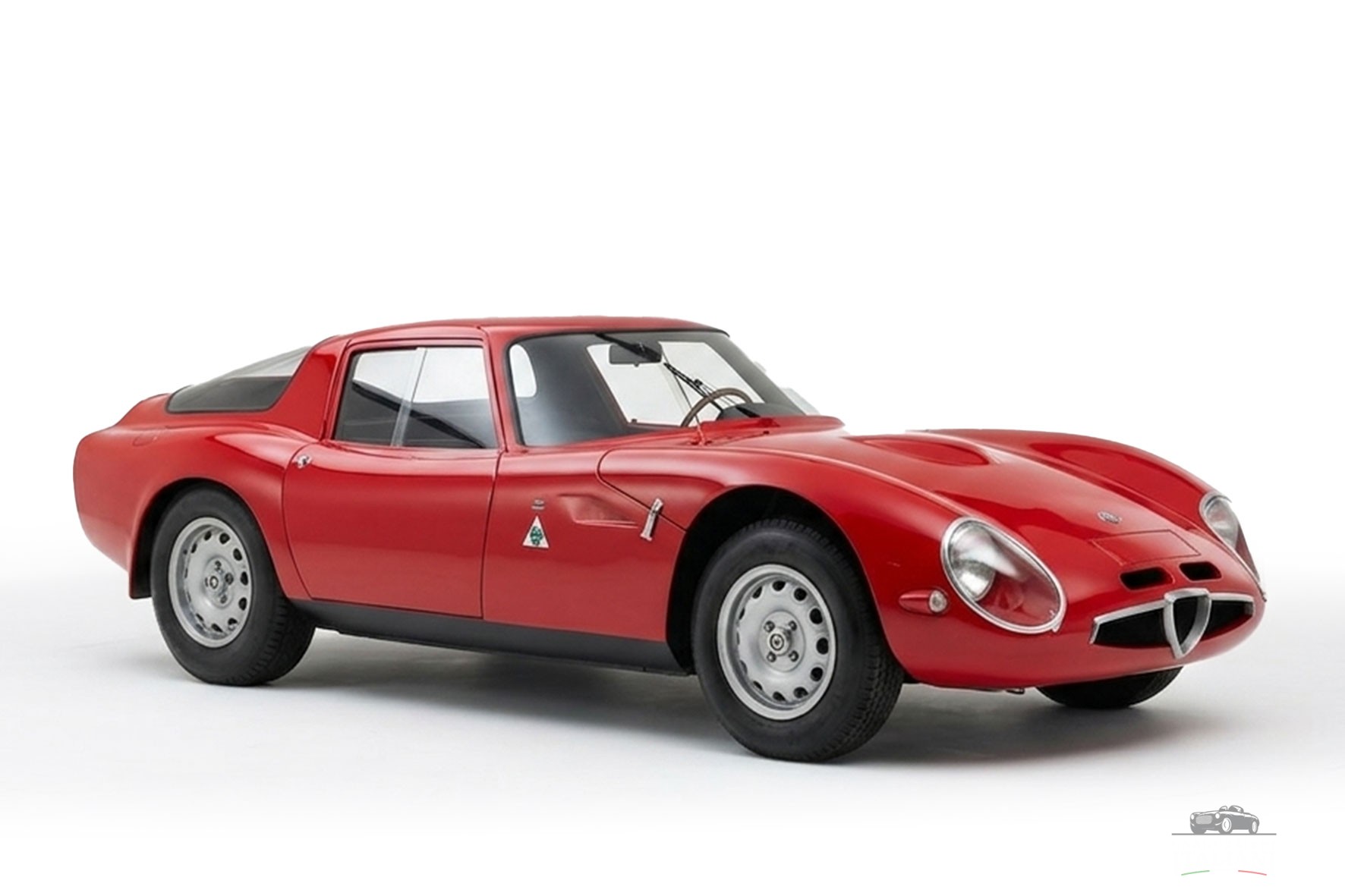
The Alfa Romeo Giulia TZ2, unveiled at the 1964 Turin Auto Show by Zagato, underwent a significant overhaul compared to the TZ. Zagato, aiming to enhance both structure and weight reduction, swapped out the lightweight alloy body for a sleeker fiberglass alternative, tightly molded to the chassis. This modification slashed the weight to a mere 620 kg (1,370 lb) while reducing drag. The Giulia TZ2 was exclusively crafted for racing, featuring an Autodelta-tuned 1,570 cc (1.6 L; 95.8 cu in) DOHC straight-4 engine, boasting 170 bhp (127 kW) at 7000 rpm with a top speed of 245 km/h (152 mph). Notable alterations included a unified rear window, departing from the previous three-part design of the TZ model. Production ceased by the close of 1965 to make way for Alfa Romeo’s burgeoning GTA racing initiative, with only a scant dozenAlfa Romeo Giulia TZ2s ever emerging from Zagato’s workshops. Yet, its legacy endured, clinching the esteemed Gran Turismo Trophy at the 2009 Pebble Beach Concours d’Elegance. Sporting triumphs abounded, highlighted by a class victory in the 1000 km of Monza on April 25, 1965, piloted by Bussinello-De Adamich, securing seventh place overall and the GT 1600 category lead. Throughout 1965, the TZ2 notched class wins under Rolland-Consten at the 12 Hours of Sebring, Bianchi-Rolland at the Targa Florio, and Adamich-“Geki” at the 1000 km of Nürburgring, the 6 Hours of Melbourne, the Giro d’Italia, and the Criterium des Cevennes. The following year witnessed further triumphs with class victories at Monza (De Adamich-Zeccoli), Sebring (Andrey-“Geki”), the Targa Florio (Pinto-Todaro), and the Nürburgring (Bianchi-Schultze).
02 / TECHNICAL IDENTITY
03 / DESIGN, BODY & SUPPLIERS
Coachbuilder / Design studio
Founded in Milan in 1919 by Ugo Zagato, the coachbuilding house developed lightweight aerodynamic bodies inspired by aircraft construction, creating distinctive racing and grand touring automobiles.
Explore record ↗Designer
Ercole Spada (1937–2025) was an Italian automotive designer associated with Zagato, BMW and I.DE.A Institute and co-founder of Spadaconcept.
Explore record ↗04 / CHRONOLOGY
05 / PEOPLE, COLLECTIONS & MUSEUMS
07 / CHASSIS REGISTER
08 / GALLERY
THE CONVERSATION
Comments 0