
Zagato
Founded in Milan in 1919 by Ugo Zagato, the coachbuilding house developed lightweight aerodynamic bodies inspired by aircraft construction, creating distinctive racing and grand touring automobiles.
Explore record ↗
1957Coachwork by Zagato
THE VEHICLE AT A GLANCE
THE PEOPLE BEHIND THE CAR
Founded in Milan in 1919 by Ugo Zagato, the coachbuilding house developed lightweight aerodynamic bodies inspired by aircraft construction, creating distinctive racing and grand touring automobiles.
Explore record ↗01 / THE STORY
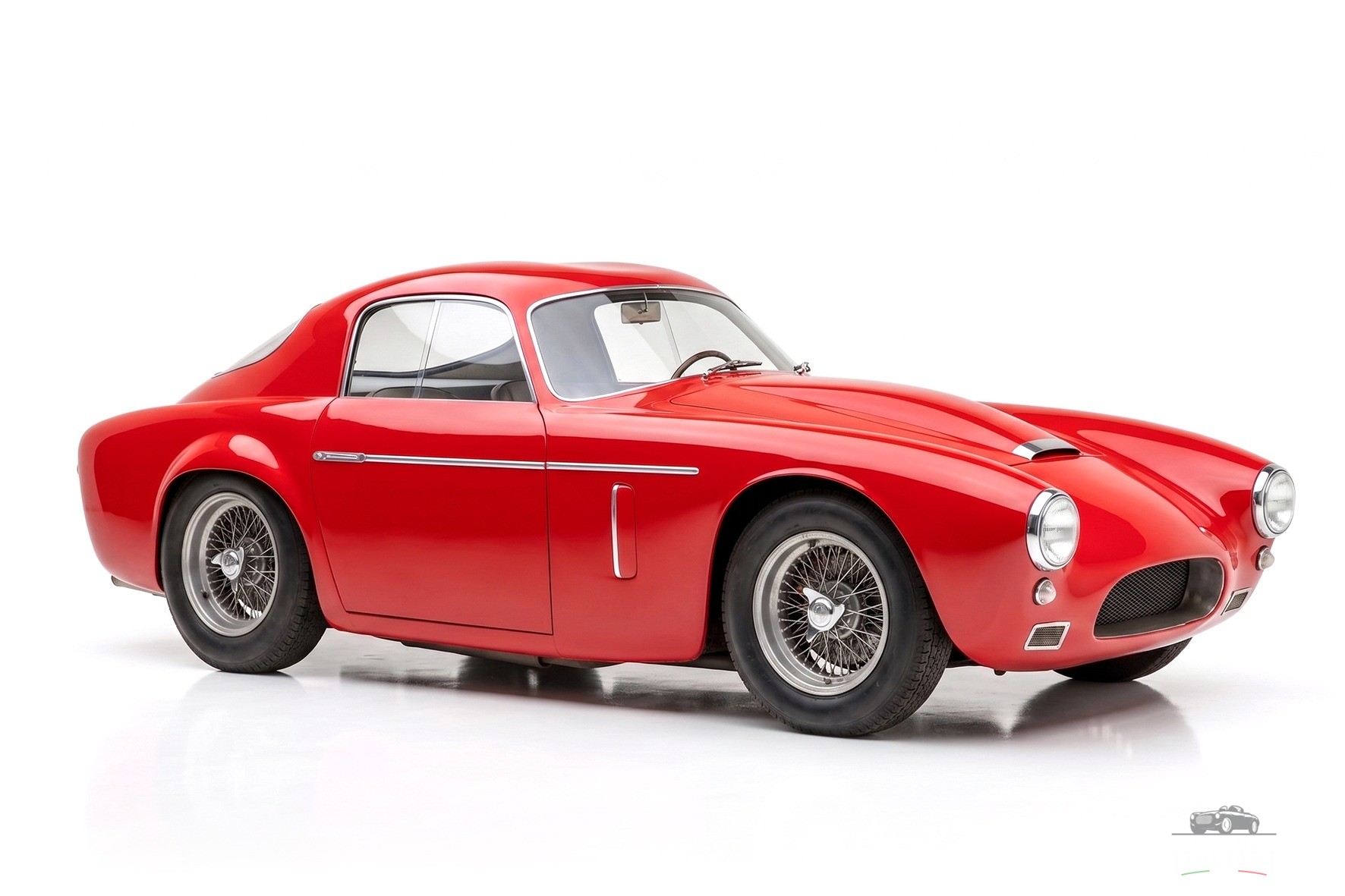
AC Ace Bristol Zagato is a one-off two-seat coupé based on AC Ace Bristol chassis BEX477, with lightweight aluminium coachwork designed and built by Zagato in Milan. The British-built mechanical platform dates from the 1957 AC Ace Bristol programme, while the special coupé body was completed in 1958. Zagato’s historical catalogue lists the project under 1957; the two dates concern different stages in the car’s history, not different vehicles.
The project originated in Switzerland, where Hubert Patthey was an AC importer and active in motorsport. Historical accounts link Patthey and John Gretener to the commission but differ over the precise order of events: one identifies Patthey as the instigator of the Zagato body, while another places Gretener’s order for the chassis through Patthey in May 1958. The surviving information does not establish a single unambiguous chronology of commissioning and first ownership. The connection to the 1957 Geneva Motor Show concerns the development of the idea; it should not be mistaken for a documented exhibition of the finished coupé that year.
Zagato replaced the conventional open Ace body with a closed, low-roofed berlinetta made from thin aluminium panels. Two distinct raised sections over the seats provided head clearance beneath a roof otherwise kept relatively low. This double-bubble roof configuration belonged to Zagato’s established post-war approach to lightweight grand touring and competition coachwork. The fixed roof, compact passenger compartment and flowing rear profile distinguished BEX477 from a standard Ace Bristol and from AC’s own production Aceca coupé.
Chassis BEX477 belongs to the Bristol-powered Ace series, combining AC’s sports-car architecture with a Bristol straight-six engine. Published model specifications commonly describe a displacement of 1,971 cc, but the precise engine number, state of tune and installed power output of this individual car require chassis-specific documentation. Technical figures from other Ace Bristol examples must therefore not be assigned to BEX477 without an exact match. Its identity as a unique Zagato-bodied Ace does not imply a separately produced AC chassis model.
Records of the 1958 Coupes du Salon at Montlhéry associate the Zagato coupé with a class victory, generally dated 5 October 1958. The result is supported by specialist histories, although its exact classification awaits confirmation against an original official results sheet. Accounts of subsequent Swiss hill-climb use are consistent with the car’s competition purpose, but should not be converted into additional race wins without event-level evidence.
Later accounts place the car with John Gretener and, subsequently, the Swiss racing driver Jo Siffert. A fuller ownership sequence includes a period in Britain and the Rosso Bianco collection, but dates and the documentary chain for several transfers remain incomplete. These reported associations should not be treated as a complete, verified register of owners. The documentary chain for several ownership transfers remains incomplete.
The car was shown at the 2009 Pebble Beach Concours d’Elegance as part of the class celebrating ninety years of Zagato design. The published participant list identifies James and Nancy Feldman of Portland, Oregon, as its exhibitors. The car was an entrant in the Zagato class, not one of the three published class award recipients. Photographs from the event confirm the presence of the recognisable coupé, but their existence does not establish licensing rights for reuse in this database.
The relationship between AC and Zagato was revisited decades later in the AC 378 GT Zagato, presented in 2012. That modern grand tourer was a distinct programme, with its own engineering and production arrangements. BEX477 remains the individually identified 1950s collaboration, rather than the first unit of a continuing AC-Zagato production series.
02 / TECHNICAL IDENTITY
03 / DESIGN, BODY & SUPPLIERS
Coachbuilder / Design studio
Founded in Milan in 1919 by Ugo Zagato, the coachbuilding house developed lightweight aerodynamic bodies inspired by aircraft construction, creating distinctive racing and grand touring automobiles.
Explore record ↗06 / CHASSIS REGISTER
07 / GALLERY
THE CONVERSATION
Comments 0