
Zagato
Founded in Milan in 1919 by Ugo Zagato, the coachbuilding house developed lightweight aerodynamic bodies inspired by aircraft construction, creating distinctive racing and grand touring automobiles.
Explore record ↗
1988Coachwork by Zagato
THE VEHICLE AT A GLANCE
THE PEOPLE BEHIND THE CAR
Founded in Milan in 1919 by Ugo Zagato, the coachbuilding house developed lightweight aerodynamic bodies inspired by aircraft construction, creating distinctive racing and grand touring automobiles.
Explore record ↗01 / THE STORY
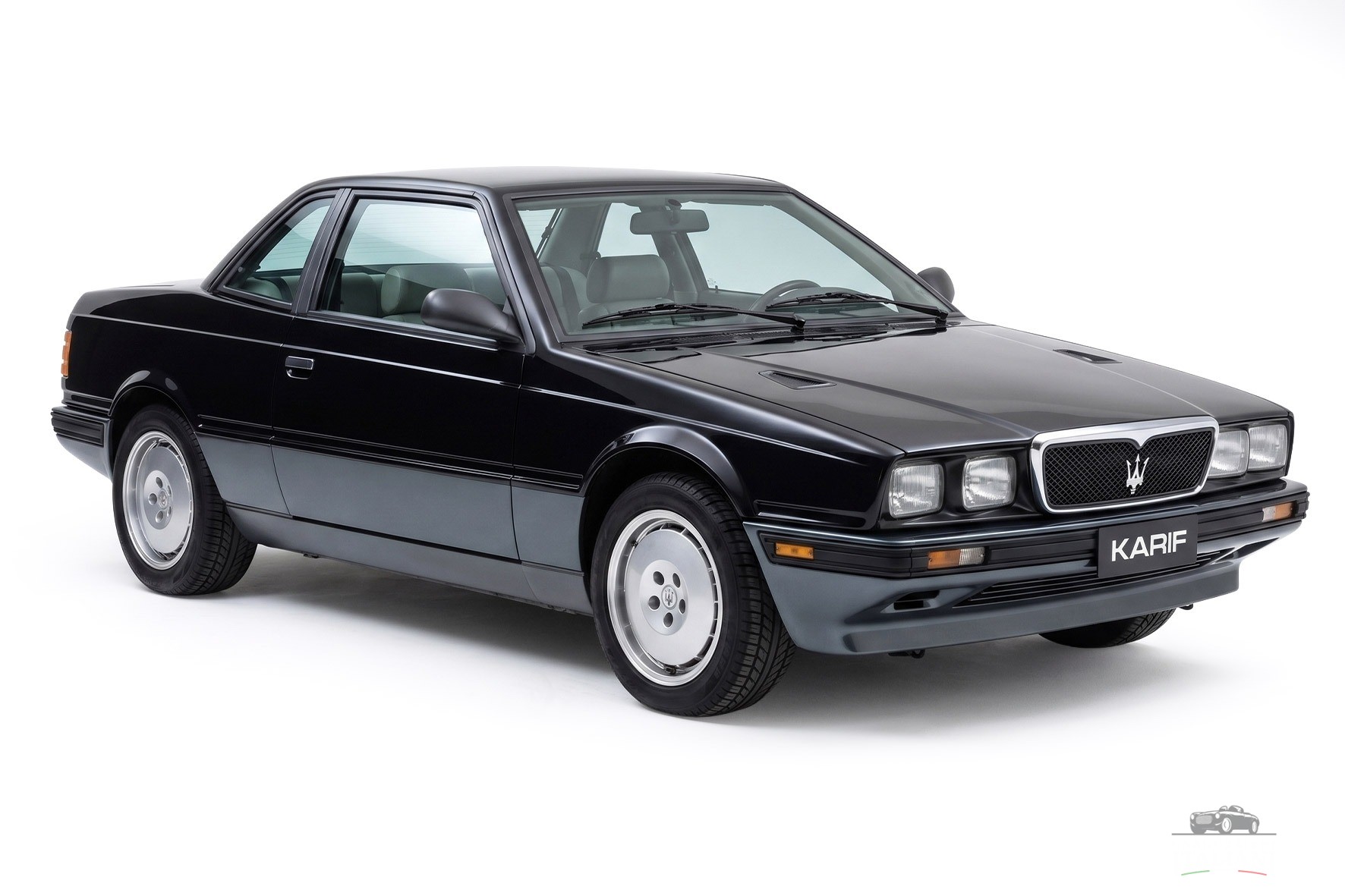
The Maserati Karif (Tipo AM339) was introduced at the Geneva Motor Show in 1988. It was developed from the Biturbo family, using the shortened platform of the Biturbo Spyder. The steel monocoque retained reinforced sills, while a fixed notchback roof replaced the open body of the Spyder. The wheelbase was shorter than that of the regular Biturbo coupé, and the rear passenger space was rearranged to provide luggage accommodation behind the two front seats.
Pierangelo Andreani designed the Karif. Zagato participated in the coachbuilding programme, a role distinct from Andreani’s individual styling attribution. The two-door coupé retained the Biturbo family’s frontal treatment, with a compact cabin and a short rear deck.
The Karif employed a 2,790 cc, 90-degree V6 engine with twin turbochargers, three valves per cylinder and a single overhead camshaft on each cylinder bank. Power was transmitted to the rear wheels through a five-speed manual gearbox. The official dry weight was 1,281 kg. The original non-catalysed engine and the later catalysed version had different rated outputs and maximum speeds; those figures cannot be treated as one specification for every Karif.
Karif production ran from 1988 to 1991. Maserati records 221 examples built, including the catalysed version introduced during the production period with reduced engine output.
02 / TECHNICAL IDENTITY
03 / DESIGN, BODY & SUPPLIERS
Coachbuilder / Design studio
Founded in Milan in 1919 by Ugo Zagato, the coachbuilding house developed lightweight aerodynamic bodies inspired by aircraft construction, creating distinctive racing and grand touring automobiles.
Explore record ↗04 / CHRONOLOGY
07 / GALLERY
THE CONVERSATION
Comments 0