
Pininfarina
Founded by Battista Pinin Farina in Turin in 1930, Pininfarina became one of the most influential Italian styling and coachbuilding houses, particularly through its work for Ferrari and other international manufacturers.
Explore record ↗
1947Coachwork by Pininfarina
THE VEHICLE AT A GLANCE
THE PEOPLE BEHIND THE CAR
Founded by Battista Pinin Farina in Turin in 1930, Pininfarina became one of the most influential Italian styling and coachbuilding houses, particularly through its work for Ferrari and other international manufacturers.
Explore record ↗Fedele Bianco was an Italian automotive stylist active in Turin, with documented work at Ghia and Pinin Farina during the 1940s.
Explore record ↗01 / THE STORY
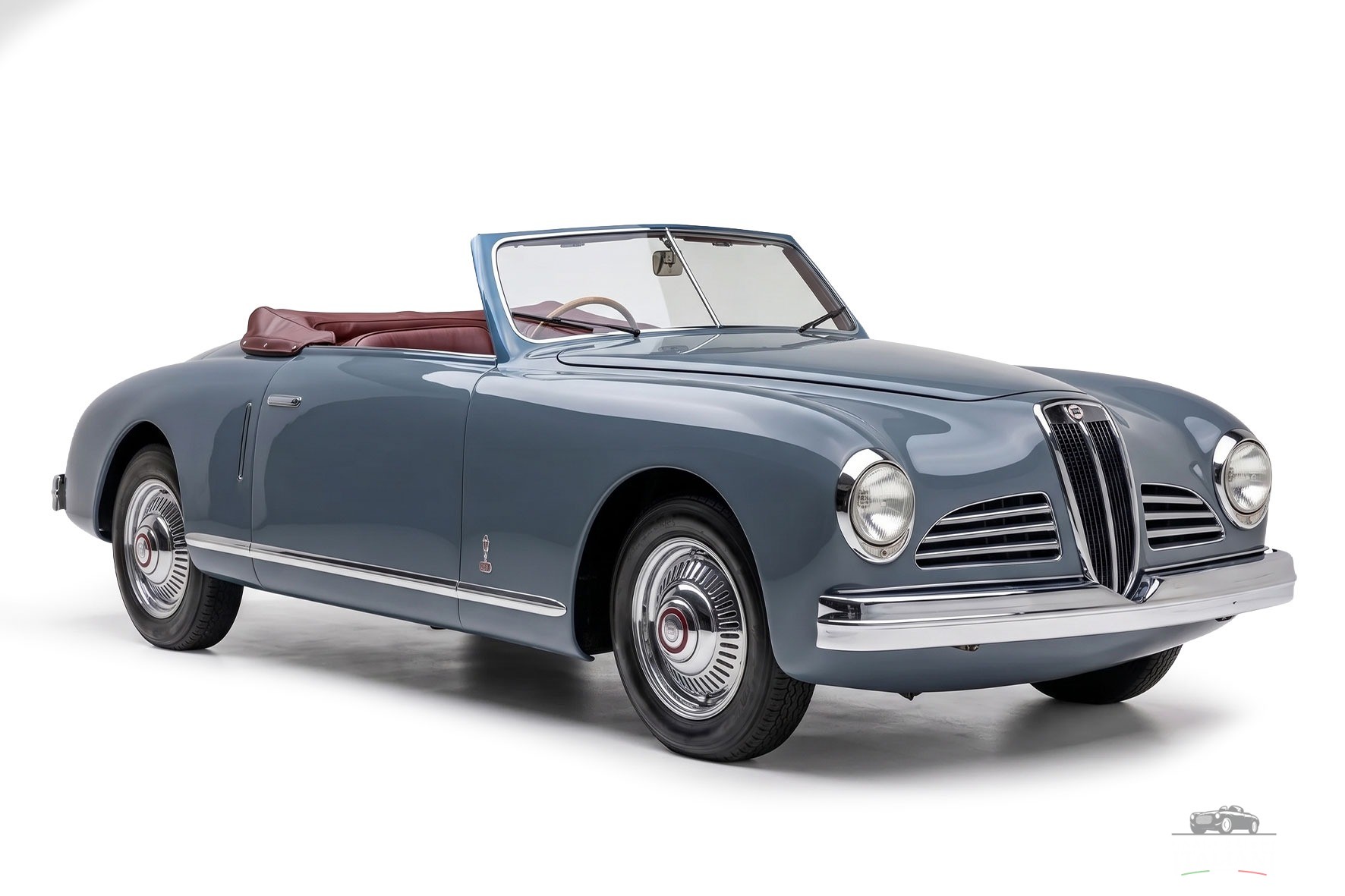
The Lancia Aprilia Cabriolet Pininfarina chassis 439-11844: The Aprilia was an important model for Lancia and the last model completed before Vincenzo Lancia’s death in 1937. Entering production that year, the cars right out of the factory had an advanced uni-body, four-wheel independent suspension, and a very advanced and compact narrow-angle V-4. The 1939 Series II saw the engine enlarged from 1,352 cc to 1,486 cc, with the emphasis on increased torque and smoothness. As was Lancia’s practice, the factory offered a platform for coachbuilders. With a structural engine bay and cowl, and a unitized sheet steel floor and rear, the platform provided torsional stiffness while allowing enormous design freedom for coachbuilders such as Pinin Farina. Remarkably, although late-war production was greatly reduced by Allied bombing, Aprilia production continued throughout the conflict. As a result, when Aprilia chassis number 439-11844 was delivered to Pininfarina in 1947, they were intimately familiar with the model and its design potential. It was fitted with beautiful one off cabriolet coachwork and fitted with two seats plus rear jump seats in case of passengers. The driver and passenger face a dashboard color-matched to the upholstery and set with a striking composition in bakelite and chrome. It is, however, the cabriolet’s exterior that sets it apart a beautiful exercise in clean lines and details. With the lines of the windshield pillar and side window extending into the door cuts, it is as beautiful with the top up as with it down. With few opportunities to show the car in war-torn Italy, and the 1946 Paris Salon d’Automobile closed to the former Axis countries, Battista Farina was determined to ‘crash the party.’ Joined by his son, Sergio, age 20, at the wheel of a Pinin Farina-designed Alfa Romeo 2500, Battista drove this car from Turin to Paris personally. Upon arrival they were barred from entering the Grand Palais so he displayed his two cars outside the Salon in the courtyard, which saw them featured on the cover of the widely read magazine, L’Illustration. Battista Farina recounted the magic of the trip in his memoirs as the first and one of the most memorable with his son. Following this publicity stunt, the Aprilia was acquired by Roblou, a Lancia importer in Neuilly sur Seine, where it remained until 1965. The car was discovered in northern France in 2010, and subsequently underwent a thorough restoration in Italy and still shows beautifully today.
02 / TECHNICAL IDENTITY
03 / DESIGN, BODY & SUPPLIERS
Coachbuilder / Design studio
Founded by Battista Pinin Farina in Turin in 1930, Pininfarina became one of the most influential Italian styling and coachbuilding houses, particularly through its work for Ferrari and other international manufacturers.
Explore record ↗Designer
Fedele Bianco was an Italian automotive stylist active in Turin, with documented work at Ghia and Pinin Farina during the 1940s.
Explore record ↗04 / CHRONOLOGY
05 / PEOPLE, COLLECTIONS & MUSEUMS
07 / CHASSIS REGISTER
View full chassis details · Pro membership
08 / GALLERY
THE CONVERSATION
Comments 0