
Pininfarina
Founded by Battista Pinin Farina in Turin in 1930, Pininfarina became one of the most influential Italian styling and coachbuilding houses, particularly through its work for Ferrari and other international manufacturers.
Explore record ↗
1958
THE VEHICLE AT A GLANCE
THE PEOPLE BEHIND THE CAR
Founded by Battista Pinin Farina in Turin in 1930, Pininfarina became one of the most influential Italian styling and coachbuilding houses, particularly through its work for Ferrari and other international manufacturers.
Explore record ↗01 / THE STORY
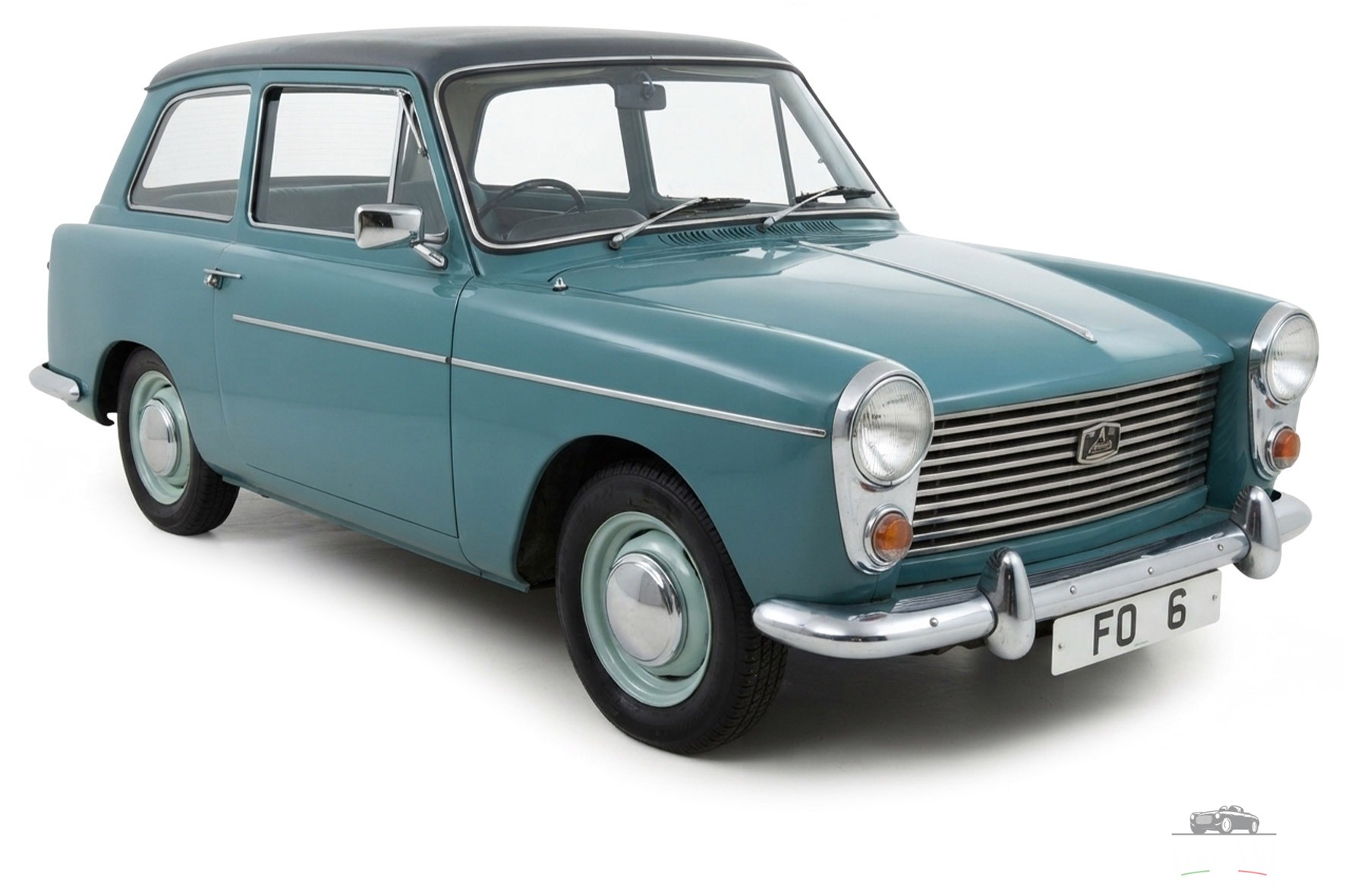
The Austin A40 Farina is a small, economy car introduced by Austin in saloon (1958) and A40 Countryman (1959) estate versions. It has a two-box body configuration. It was badged, like many before it, as an A40, consistent with Austin’s naming scheme at the time, based on the approximate engine output in horsepower; and to distinguish it from other A40 models, it was also given a suffix name – this one being the Farina, so named, reflecting the all-new design by Italian Battista Farina’s Pinin Farina Turin studio. The Austin A40 Farina: The nice and “humpy” Austin A30/A35, in the second half of the 1950s, was beginning to feel the weight of its years and needed a radical change, at least in the bodywork. Retaining the traditional mechanicals of the previous model, also common to the Morris Minor (which remained on the list, as it was still “well-sold”), BMC turned to Pininfarina to redesign its line. The result was a small (and original, for the time) two-door hatchback that combined roominess, sturdiness and elements of “British” elegance (such as the small rear fins and the “flap” trunk lid). Featuring an understated and economical (but not Spartan) interior, the Austin A40 Farina, launched in 1957, had traditional mechanicals: rear-wheel drive, longitudinal front engine, rigid axle rear axle with leaf springs and drum brakes. Powering the new BMC hatchback was the familiar 4-cylinder A-series with side-camshaft timing of 948cm³ with 40hp SAE. Singular was the fact that rust resistance was better in the first version than in the later ones, despite the thicker sheet metal, which was explicitly mentioned in the advertisement. In 1962, alongside some marginal retouches to the front end and interior, the A40 MK2 was born, equipped with an upgraded 4hp engine. The Mk2 was also offered as a Countryman version, that is, equipped with a tailgate (but the tail remained unchanged). In 1965 the displacement of the A-series was increased to 1098 cm³ and power to 50hp SAE. Production ceased in 1967 after 342,162 examples (169,612 MK I and 172,550 MK 2).
02 / TECHNICAL IDENTITY
03 / DESIGN, BODY & SUPPLIERS
Coachbuilder / Design studio
Founded by Battista Pinin Farina in Turin in 1930, Pininfarina became one of the most influential Italian styling and coachbuilding houses, particularly through its work for Ferrari and other international manufacturers.
Explore record ↗04 / CHRONOLOGY
07 / GALLERY
THE CONVERSATION
Comments 0