
Pininfarina
Founded by Battista Pinin Farina in Turin in 1930, Pininfarina became one of the most influential Italian styling and coachbuilding houses, particularly through its work for Ferrari and other international manufacturers.
Explore record ↗
1955Coachwork by Pininfarina
THE VEHICLE AT A GLANCE
THE PEOPLE BEHIND THE CAR
Founded by Battista Pinin Farina in Turin in 1930, Pininfarina became one of the most influential Italian styling and coachbuilding houses, particularly through its work for Ferrari and other international manufacturers.
Explore record ↗01 / THE STORY
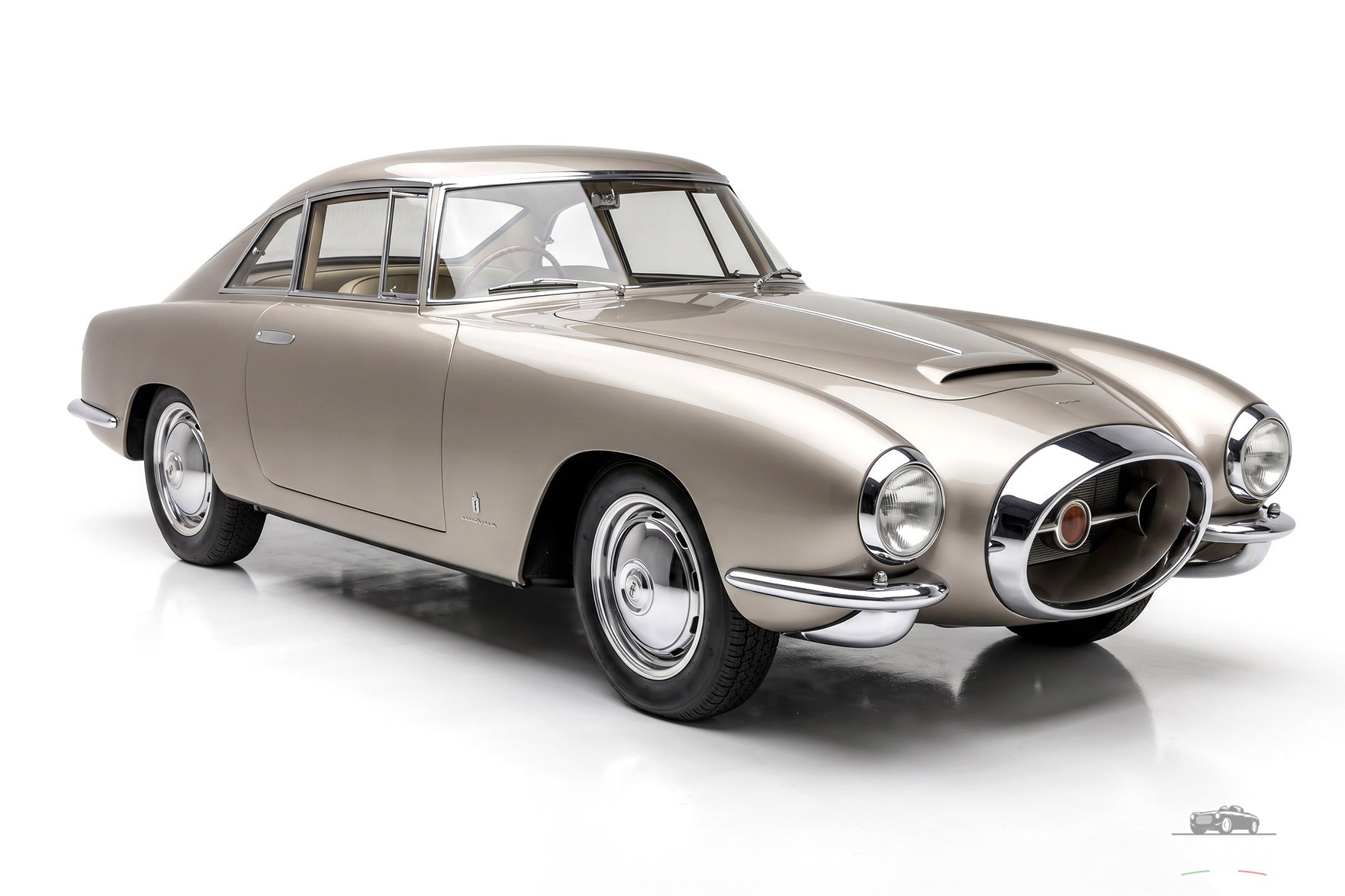
The Lancia Aurelia PF200 Coupé (1955) was coachbuilt by Pininfarina and designed by Aldo Brovarone. The development of the Aurelia model line began in the early 1950s, marking Lancia’s foray into innovative engineering and design, particularly with its use of a V6 engine, which was a pioneering feature at that time. The PF200 Coupé represents a collaboration between Lancia and Pininfarina, emphasizing a synthesis of performance and aesthetics through meticulous design processes.
The construction of the PF200 Coupé involved traditional coachbuilding techniques, with a focus on curvilinear forms and aerodynamic proportions that characterized mid-20th century automotive design. The body was constructed using lightweight materials to enhance performance, while the interior was optimized for driver comfort and engagement. The stylistic context of the era influenced the design, resulting in a vehicle that balanced function with an artistic approach to automotive form.
Mechanically, the Lancia Aurelia PF200 Coupé featured a V6 engine, which provided a significant advancement in power delivery and efficiency compared to its contemporaries. The chassis was designed to accommodate this engine configuration, contributing to the vehicle’s handling dynamics. The suspension system was engineered to support both comfort and performance, indicative of Lancia’s commitment to engineering excellence.
Production of the Lancia Aurelia PF200 Coupé was limited to a single unit, which highlights its exclusivity among automotive enthusiasts and collectors. Documentation indicates that this vehicle has been preserved in private collections, serving as a reference for researchers interested in postwar coachbuilding and the evolution of Italian automotive design. Surviving examples are recorded in institutional archives, providing valuable insights into the craftsmanship and innovation of the era.
02 / TECHNICAL IDENTITY
03 / DESIGN, BODY & SUPPLIERS
Coachbuilder / Design studio
Founded by Battista Pinin Farina in Turin in 1930, Pininfarina became one of the most influential Italian styling and coachbuilding houses, particularly through its work for Ferrari and other international manufacturers.
Explore record ↗04 / CHRONOLOGY
07 / GALLERY
THE CONVERSATION
Comments 0