
Pininfarina
Founded by Battista Pinin Farina in Turin in 1930, Pininfarina became one of the most influential Italian styling and coachbuilding houses, particularly through its work for Ferrari and other international manufacturers.
Explore record ↗
1974Coachwork by Pininfarina
THE VEHICLE AT A GLANCE
THE PEOPLE BEHIND THE CAR
Founded by Battista Pinin Farina in Turin in 1930, Pininfarina became one of the most influential Italian styling and coachbuilding houses, particularly through its work for Ferrari and other international manufacturers.
Explore record ↗01 / THE STORY
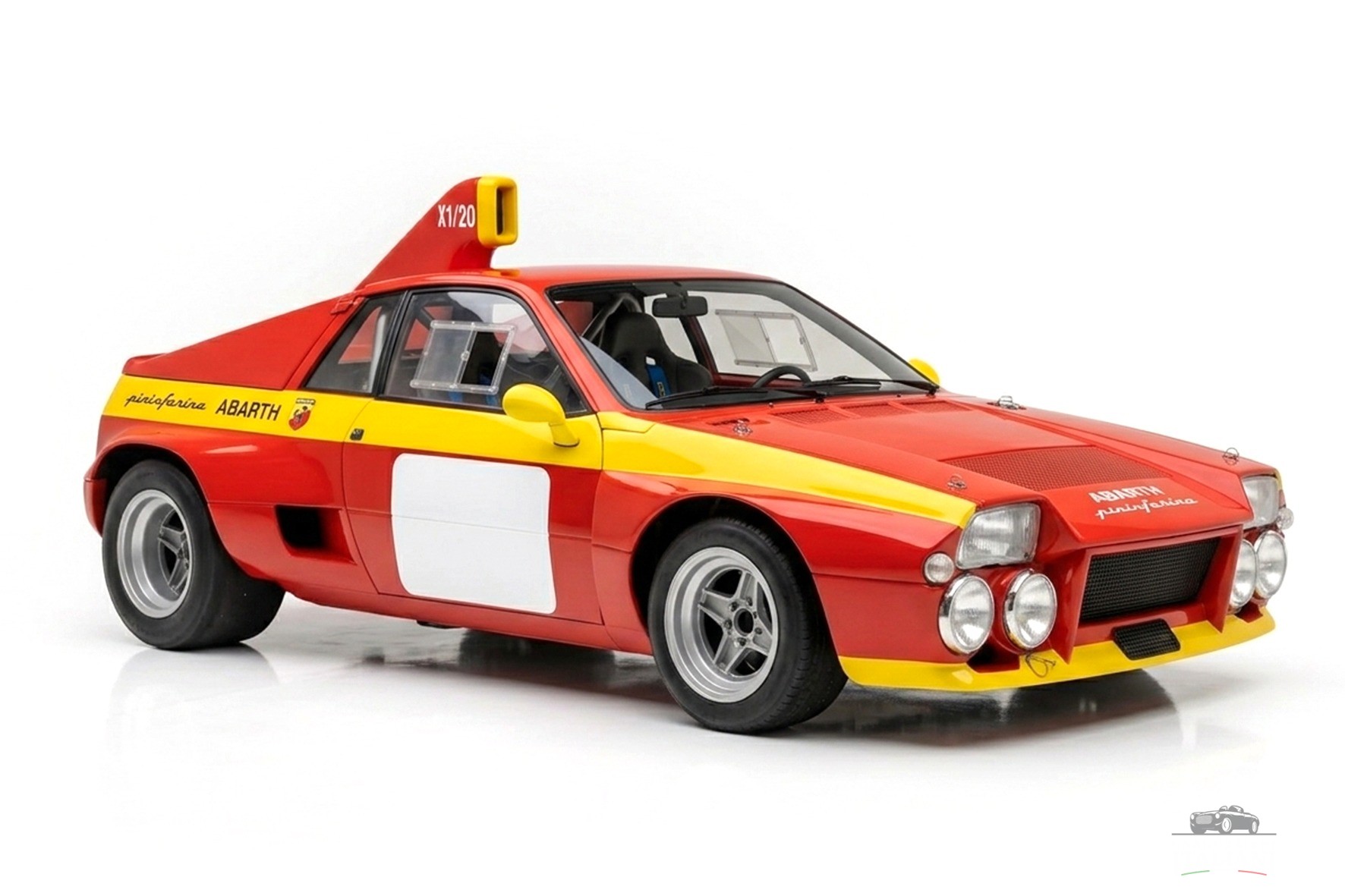
The Abarth SE 030: synergy between FIAT, Abarth and Pininfarina paid off and, at the end of 1973, the first prototypes were in a rather advanced stage of construction. Given the advance on the times, it was decided to set up a special racing model to make it participate, for promotional purposes, in the Giro d’Italia, a race that consisted of road and circuit tests, at the time very followed by enthusiasts from all over Europe. Once the racing version was completed and it was time to register for the race, no decision had been made about the future of the X1/20 project. Thus it was that the car was entered in the 1974 Giro d’Italia, under the name of Abarth SE 030. Led by the crew Giorgio Pianta and Cristine Becker, it took a considerable second place overall, behind the Lancia Stratos Turbo driven by the couple. Andruet-Biche. Subsequently presented in an official capacity at the Turin Motor Show in ’74 as Fiat Abarth 030, the car was then produced in a street version and marketed starting in 1975, this time under the Lancia insignia (another brand of the Turin group), and with the name of Beta Montecarlo. The development of the Abarth SE 030 continued, evolving in 1980 into the Abarth SE 037 model, later transformed in the early 1980s into the multi-victorious Lancia Rally 037. There were two bodies built (n. 300 and 301), but it does not appear that the second car was used in competitions. Both the appearance of the bodywork and the technical configuration “all behind” (engine in the rear position, as well as the traction) anticipated those of the future Lancia Beta Montecarlo, albeit with important differences. The engine is derived from the 6-cylinder 3.200 of the Fiat 130, which was suitably developed by Abarth by increasing the displacement, strengthening the camshafts and varying the fuel system with the insertion of 3 Weber 48 IDF double-barrel carburettors. The changes brought the power to well exceed 250 hp. As already mentioned, the engine was mounted at the rear of the Abarth SE 030, but it was necessary to insert it in a longitudinal position in order to use the gearbox-differential unit produced by ZF, of the same type already used to equip the De Tomaso Pantera. The car driven by Giorgio Pianta was purchased in 1979 by American Abarth driver and importer Alfred Cosentino.
02 / TECHNICAL IDENTITY
03 / DESIGN, BODY & SUPPLIERS
Coachbuilder / Design studio
Founded by Battista Pinin Farina in Turin in 1930, Pininfarina became one of the most influential Italian styling and coachbuilding houses, particularly through its work for Ferrari and other international manufacturers.
Explore record ↗04 / CHRONOLOGY
07 / GALLERY
THE CONVERSATION
Comments 0