
Pininfarina
Founded by Battista Pinin Farina in Turin in 1930, Pininfarina became one of the most influential Italian styling and coachbuilding houses, particularly through its work for Ferrari and other international manufacturers.
Explore record ↗
1952
THE VEHICLE AT A GLANCE
THE PEOPLE BEHIND THE CAR
Founded by Battista Pinin Farina in Turin in 1930, Pininfarina became one of the most influential Italian styling and coachbuilding houses, particularly through its work for Ferrari and other international manufacturers.
Explore record ↗01 / THE STORY
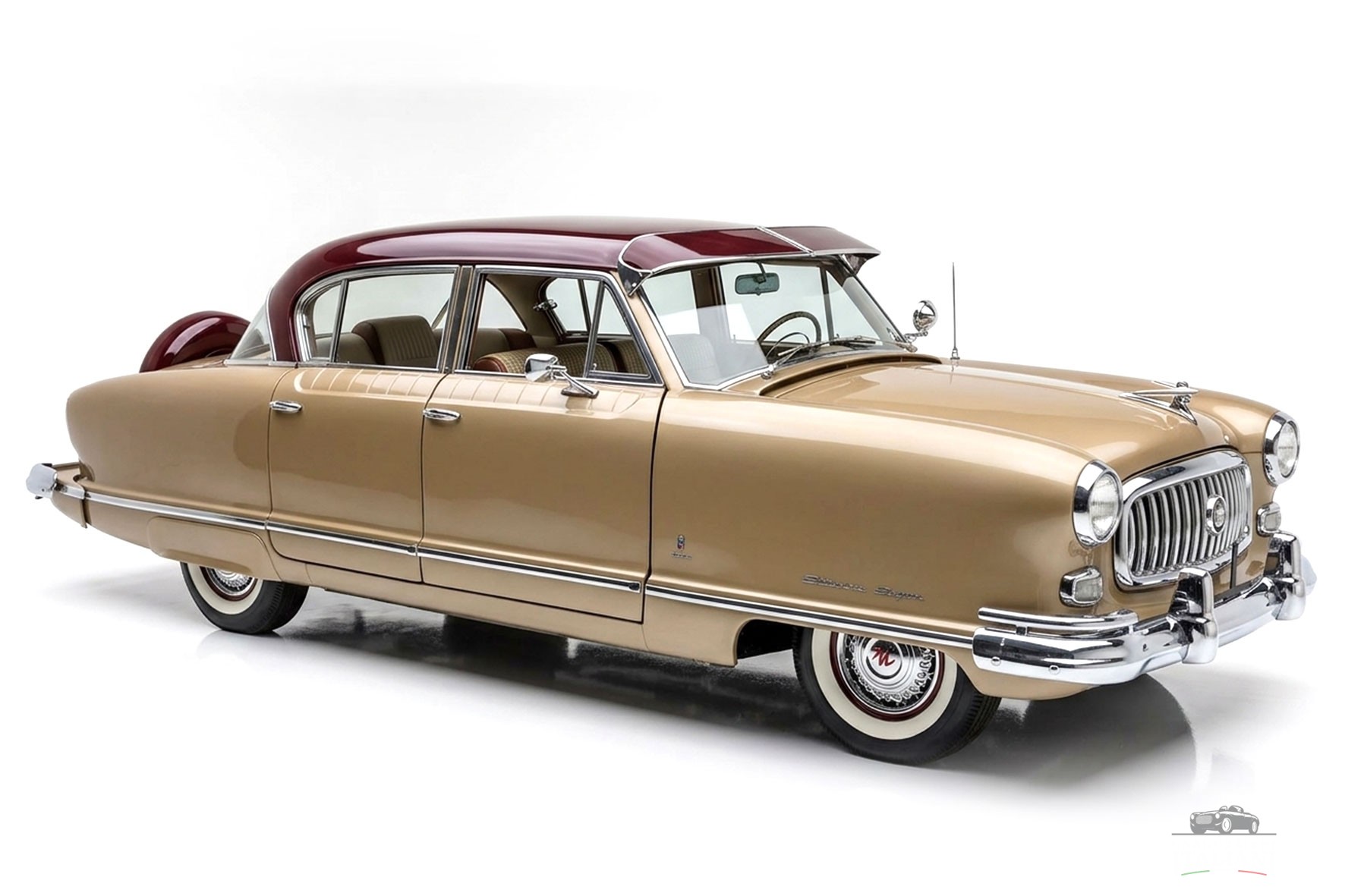
The Nash Airflyte Statesman (19521954) was a full-size American automobile produced by Nash Motors, notable for its distinctive design collaboration with Italian styling house Carrozzeria Pininfarina. This second generation of the Statesman marked a major departure from the bulbous “bathtub” styling of its 19491951 predecessor, introducing a more refined and internationally influenced aesthetic. The car was built on Nash’s unitized body structure, a hallmark of the company’s engineering philosophy, providing enhanced rigidity and reduced weight compared to traditional body-on-frame construction. The wheelbase measured 114.25 inches, and the model was positioned below the Ambassador in Nash’s lineup as a mid-range offering. The restyling by Pininfarina brought slimmer proportions and cleaner lines. The front fascia featured a redesigned vertical-bar grille and integrated headlamps, while the rear adopted subtle tailfins and a more streamlined deck. These changes modernized the appearance while preserving the aerodynamic principles central to Nash’s “Airflyte” branding. Pininfarina’s touch added European elegance to an otherwise conservatively engineered vehicle. Power was supplied by Nash’s 184 cubic inch (3.0-liter) inline-six L-head engine, producing 85 horsepower. The car came standard with a three-speed manual transmission, with optional overdrive and automatic “Hydra-Matic” sourced from General Motors. Though not a performance car, the Statesman emphasized ride comfort, fuel efficiency, and innovative features. Inside, the Statesman offered generous passenger space and several unique amenities. The most notable was the Airliner Reclining Seats system, which allowed the front seats to fold flat into a bed-like configuration. The dashboard was cleanly laid out with large, legible gauges, and upholstery was available in a variety of fabrics and finishes. Production of the Nash Statesman continued through the 1954 model year. The merger of Nash and Hudson in 1954 formed American Motors Corporation (AMC), and the Statesman name was retired shortly afterward. The 19521954 Nash Statesman remains significant as one of the earliest American automobiles to benefit from European design input, and one of the few examples of a mid-century transatlantic styling partnership influencing mainstream U.S. production cars.
02 / TECHNICAL IDENTITY
03 / DESIGN, BODY & SUPPLIERS
Coachbuilder / Design studio
Founded by Battista Pinin Farina in Turin in 1930, Pininfarina became one of the most influential Italian styling and coachbuilding houses, particularly through its work for Ferrari and other international manufacturers.
Explore record ↗04 / CHRONOLOGY
07 / GALLERY
THE CONVERSATION
Comments 0