
Pininfarina
Founded by Battista Pinin Farina in Turin in 1930, Pininfarina became one of the most influential Italian styling and coachbuilding houses, particularly through its work for Ferrari and other international manufacturers.
Explore record ↗
1931Coachwork by Pininfarina
THE VEHICLE AT A GLANCE
THE PEOPLE BEHIND THE CAR
Founded by Battista Pinin Farina in Turin in 1930, Pininfarina became one of the most influential Italian styling and coachbuilding houses, particularly through its work for Ferrari and other international manufacturers.
Explore record ↗01 / THE STORY
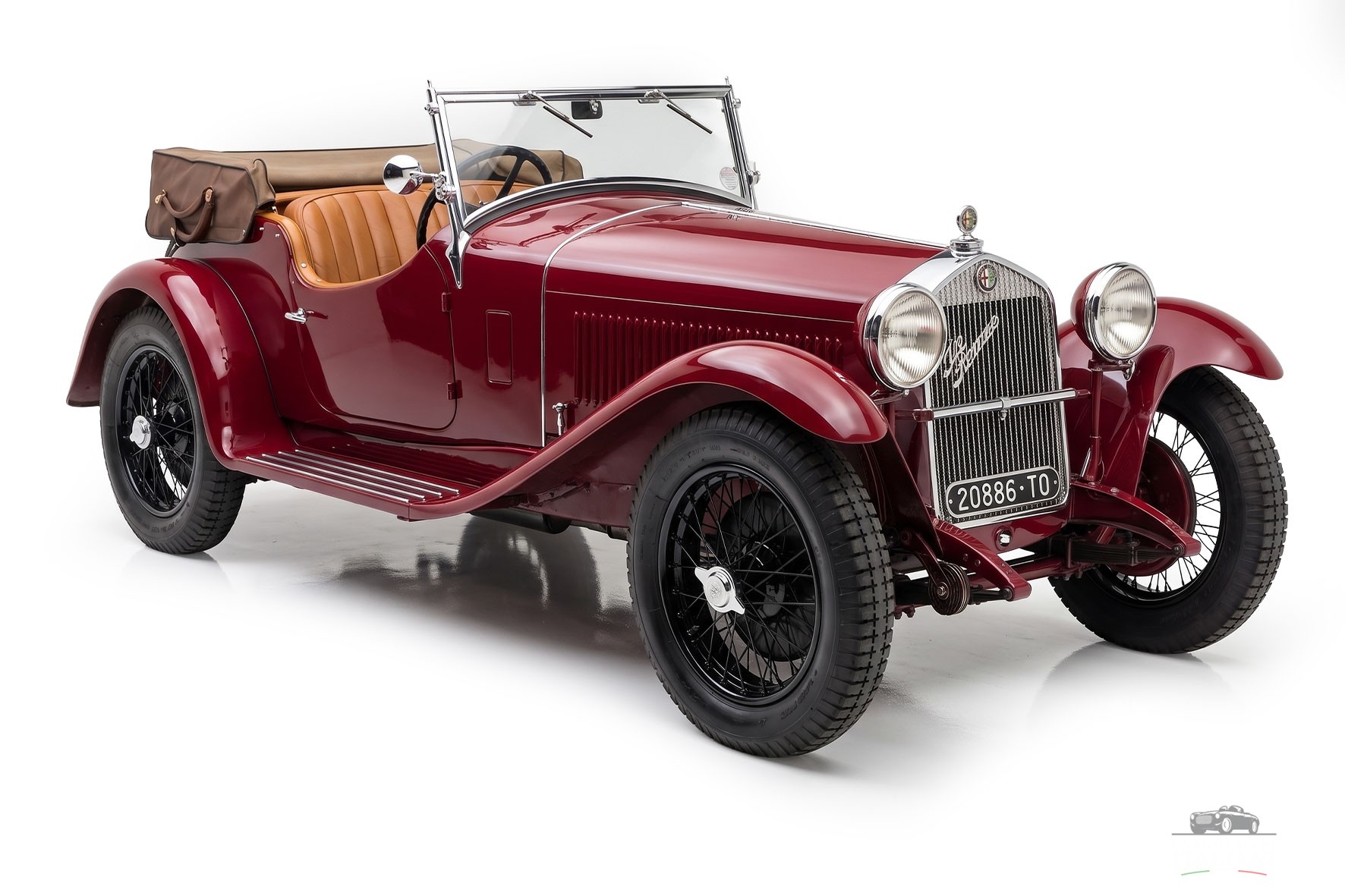
The Alfa Romeo 6C 1750 Cabriolet by Pinin Farina represents a one-off interpretation of the celebrated 6C 1750 Super Sport chassis, distinguished by its restrained execution and early signs of design departure. Built in the early 1930s, this two-seat open car was among the first major commissions executed at Pinin Farina’s Corso Trapani facility in Turin, a location that would soon become central to his coachbuilding operations. While the overall body retained the classical proportions and formal character typical of contemporary Alfa Romeo designs, it also revealed several key modifications that indicated a move toward greater stylistic clarity. The radiator and windscreen were inclined slightly, breaking with the strict verticality customary at the time. Running boards were shaped and integrated with the fenders in a manner that simplified the car’s side profile, a feature that would later become more widespread. A mesh covering protected both the radiator and the headlamps, a detail suggesting both a functional and aesthetic intent in line with the car’s sporting nature. Construction employed a traditional wooden substructure with steel plating bolted to the main chassis members. This technique, while standard for the period, was approaching obsolescence as all-metal body techniques began to emerge more broadly by the end of the decade. The vehicle thus occupies a transitional phase between pre-war coachbuilding practice and more modern forms of body construction. Mechanically, the 6C 1750 was powered by Alfa Romeo’s 1,752 cc inline-six engine, often fitted with a supercharger in Super Sport specification, delivering performance that placed the model among the most competitive sports cars of its class. Paired with a four-speed gearbox and a lightweight frame, the chassis was favored by private clients and racing entrants alike. The one-off Pinin Farina cabriolet remains notable not only for its rarity but also for the subtle innovations in body form and detail treatment, foreshadowing stylistic developments that would define Italian design in the postwar period.
02 / TECHNICAL IDENTITY
03 / DESIGN, BODY & SUPPLIERS
Coachbuilder / Design studio
Founded by Battista Pinin Farina in Turin in 1930, Pininfarina became one of the most influential Italian styling and coachbuilding houses, particularly through its work for Ferrari and other international manufacturers.
Explore record ↗07 / GALLERY
THE CONVERSATION
Comments 0