
Aurelio Lampredi
AT A GLANCE
- Born
- 1917-06-16
- Birthplace
- Livorno
- Died
- 1989-06-01
- Nationality
- Italian
- Occupation
- Engine designer and automotive engineer
- Active from
- 1937
- Based in
- Livorno / Maranello / Turin, Italy
THE STORY
Overview
Aurelio Lampredi (Livorno, 16 June 1917 – Livorno, 1 June 1989) was an Italian mechanical engineer and engine designer whose career extended from aircraft engineering to Ferrari racing engines, Fiat production powertrains and Abarth competition management. He is associated above all with Ferrari’s large-displacement V12 engines, its successful early-1950s racing four-cylinders and later Fiat four-cylinder families. Contemporary research also documents his involvement in the aerodynamic form of certain Ferrari sports-car bodies in 1953, a limited and specific styling contribution that should not be confused with the work of the coachbuilders responsible for executing the bodies.
Training and early work
Born in Livorno, Lampredi undertook technical training before entering the mechanical-engineering profession. Biographical accounts place his early employment at the Livorno shipyards and subsequently at Piaggio, where he worked in the period when Corradino D’Ascanio was a leading technical figure. During the Second World War he was involved in aircraft-engine development at Reggiane. These assignments preceded his better-known automotive career and help explain the emphasis on engineering efficiency, engine architecture and competition requirements in his later work.
Lampredi also contributed to the engineering programme of the postwar Isotta Fraschini 8C Monterosa, a rear-engined luxury-car project coordinated by Fabio Rapi. The Monterosa’s V8 power unit is attributed to Lampredi, while the car’s chassis concept and the coachwork of the surviving variants require separate attribution. The connection illustrates his involvement with an ambitious Italian manufacturer’s technical programme before and around his early Ferrari years; it does not imply that he designed the exterior bodies produced by Touring, Zagato or Boneschi.
Ferrari: V12 engines and racing four-cylinders
At Ferrari, Lampredi developed a family of larger-capacity V12 engines as an alternative to the smaller twelve-cylinder architecture associated with Gioachino Colombo. During the first half of the 1950s his engineering work helped shape Ferrari’s sports-racing and single-seater programmes, including the 340 and 375 families. José Froilán González’s victory at Silverstone in July 1951, Ferrari’s first Formula One World Championship Grand Prix victory, came with the 375 F1 powered by a Lampredi-developed V12.
Lampredi also designed the twin-overhead-camshaft inline-four used in Ferrari’s 500 F2. Alberto Ascari won the World Drivers’ Championship in 1952 and 1953 with the Ferrari 500, when Formula Two regulations provided the basis for championship Grand Prix racing. The same engineering school informed subsequent Ferrari four-cylinder sports cars, including the 500 Mondial and 750 Monza. Engine design and complete vehicle, chassis or body authorship remain distinct historical roles.
Experimental Ferrari body shapes in 1953
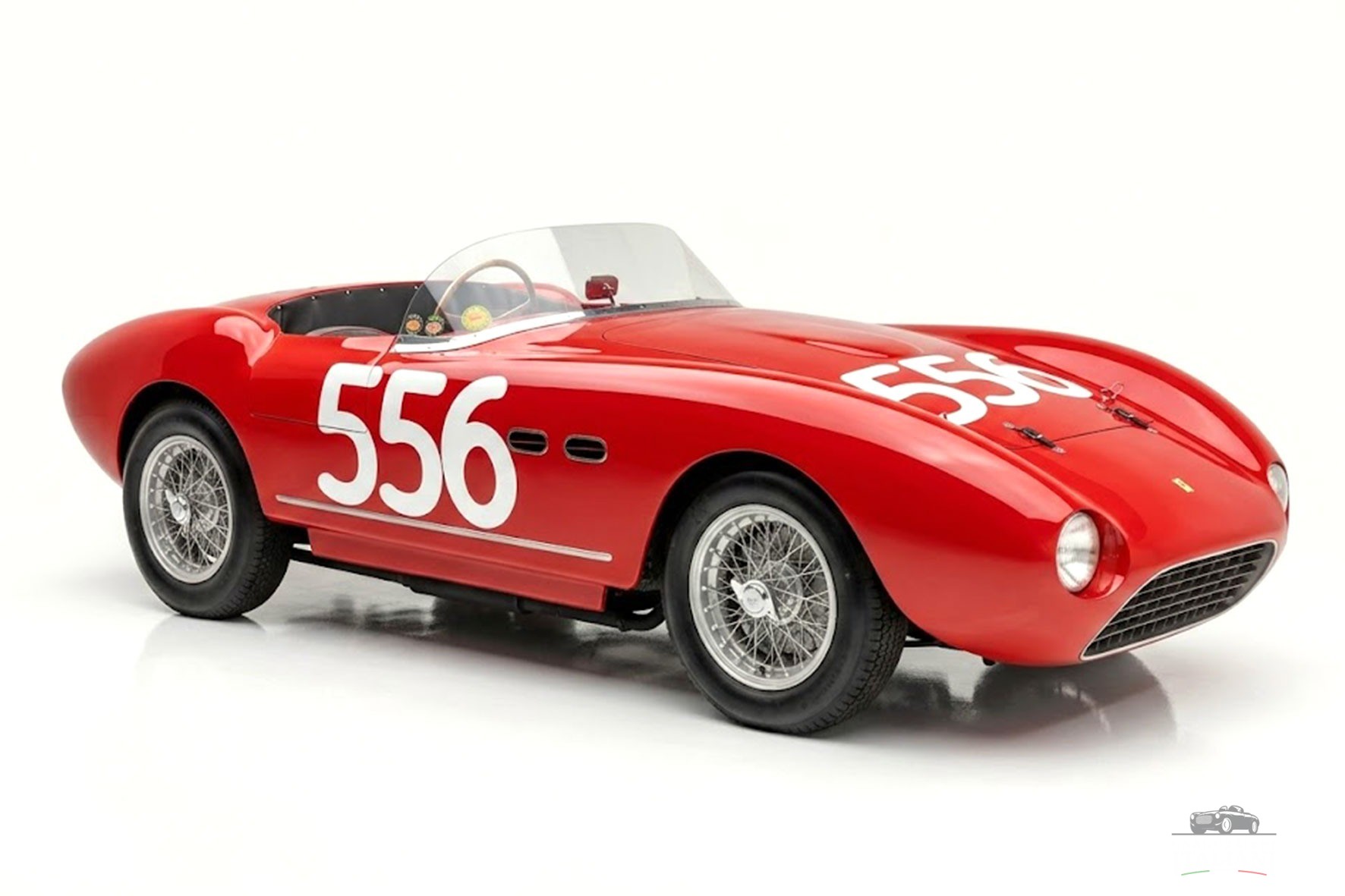
Although primarily a powertrain specialist, Lampredi directly investigated the body shape of Ferrari’s early sports-racing cars. An AISA historical monograph describes his work with Ferrari’s in-house panel specialists Pairetti and Fontanesi in February 1953 on a more penetrating nose profile for the 166 MM/53 programme, beginning with chassis 0264 M. The related Ferrari 166 MM/53 Spider, chassis 0272 M, was prepared for Alberico Cacciari and became one of the cars associated with his technical direction.
There is a significant attribution distinction. Some chassis histories and an RM Sotheby’s catalogue identify Lampredi with the design and describe Ferrari’s in-house body construction with possible Autodromo refinement. AISA’s reconstruction places greater emphasis on Sergio Scaglietti’s execution of chassis 0272 M under the direction of the Ferrari technical department. Lampredi’s role in the conception of the aerodynamic form is well supported, but these accounts do not provide a single uncontested coachbuilder attribution. The debate concerns a particular chassis and must not be extended to unrelated 166 MM or 735 S cars.
The same AISA research connects Lampredi with the striking experimental body of the Ferrari 625 TF generally identified in that account as 0302 TF. Its extreme nose profile was developed for aerodynamic purpose rather than conventional elegance, with Scaglietti undertaking the bodywork. Later work on four-cylinder Ferrari sports racers helped establish a distinctive collaboration between engineers, in-house metalworkers and Modenese coachbuilders. Descriptions of the experimental car’s chassis identity differ among publications; it remains a separate provenance problem from chassis 0272 M.
Fiat production engines and Abarth
After leaving Ferrari in the mid-1950s, Lampredi joined Fiat, where he worked on engines for series-production cars. His projects included overhead-camshaft four-cylinder engines and the celebrated Fiat twin-cam family. A Fiat Heritage account published in September 2026 specifically attributes the original 1,197 cc engine of the 1966 Fiat 124 saloon to him; that pushrod engine should not be conflated with the later twin-cam unit fitted to sporting derivatives of the 124 family.
For the Fiat 124 Sport Spider, contemporary Fiat historical material identifies Lampredi as the designer of the 1.4-litre twin-overhead-camshaft four-cylinder introduced in 1966, with belt-driven camshafts and an aluminium crossflow cylinder head. Pininfarina’s body design and construction were separate responsibilities. Variants of Lampredi’s powertrain architecture subsequently served several Fiat and Lancia road and competition applications, including programmes associated with the Fiat 131 Abarth. Lampredi held senior responsibilities within Abarth during the 1970s and up to 1982.
Historical significance and crediting practice
Lampredi’s career connected high-performance engine development, long-lived mass-production engineering and the aerodynamics of racing cars. The Ferrari 500 F2 and the Fiat twin-cam family represent distinct scales of achievement, while the 1953 Ferrari sports-body experiments show that engineering leadership could also influence external form. His name belongs in the engine-designer or engineering role for the relevant mechanical programmes, and in an explicitly qualified body-design role only where a particular Ferrari chassis is supported by documented historical evidence. A designer credit for Lampredi should never automatically displace the documented coachbuilder or stylist of a complete automobile.
THE NETWORK
Shared vehicle credits

KEY MOMENTS
Timeline
-
Birth of Aurelio Lampredi
Livorno, Italy
-
Career begins
-
Career ends
-
Death of Aurelio Lampredi
Livorno, Italy
CONTINUE EXPLORING
THE CONVERSATION
Comments 0