
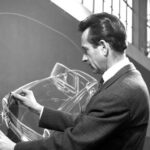
Giovanni Michelotti
Giovanni Michelotti was a prolific Italian automotive designer whose independent Turin studio produced coachwork and production-car designs for Vignale, Triumph, BMW and numerous other manufacturers.
Explore record ↗
1955Coachwork by Boano
THE VEHICLE AT A GLANCE
THE PEOPLE BEHIND THE CAR
Giovanni Michelotti was a prolific Italian automotive designer whose independent Turin studio produced coachwork and production-car designs for Vignale, Triumph, BMW and numerous other manufacturers.
Explore record ↗Carrozzeria Boano was a Turin coachbuilding enterprise associated with Mario Felice Boano, whose managerial and production experience connected the firm to Italy’s post-war tradition of bespoke GT bodies.
Explore record ↗01 / THE STORY
In 1955 Carlo Abarth and Carrozzeria Boano explored a small family of sports cars aimed in particular at the American market. The best known members were the racing 207 A Spyders, but the programme also included two road-going interpretations. One was an open 208 A; the other was the 209 A Coupé, built only once. Chassis 006 is preserved in the Louwman Museum collection in The Hague, giving this unusual chapter in Abarth history a surviving, identifiable reference point.
The 209 A was conceived as a compact grand tourer rather than a conventional Fiat-bodied conversion. Its pressed-steel box-section frame carried lightweight aluminium coachwork, while much of the mechanical package derived from the Fiat 1100 and was developed by Abarth. Specialist technical documentation describes a 1,089 cc overhead-valve four-cylinder engine with twin Weber carburettors, producing approximately 66 bhp at 6,000 rpm, a four-speed manual gearbox and rear-wheel drive. Its quoted wheelbase is 2,050 mm, although the museum summarises the dimension as approximately two metres. Those specifications belong to the unique coupé, not to the number of cars in the Boano-Abarth programme.
The body was unmistakable. Broad wings framed the low bonnet, discreet retractable headlamps were incorporated into the nose, and the right-hand side carried a conspicuous polished-steel exhaust. Curved panoramic glazing and a two-colour finish helped the coupé stand apart from the competition-oriented 207 A, despite their related technical origins. The Louwman Museum describes twelve vehicles in the overall Boano-Abarth project, including ten racing cars and two road-going examples. That is a family total: the 209 A itself was a one-off.
The individual styling credit is less settled than the identity of the car. The Louwman Museum attributes the design to Mario Boano, while specialist coachbuilding literature identifies Giovanni Michelotti. Both sources agree on Boano as the coachbuilder. Without a dated original design drawing or an archival commission assigning the roles, these divergent attributions should remain visible rather than being resolved merely by choosing one reference. Mario Felice Boano’s management of the workshop must also be distinguished from the specific hand responsible for the original styling.
Specialist histories associate the 209 A with the 1955 Turin motor show and a later appearance in Chicago. Accounts also refer to a Geneva showing, but the chronology of those exhibition appearances has not been fully reconciled against original catalogues. The car was subsequently sold to an owner from the Chicago area, whose name is not established in the accessible histories. It later joined Peter Kaus’s Rosso Bianco Collection in Germany and eventually became part of the Louwman Collection, where its original character has been preserved.
Unlike individual 207 A competition cars, which have recorded race results and more recent auction transactions, chassis 006 has no independently authenticated sale price in the sources examined here. Its significance lies instead in the existence of this singular road-going coupé: an Italian interpretation of a compact American-market sports GT, conceived alongside Abarth’s early experiments in competition-car manufacture and preserved as a distinct vehicle in its own right.
02 / TECHNICAL IDENTITY
03 / DESIGN, BODY & SUPPLIERS
Coachbuilder / Design studio
Carrozzeria Boano was a Turin coachbuilding enterprise associated with Mario Felice Boano, whose managerial and production experience connected the firm to Italy’s post-war tradition of bespoke GT bodies.
Explore record ↗Designer
Giovanni Michelotti was a prolific Italian automotive designer whose independent Turin studio produced coachwork and production-car designs for Vignale, Triumph, BMW and numerous other manufacturers.
Explore record ↗04 / CHRONOLOGY
05 / PEOPLE, COLLECTIONS & MUSEUMS
07 / CHASSIS REGISTER
08 / GALLERY

THE CONVERSATION
Comments 0