
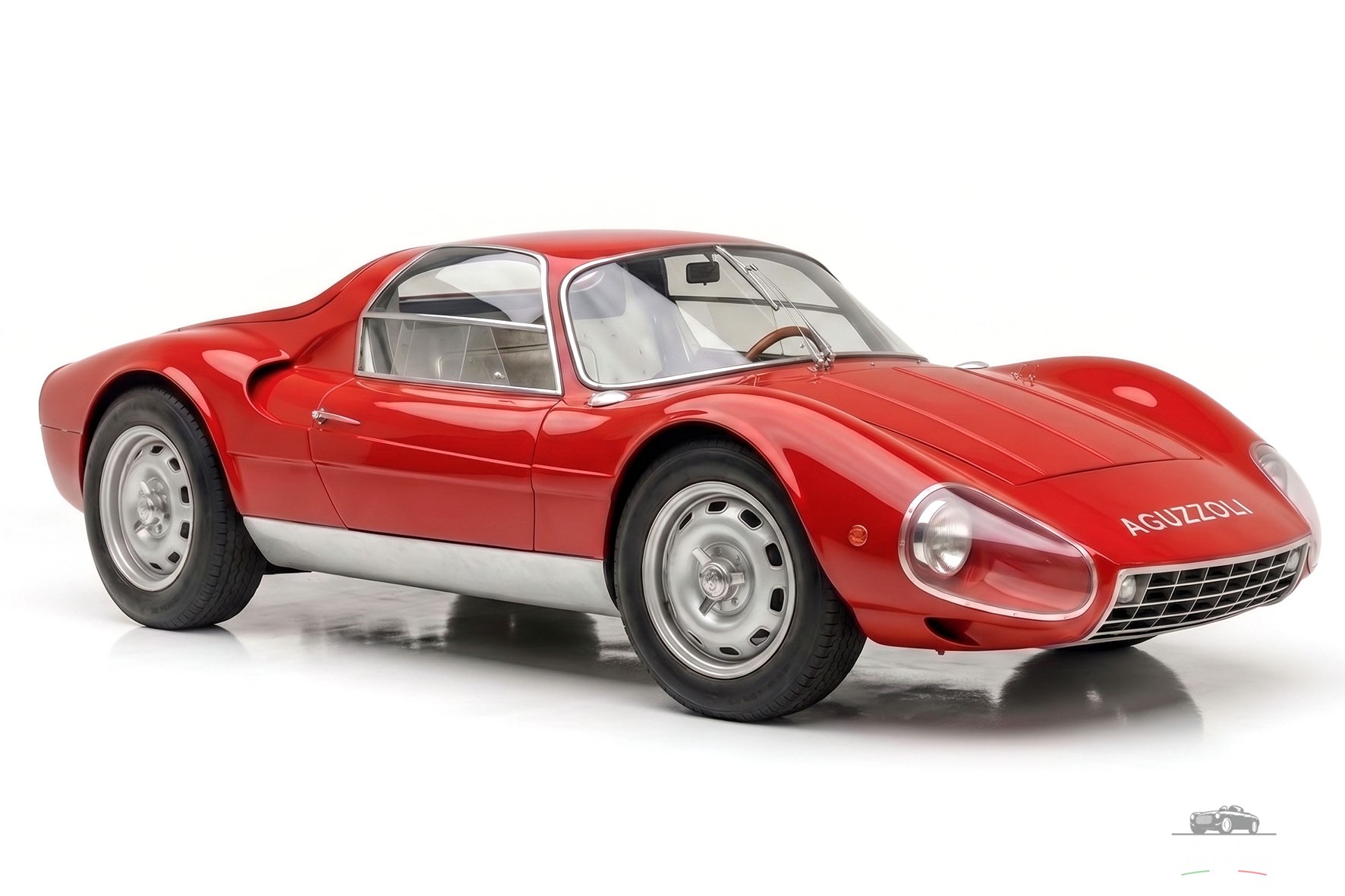
THE VEHICLE AT A GLANCE
Model dossier
- Manufacturer
- Aguzzoli
- Base model
- Condor
- Coachbuilt version
- Two-car competition programme; Mk1 Drogo, Mk2 Reggiani role split
- Coachbuilder
- Sports Cars
- Production period
- 1963
- Body style
- Coupé
- Attributed designer
- Piero Drogo
THE PEOPLE BEHIND THE CAR
Coachbuilding, design & conversions
01 / THE STORY
History & context
The Aguzzoli Condor, born from the ingenuity of Giovanni and Sergio Aguzzoli, represents a remarkable chapter in automotive history. Built on the chassis of an Alfa Romeo Giulia TZ and powered by the Giulietta SZ engine, this vehicle was baptized “Aguzzoli” after the dealership and “Condor” as a tribute to Sergio Aguzzoli himself. The journey of the Condor began with promising test runs at the Modena Autodrome in autumn 1963, conducted by Luigi Bertocco, yielding encouraging results that propelled its entry into the prestigious Coppa Fisa at Monza on November 14, 1963. This event marked the debut not only of the Condor but also of the Alfa Romeo Giulia TZ series. Despite a last-minute change where the designated driver opted for a different vehicle, the Condor captivated Alfa Romeo’s Experimental Department with its mechanical prowess, sparking discussions of potential racing development. While Alfa Romeo had considered establishing a racing department with Aguzzoli, the partnership eventually materialized with Autodelta, founded by engineer Carlo Chiti and the Chizzola brothers. Nevertheless, undeterred, another chassis was prepared to advance the Condor project further. The second iteration featured the Alfa Romeo Giulia TZ engine, a Hewland gearbox, and a fiberglass body designed by sculptor Franco Reggiani in Sant’Ilario d’Enza and built by Drogo Carrozzeria Sports Cars. Painted black with red accents and adorned with red leather interiors, it debuted at the Paris Motor Show before hitting the streets for testing. However, initial road tests revealed issues with the front end’s aerodynamics, prompting modifications to raise the frontal profile and introduce a conventional air intake. Re-painted in red and fitted with new 14-inch wheels, the revised Condor demonstrated improved performance and aesthetics. The debut of both the original and revised Condor models at the Trento-Bondone hill climb in July 1964 showcased their potential, with Luigi Bertocco and Umberto Masetti achieving notable finishes. Success continued at subsequent events, culminating in a significant victory at the Coppa Fisa in December 1964, where Ernesto Brambilla and Bertocco secured podium positions. Despite challenges in early 1965, including setbacks at the Monza 1000 Km race, the Condor persevered. The 1730cc engine upgrade proved pivotal, leading to a triumphant showing at the Castione Baratti – Neviano Arduini hill climb in June 1965, where Bertocco defeated the formidable Abarth 2000 models, marking a historic moment for Aguzzoli and the Condor legacy.
02 / TECHNICAL IDENTITY
Specifications & construction
Production & construction
- Production
- 2
- Production type
- Limited
03 / DESIGN, BODY & SUPPLIERS
Design, body & suppliers
Coachbuilder / Design studio

Sports Cars
Founded in Modena by former racing driver Piero Drogo, Carrozzeria Sports Cars built specialist bodies for Ferrari and other Italian competition-car manufacturers during the 1960s.
Explore record ↗Attributed designer
Body form & construction
- Body style
- Coupé
07 / GALLERY
THE CONVERSATION
Comments 0