Carlo Gaino
Carlo Gaino is a Turin-born automotive and industrial designer, co-founder of Synthesis Design, associated with the Maserati Barchetta and De Tomaso Guarà.
Explore record ↗
1993Coachwork by Synthesis Design
THE VEHICLE AT A GLANCE
THE PEOPLE BEHIND THE CAR
Carlo Gaino is a Turin-born automotive and industrial designer, co-founder of Synthesis Design, associated with the Maserati Barchetta and De Tomaso Guarà.
Explore record ↗Founded in Turin in 1988 by Carlo and Giorgio Gaino, Synthesis Design works across automotive, nautical and product design, with projects linked to Maserati, De Tomaso and Lancia.
Explore record ↗01 / THE STORY
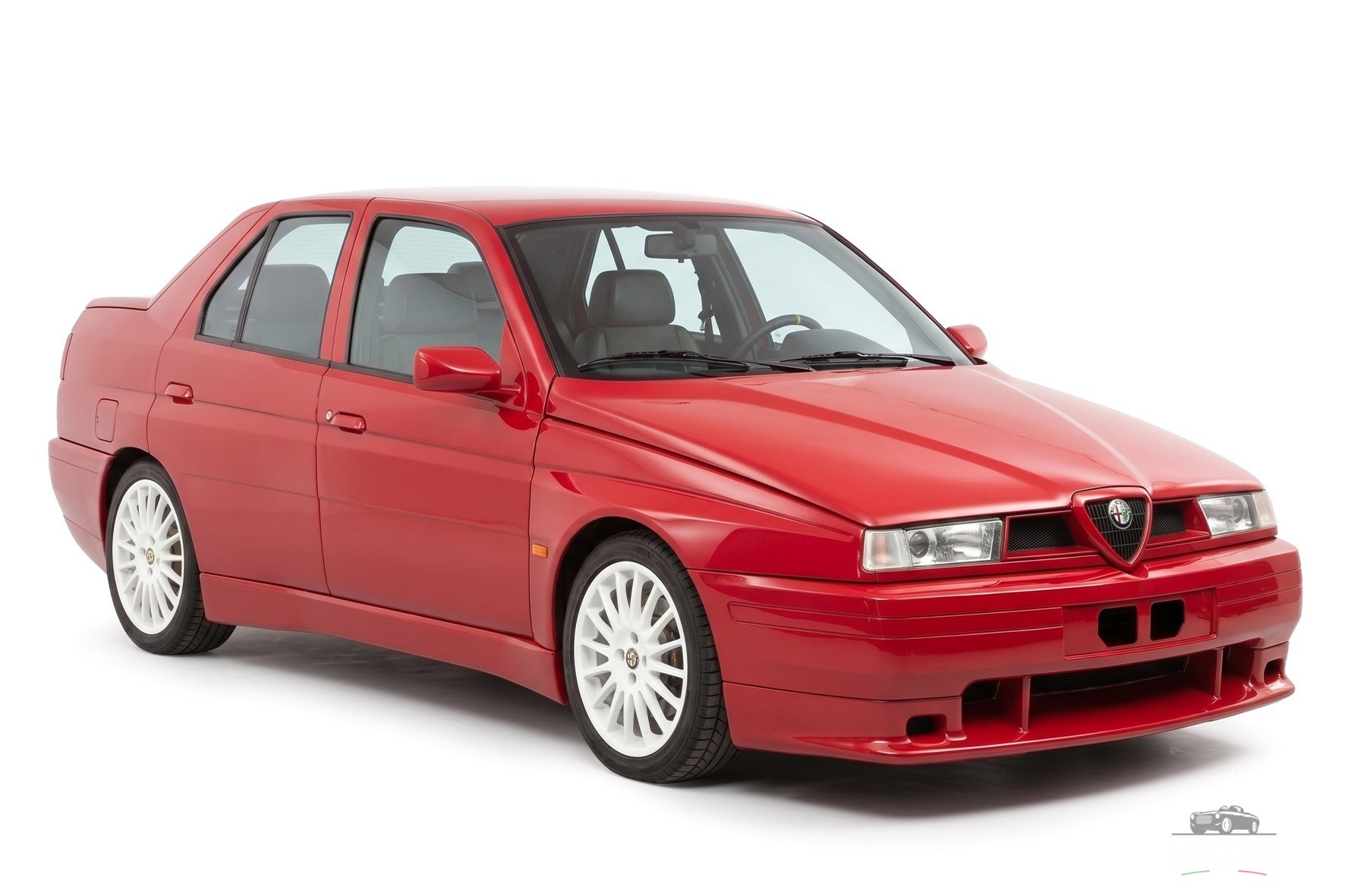
The Alfa Romeo 155 GTA Stradale (1993) is the sole four-door sports saloon prototype built by Abarth for Alfa Romeo as a possible road-going derivative of the 155 touring-car programme. The surviving vehicle is identified by chassis number ZAR16700000005892 in Bonhams’ 2018 catalogue. Although production of a limited series was considered, only this prototype was completed.
The project followed the successes of Alfa Romeo’s competition 155, notably the 1992 Italian touring-car championship and 1993 DTM title. These achievements belonged to racing versions, not the Stradale. Engineer Sergio Limone supervised the development at Abarth, using the Alfa Romeo 155 Q4 as its mechanical starting point. The intended road car would have competed with contemporary high-performance saloons. Management ultimately rejected a separate low-volume production line and reportedly preferred a more powerful six-cylinder engine, which could not be accommodated readily with the existing four-wheel-drive package.
The body retained the four-door silhouette but gained flared wheel arches, modified front and rear bumpers, extended sills and a prominent rear spoiler. The cabin was trimmed in black leather and fitted with shaped sports seats. Independent design research attributes the modified styling to Carlo Gaino at Synthesis Design, but the available original auction catalogue identifies Abarth’s construction work without confirming an individual stylist. That styling credit remains a qualified attribution, separate from the documented engineering responsibility.
The engine and transmission were based on the turbocharged Alfa Romeo 155 Q4, itself closely related to the first-generation Lancia Delta HF Integrale. The Stradale used an approximately two-litre, sixteen-valve four-cylinder engine, not the V6 of some contemporary racing 155 models. Quattroruote reports 190 CV at 6,000 rpm, a Garrett T3 turbocharger, air-to-air intercooler and five-speed manual transmission. This is a published specification rather than an independent dynamometer test of the individual car.
Its permanent all-wheel-drive system incorporated a cast-iron rear differential housing, rather than the aluminium casing of the Lancia application, modifying the distribution of mass. Bonhams described the engine as prepared to Group N specification and the suspension as incorporating changes related to the Delta Integrale. The specific transmission and suspension details belong to the Stradale prototype and should not be assigned to unrelated Alfa Romeo 155 variants.
Chassis ZAR16700000005892 was exhibited at the 1994 Bologna Motor Show. During the 1994 Italian Grand Prix at Monza it served as a medical car, carrying FIA medical officer Sid Watkins. Neither appearance represents a race entry or an award for the prototype. The car’s connection with Alfa Romeo’s touring-car successes was conceptual and technical rather than a record of its own competition results.
The subsequent history described by Bonhams places the vehicle in Tony Fassina’s Milan workshop for about four years before it was acquired by an acquaintance and taken to Germany, where it was first registered. It returned to Italy in 1999 and entered the collection of an Alfa Romeo engine specialist in the Marche region. The rear spoiler had been reconstructed by the time of the 2018 catalogue, which recorded approximately 40,000 kilometres and referred to a letter from Limone attesting to its originality. A workshop association is not, by itself, proof of legal ownership.
Bonhams listed the prototype as lot 23 for the Padua auction scheduled on 27 October 2018. It was withdrawn before bidding after a private sale was arranged. The private transaction amount was not publicly confirmed; consequently, the auction produced no hammer price for this vehicle.
02 / TECHNICAL IDENTITY
03 / DESIGN, BODY & SUPPLIERS
Coachbuilder / Design studio
Founded in Turin in 1988 by Carlo and Giorgio Gaino, Synthesis Design works across automotive, nautical and product design, with projects linked to Maserati, De Tomaso and Lancia.
Explore record ↗Attributed designer
Carlo Gaino is a Turin-born automotive and industrial designer, co-founder of Synthesis Design, associated with the Maserati Barchetta and De Tomaso Guarà.
Explore record ↗04 / CHRONOLOGY
07 / GALLERY
CONTINUE EXPLORING


THE CONVERSATION
Comments 0