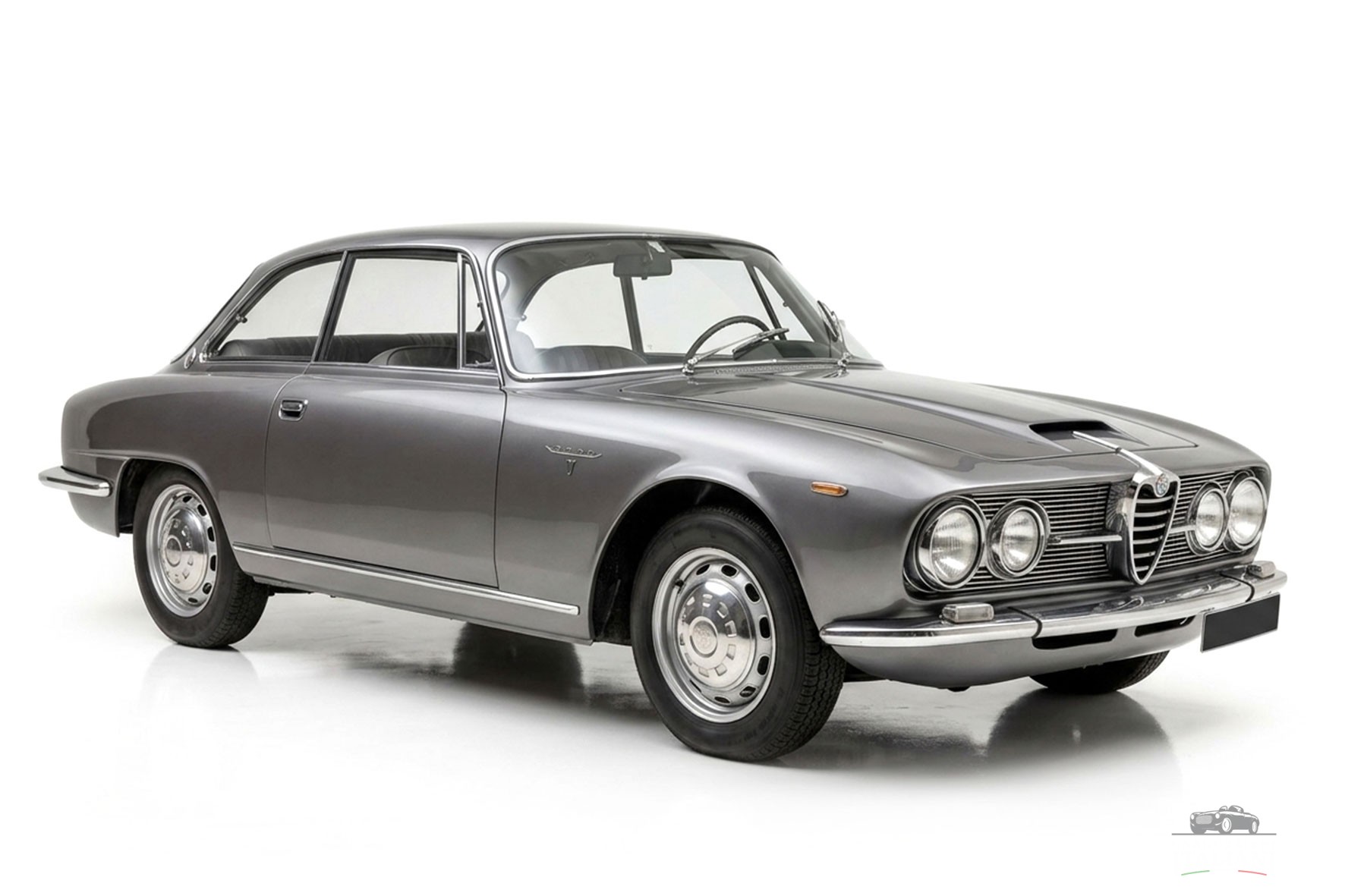
Introduced in 1962, the Alfa Romeo 2600 Sprint was a six-cylinder grand-touring coupé styled by Giorgetto Giugiaro at Carrozzeria Bertone. The 2600 range made its debut at the 1962 Geneva Motor Show. It developed the design of the earlier 2000 Sprint, which had established Giugiaro’s association with Alfa Romeo at the Turin coachbuilder. The 2600 Sprint was a series-production model rather than a one-off show car. Alfa Romeo’s published production total for 1962–1966 is 6,999 examples.
Design and coachwork
The 2600 Sprint retained the predecessor’s broad proportions: a long bonnet, four headlamps integrated within the wide front grille, relatively slender roof pillars and a restrained, nearly finless rear. The principal visible alteration was a new air intake in the bonnet to accommodate the six-cylinder powerplant. Chrome trim accentuated the clean flanks, while the rear wheel openings and recessed tail panel provided continuity with the 2000 Sprint. Its design also belongs to the Bertone lineage that included the earlier Giulietta Sprint and subsequently influenced the Giulia GT.
The two-door body employed steel unitary construction, with a 2,580 mm wheelbase. The manufacturer’s published dimensions were 4,580 mm long, 1,706 mm wide and 1,380 mm high, with a listed weight of 1,370 kg. These figures describe the 2600 Sprint model and should not be assigned automatically to individual modified or coachbuilt examples. The four-place interior combined separate front seats with a smaller rear bench, a three-instrument driver’s panel and a padded dashboard. Period descriptions also mention optional leather trim, air conditioning and other comfort equipment.
Six-cylinder engineering
Power came from Alfa Romeo’s 2,584 cc, chain-driven twin-cam inline-six with an alloy block and cylinder head, two valves per cylinder and three twin-choke carburettors. The manufacturer’s specification gives 145 CV at 5,900 rpm and 18.8 kgm of torque at 2,000 rpm. Drive went to the rear wheels through a five-speed manual gearbox and a single dry-plate clutch. The front suspension used wishbones and coil springs, while the rear retained a live axle located by links and coil springs. Alfa Romeo quoted a maximum speed of 197 km/h.
Disc brakes were initially fitted at the front, with rear discs introduced later in production. This development distinguishes early and later examples, so brake configurations should be established from the specification and history of a particular car rather than assumed from the model name. The related 2600 Spider shared the six-cylinder generation but had separate open coachwork and its own body dimensions.
Production and service
The 2600 Sprint was designed principally for road use and long-distance touring. Its competition history was limited compared with Alfa Romeo’s lighter Giulia derivatives. Some specially equipped cars entered Italian police service and became associated with the “Pantera” patrol-car tradition. The 2600 Sprint reached a broad clientele for an Italian six-cylinder coupé. Equipment and later service histories differed between individual cars and require chassis-level documentation.


THE CONVERSATION
Comments 0