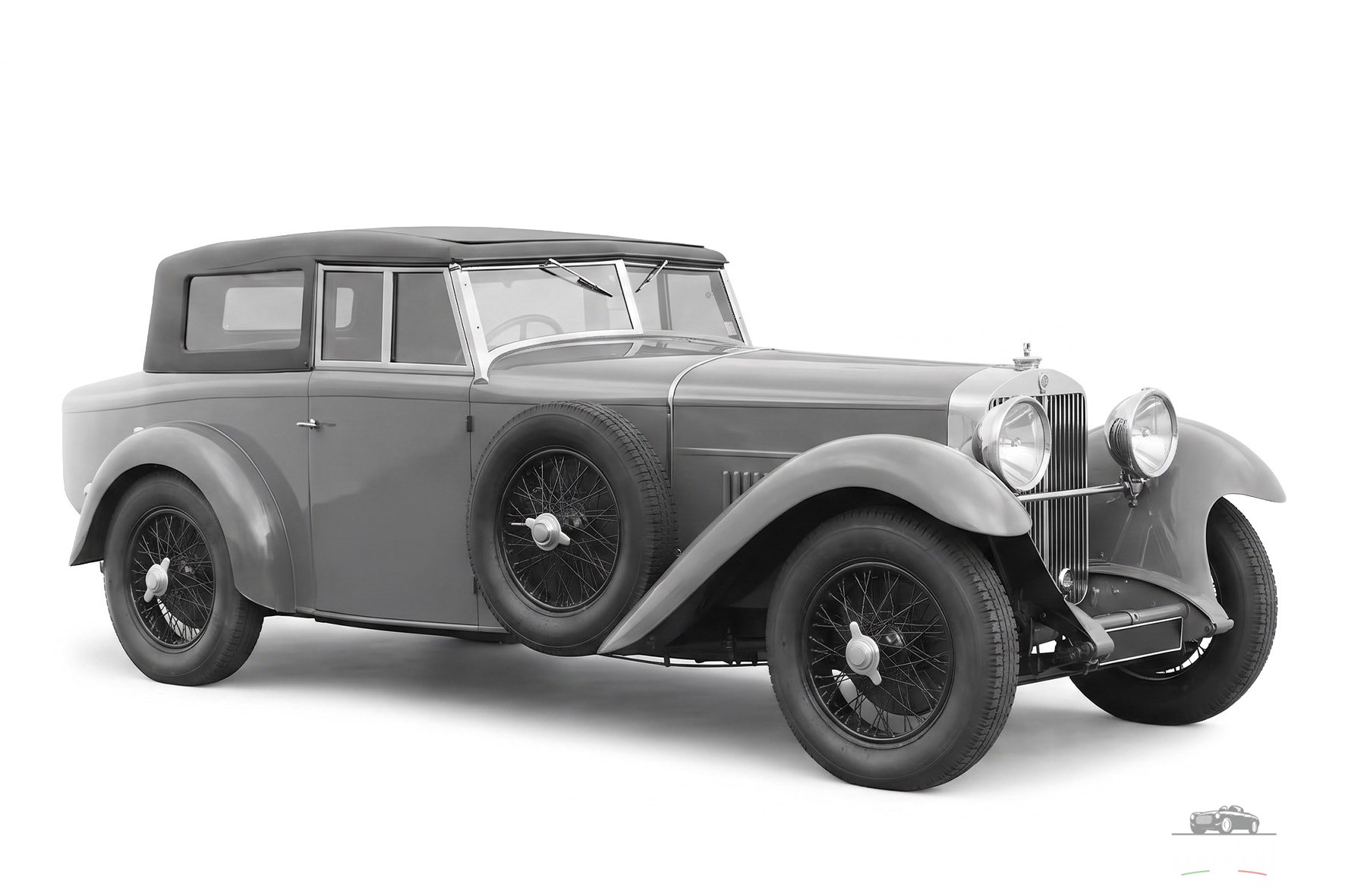
The Alfa Romeo RL Super Sport, introduced in 1922, was developed as the high-performance evolution of the RL model first presented by the marque in 1921. Designed by Giuseppe Merosi, the RL SS featured a shortened wheelbase, lighter chassis, and higher-output engine compared to the standard and Turismo variants. It was conceived for competitive use, and its mechanical configuration formed the foundation for several coachbuilt variants, including a one-off coupé created by Carrozzeria Bertone in the early years of the firm’s independent activity. This particular example, executed by Bertone in 1922, was based on the RL SS chassis equipped with a 2,994 cc inline-six engine. The engine, an overhead-valve design with a cast iron block and aluminium crankcase, was capable of delivering approximately 71 to 83 horsepower depending on tuning. The engine was coupled to a four-speed manual gearbox. The RL SS featured semi-elliptic leaf spring suspension and mechanical brakes on all four wheels. The shortened chassis was intended to reduce weight and enhance agility, making it more suitable for competition and grand touring applications. Bertone’s coachwork for the RL SS comprised a two-seat open body in the sporting tradition of the early 1920s. The design included pontoon-style wings, an inclined windscreen, and a slim body profile, reflecting both aerodynamic concerns and the evolving formal language of Italian sporting cars. The result was a compact yet elegant car suited for road and endurance events. While the majority of RL SS examples were bodied by Zagato and Castagna, the Bertone-bodied specimen remained unique and did not enter series production. Approximately 2,640 Alfa Romeo RL units were built in total between 1922 and 1927, with 392 produced in the Super Sport configuration. The Bertone-bodied RL SS is not known to have survived, and no surviving chassis has been definitively linked to this one-off.


THE CONVERSATION
Comments 0