
Sibona & Basano
Active in Turin during the 1960s, Sibona & Basano built specialist bodies and prototypes for Abarth and other marques, combining skilled fabrication with external design collaborations.
Explore record ↗
1965Coachwork by Sibona & Basano
THE VEHICLE AT A GLANCE
THE PEOPLE BEHIND THE CAR
Active in Turin during the 1960s, Sibona & Basano built specialist bodies and prototypes for Abarth and other marques, combining skilled fabrication with external design collaborations.
Explore record ↗Pio Manzu \(1939-1969\), trained at the Ulm School of Design, developed the Autonova concepts before joining Fiat as a consultant. His projects included the 1968 City Taxi and the original design of the Fiat 127, launched after his death in 1971.
Explore record ↗01 / THE STORY
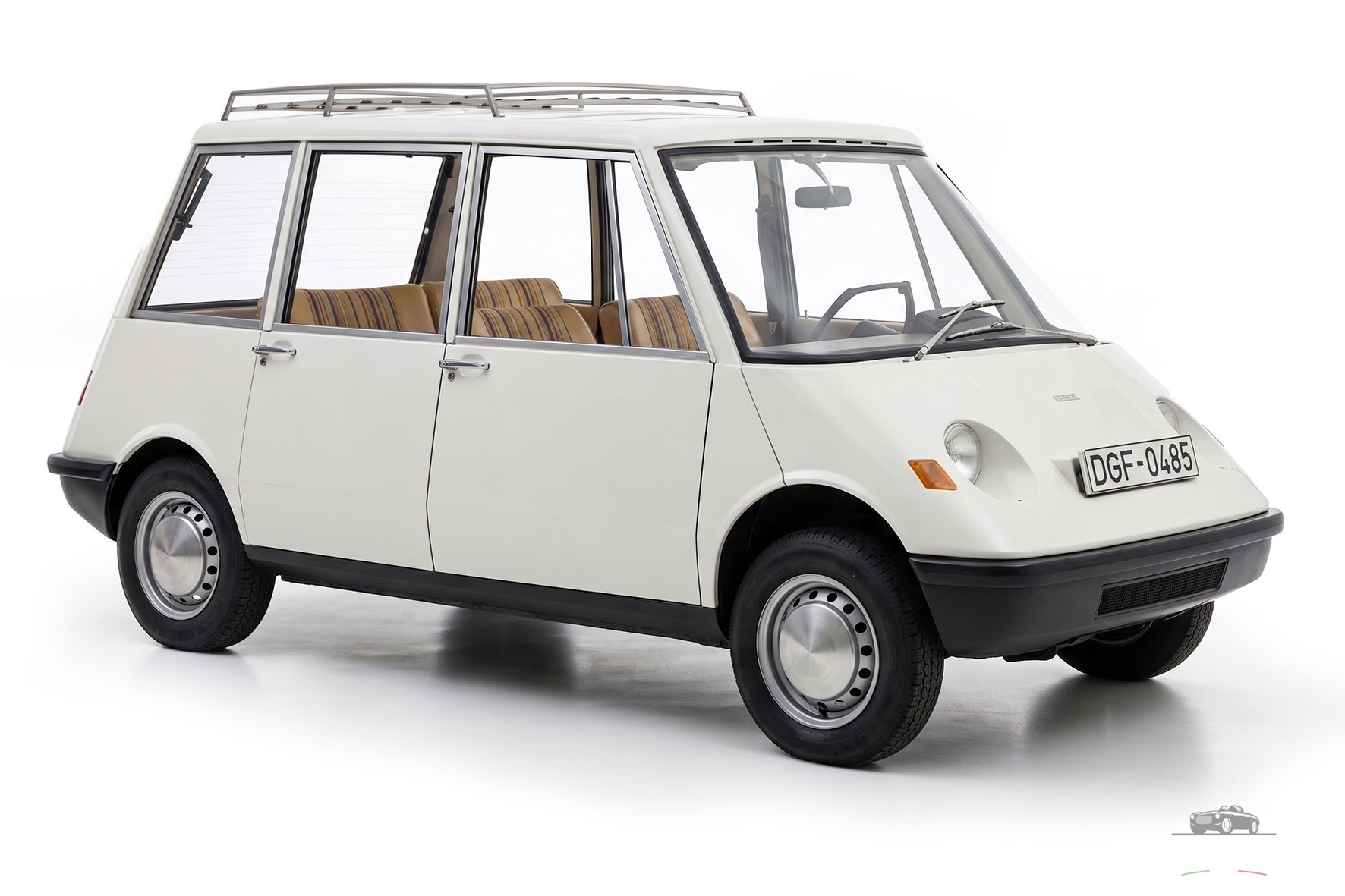
The Autonova Fam: Reflecting the guidelines of the Autonova project, the Fam (a contraction of familiare, i.e. a station wagon) was intended to be versatile, “logical in every detail”, as Pio Manzù and Michael Conrad were careful to note, a car for the community. It was compact outside (3.5 meters long and 1.6 wide) but offered plenty of room inside. This was achieved by making the most of the height, 1600 mm. The engine hood and trunk were absorbed into a single volume with a trapezoidal form. The cabin was lined with large windows and accommodated up to five passengers. It could be adapted to take different kinds of loads since all the seats were independent and the backs folded over. The raised driving position and height off the ground were considered significant factors making for comfort and safety on board. The technical features of the Autonova Fam anticipated certain ideas that have only recently been adopted on a large scale by the automobile industry. They included automatic electro hydraulic transmission, height adjustable suspension and progressive action steering. Of the Autonova’s numerous functional and technical-constructional features, the most striking were its rigorous formal synthesis, the simple, “modern” design of its different parts, from the lines that unite or segment the different sections of the body down to individual details like handles and switches and the most minute seams and welds. Both the Autonova prototypes are still surprising for their originality and coherence, even after this lapse of time. Pio Manzù and Michael Conrad’s project can still be seen as an exemplary contribution to the evolution of the automobile and car design, not only because of the results they achieved but also in terms of method and the development of radically innovative contents. The body was built by italian coachbuilder Sibona Basano.
02 / TECHNICAL IDENTITY
03 / DESIGN, BODY & SUPPLIERS
Coachbuilder / Design studio
Active in Turin during the 1960s, Sibona & Basano built specialist bodies and prototypes for Abarth and other marques, combining skilled fabrication with external design collaborations.
Explore record ↗Designer
Pio Manzu \(1939-1969\), trained at the Ulm School of Design, developed the Autonova concepts before joining Fiat as a consultant. His projects included the 1968 City Taxi and the original design of the Fiat 127, launched after his death in 1971.
Explore record ↗Become a Pro member to see the full details in this section.
Membership is not available yet.
View membership options07 / GALLERY
THE CONVERSATION
Comments 0