
Sibona & Basano
Active in Turin during the 1960s, Sibona & Basano built specialist bodies and prototypes for Abarth and other marques, combining skilled fabrication with external design collaborations.
Explore record ↗
1964Coachwork by Sibona & Basano
THE VEHICLE AT A GLANCE
THE PEOPLE BEHIND THE CAR
Active in Turin during the 1960s, Sibona & Basano built specialist bodies and prototypes for Abarth and other marques, combining skilled fabrication with external design collaborations.
Explore record ↗Pio Manzu \(1939-1969\), trained at the Ulm School of Design, developed the Autonova concepts before joining Fiat as a consultant. His projects included the 1968 City Taxi and the original design of the Fiat 127, launched after his death in 1971.
Explore record ↗01 / THE STORY
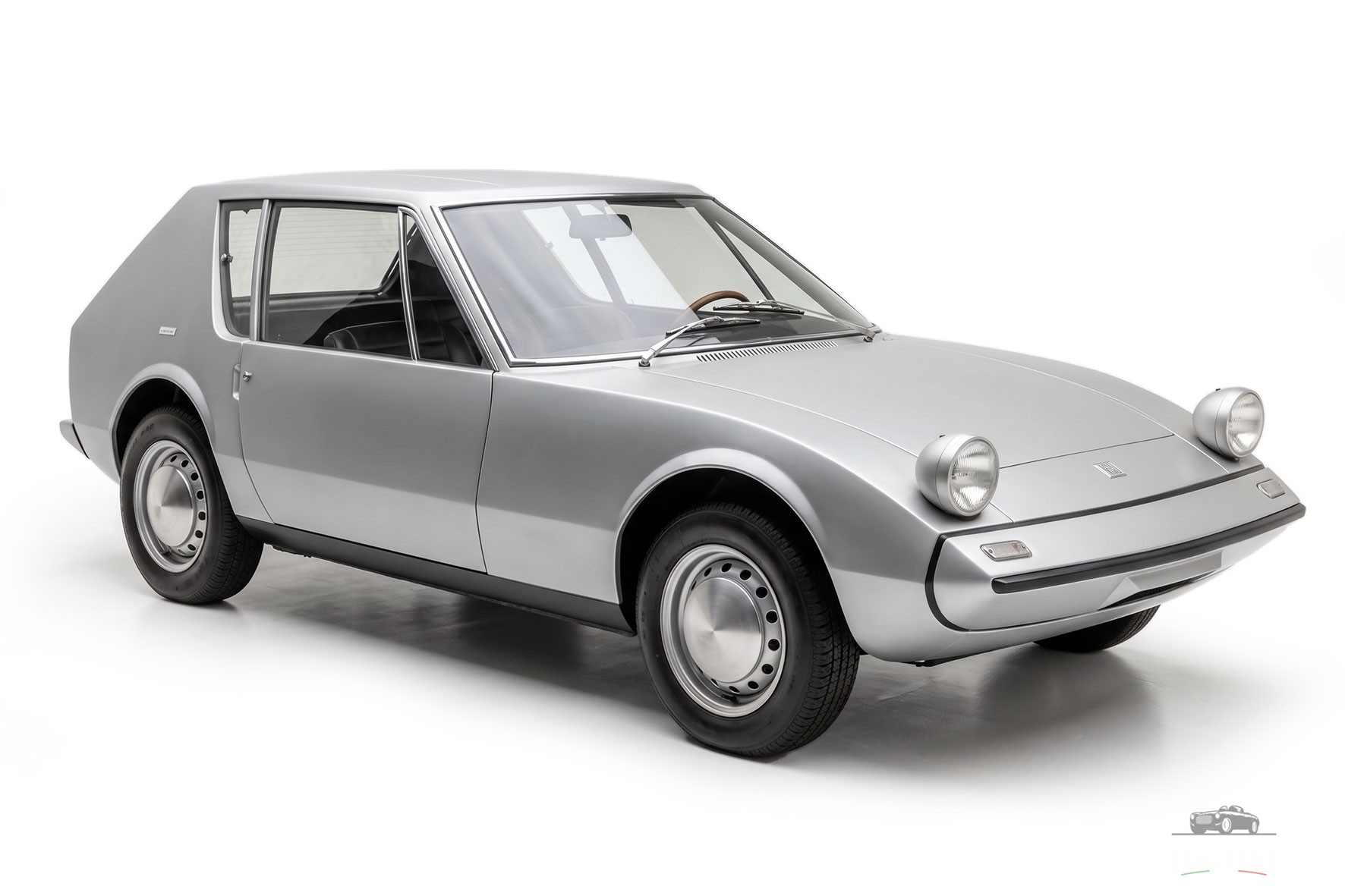
The Autonova GT was built by Sibona Basano on the platform of the standard NSU Prinz 1000 TT, with a rear-mounted 1085 cc engine producing 55 HP. The spare lines of the profile of the body converged at the front in an original appendage to the nose, which served the twofold function of a bumper and a fascia uniting the surfaces of the low, elongated engine hood. However, perhaps the most original feature of the Autonova GT was the aerodynamic design of the flanks, enhanced by a truncated integral rear end with a window that could be opened (unusual in a fastback body type). Also distinctive was the arrangement of the headlights. Its protruding outlines were dictated not only by functional constructional criteria but also by practical considerations, because they helped give the driver a sense of the car’s volumes. The interior was notable for the austere design of the bucket seats, the central tunnel housing the gearshift and other principal switches and levers, and the door panels equipped with tubular armrests of an original design. In this car Pio Manzù and Michael Conrad sought to rethink critically the stylistic currents of the day, which Manzù regarded as stuck with a sort of “formal catechism” and incapable of moving beyond their established schemes. Of the Autonova GT ‘s numerous functional and technical-constructional features, the most striking were its rigorous formal synthesis, the simple, “modern” design of its different parts, from the lines that unite or segment the different sections of the body down to individual details like handles and switches and the most minute seams and welds. Both the Autonova prototypes are still surprising for their originality and coherence, even after this lapse of time. Pio Manzù and Michael Conrad’s project can still be seen as an exemplary contribution to the evolution of the automobile and car design, not only because of the results they achieved but also in terms of method and the development of radically innovative contents.
02 / TECHNICAL IDENTITY
03 / DESIGN, BODY & SUPPLIERS
Coachbuilder / Design studio
Active in Turin during the 1960s, Sibona & Basano built specialist bodies and prototypes for Abarth and other marques, combining skilled fabrication with external design collaborations.
Explore record ↗Attributed designer
Pio Manzu \(1939-1969\), trained at the Ulm School of Design, developed the Autonova concepts before joining Fiat as a consultant. His projects included the 1968 City Taxi and the original design of the Fiat 127, launched after his death in 1971.
Explore record ↗Become a Pro member to see the full details in this section.
Membership is not available yet.
View membership options04 / CHRONOLOGY
07 / GALLERY
THE CONVERSATION
Comments 0