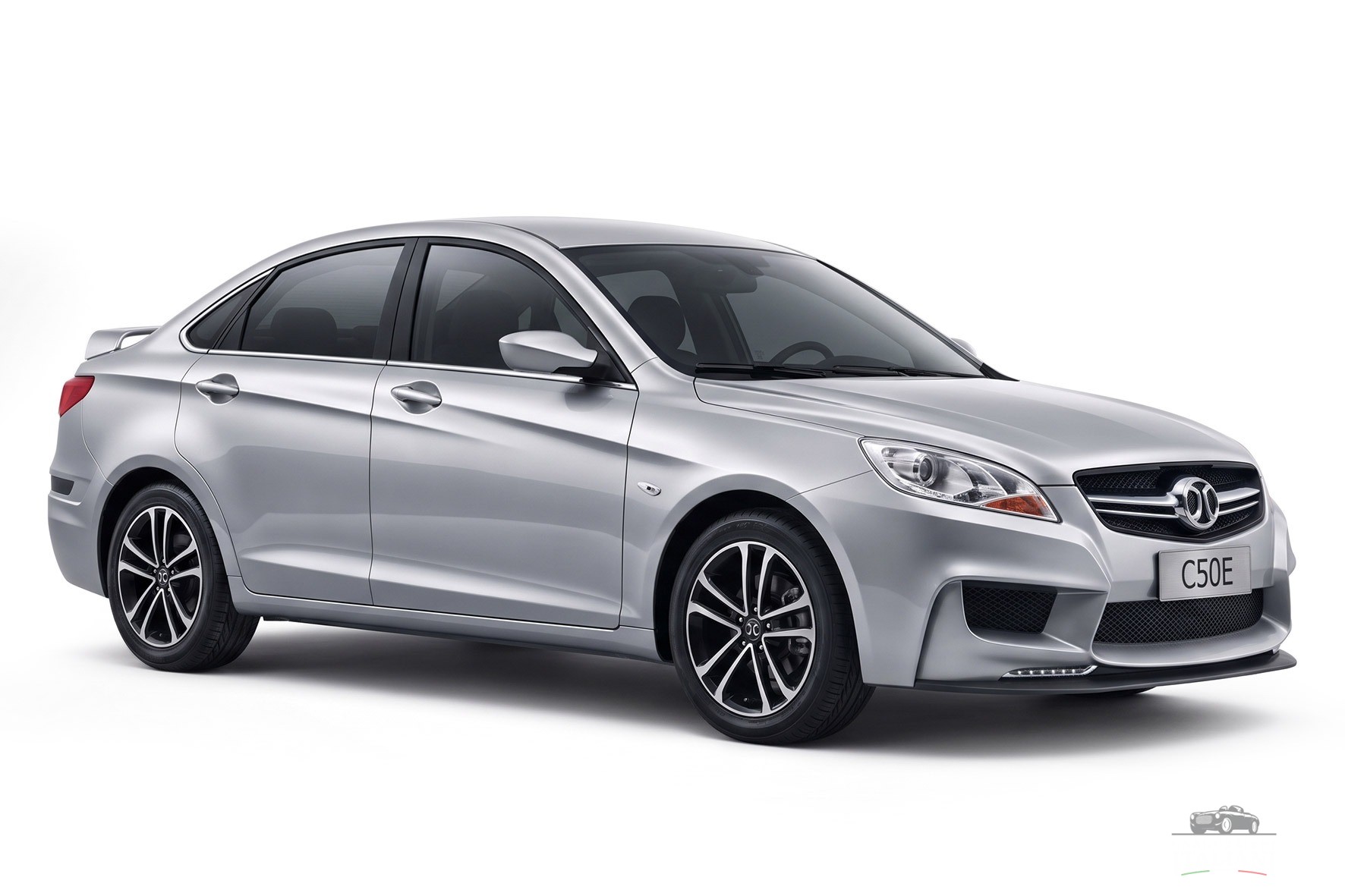
The first-generation BAIC Senova D50 was a compact four-door saloon developed for the Chinese market and introduced publicly at the Beijing International Automotive Exhibition on 20 April 2014. The car followed BAIC’s C50E design study and extended the Senova range below the larger D70. Although the public launch took place in 2014, Chinese government recall records identify D50 vehicles manufactured from August 2013, distinguishing the start of production from the date of market introduction. The D50 was manufactured by BAIC in China; it was not a series of bodies built in Turin.
Italian design and the BAIC programme
The model belongs to the period when BAIC commissioned styling and engineering work from European design consultancies. Bertone was among its partners: a 2013 interview with Bertone management documents work on the BAIC C51X concept, while specialist designer records associate the D50 with the Bertone studio directed by Michael Robinson. The precise allocation of individual styling responsibilities has not been independently established from original design drawings or a factory project file. The D50’s exterior adopted the Senova family’s angular front treatment and prominent grille, alongside a conventional three-box saloon silhouette. The C51X and D50 can be considered related BAIC design programmes, but no direct physical derivation from one vehicle to the other is documented.
Production specification
The 2014 D50 measured 4,582 mm long, 1,794 mm wide and 1,486 mm high, with a 2,650 mm wheelbase. It offered five seats and front-wheel drive. Its initial 1,499 cc naturally aspirated four-cylinder petrol engine was rated at 83 kW and 147 Nm, with five-speed manual and continuously variable transmissions available according to trim. Contemporary specifications describe MacPherson-strut front suspension and an independent multi-link rear arrangement. Published kerb weights differ between the manual and CVT versions, and engine-code catalogues contain inconsistencies; neither a single weight nor one engine designation should be assigned indiscriminately to every example.
At launch BAIC announced six Chinese-market versions priced from CNY 74,800 for the basic manual car to CNY 119,800 for the highest-priced CVT trim. These were official advertised prices, not records of completed transactions. The 2017 replacement adopted different dimensions and styling and should be distinguished from the Bertone-era first-generation D50; subsequent Beijing U5 and electric EU-series developments likewise cannot be treated as the same 2014 specification. This record concerns the production model family rather than an identified individual chassis, and no specific owner, registration, competition result or chassis-level provenance is claimed.


THE CONVERSATION
Comments 0