Touring
Founded in Milan in 1926, Carrozzeria Touring became renowned for elegant grand touring bodies and its patented Superleggera lightweight construction method, later revived under new ownership.
Explore record ↗
1947Coachwork by Touring
THE VEHICLE AT A GLANCE
THE PEOPLE BEHIND THE CAR
Founded in Milan in 1926, Carrozzeria Touring became renowned for elegant grand touring bodies and its patented Superleggera lightweight construction method, later revived under new ownership.
Explore record ↗Italian engineer and post-war director of Carrozzeria Touring, overseeing coachbuilding, styling and technical projects with its design team.
Explore record ↗01 / THE STORY
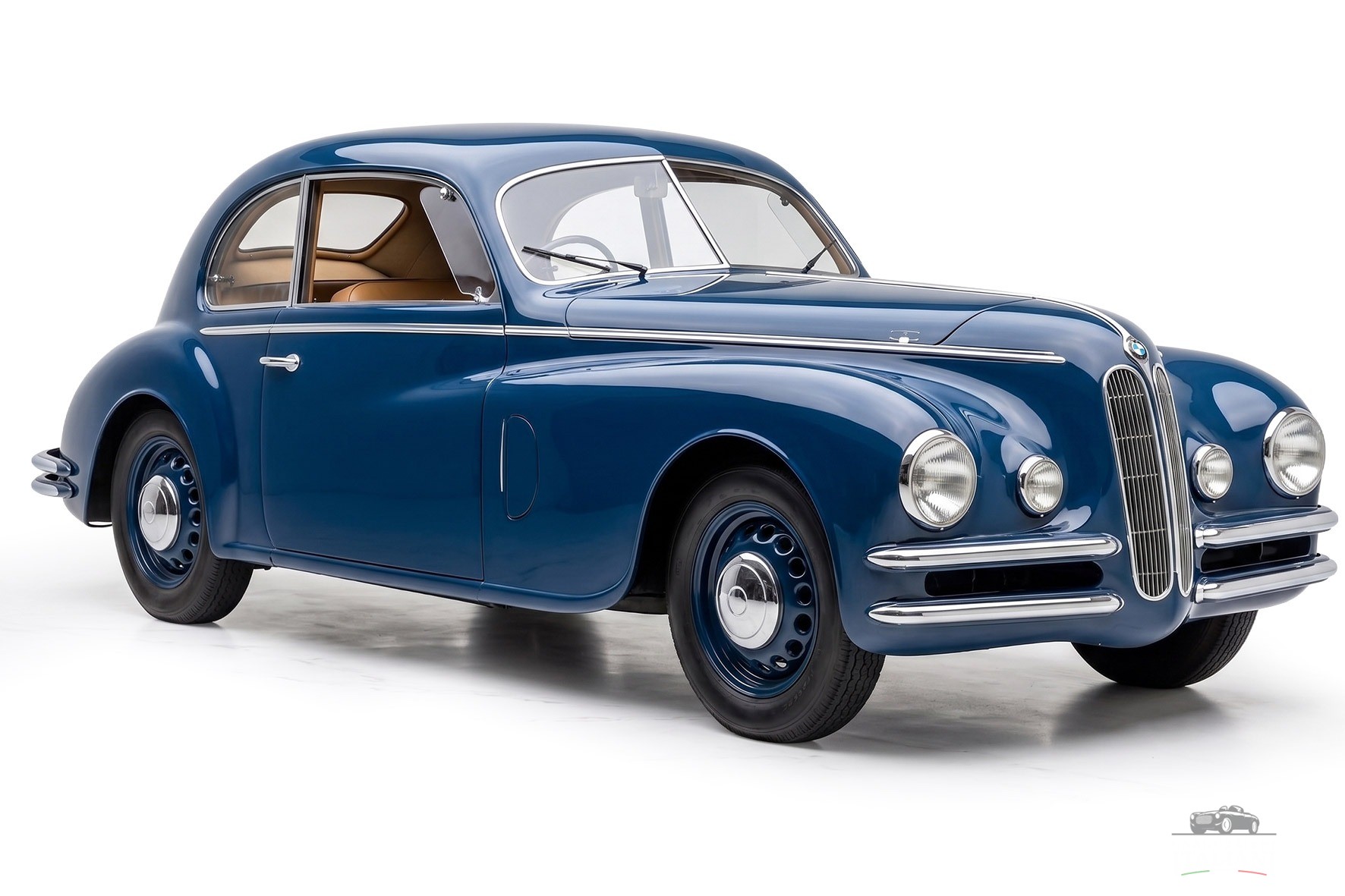
The Bristol 401, introduced in 1948, represents a pivotal moment in the British manufacturer’s post-war evolution from aircraft engineering to luxury automobile production. Building upon its wartime aeronautical expertise, Bristol applied principles of lightweight construction, aerodynamic efficiency, and mechanical precision to the development of its early road cars. The 401 was the company’s second production model and its first to feature fully bespoke coachwork, designed by Carrozzeria Touring of Milan and executed under license in England. The body of the Bristol 401 was constructed using the Superleggera method, a patented system developed by Touring that combined an aluminum outer skin with a tubular steel framework. This approach minimized weight while maintaining structural rigidity, significantly enhancing the car’s performance, efficiency, and handling. The design itself was derived directly from a Touring Berlinetta body developed for the Alfa Romeo 6C 2500 Sport and also applied to a Lancia Aprilia Berlinetta. These three cars—Alfa, Bristol, and Lancia—shared a near-identical silhouette, characterized by smooth, integrated fenders, a long, tapering tail, minimal brightwork, and an emphasis on aerodynamic purity. The relationship between the 401 and its Italian counterparts exemplifies the international influence of Touring’s postwar design language. Beneath the aluminum bodywork, the 401 employed a 2.0-liter inline-six engine, derived from the BMW M328 and refined by Bristol engineers. Producing approximately 85 horsepower and paired with a four-speed manual transmission, the engine was front-mounted with power delivered to the rear wheels. The vehicle utilized a complex suspension system, with an independent front setup featuring transverse leaf springs and swing arms, and a live axle with torsion bar suspension at the rear. Additional technical features included rack-and-pinion steering and hydraulic drum brakes on all four wheels. Notable details on the 401 included concealed door handles operated by pushbuttons, flush-fitting panels, and a distinctive narrow grille reminiscent of pre-war BMW styling. The body’s curvature and flush integration of surfaces yielded a drag coefficient of 0.36, a remarkably low figure for its era and still notable by contemporary standards. This aerodynamic efficiency contributed to the car’s excellent performance: in a 1952 The Motor magazine road test, the 401 reached a top speed of 156.6 km/h and accelerated from 0 to 97 km/h (0–60 mph) in 15.1 seconds. Fuel consumption was recorded at 13.6 liters per 100 kilometers.
02 / TECHNICAL IDENTITY
03 / DESIGN, BODY & SUPPLIERS
Coachbuilder / Design studio
Founded in Milan in 1926, Carrozzeria Touring became renowned for elegant grand touring bodies and its patented Superleggera lightweight construction method, later revived under new ownership.
Explore record ↗Designer
Italian engineer and post-war director of Carrozzeria Touring, overseeing coachbuilding, styling and technical projects with its design team.
Explore record ↗07 / GALLERY
THE CONVERSATION
Comments 0