
Frua
Frua was a Turin coachbuilder founded in 1944 by Pietro Frua; its later design studio styled Maserati, Renault, Glas, AC and other European automobiles.
Explore record ↗
1950Coachwork by Frua
THE VEHICLE AT A GLANCE
THE PEOPLE BEHIND THE CAR
Frua was a Turin coachbuilder founded in 1944 by Pietro Frua; its later design studio styled Maserati, Renault, Glas, AC and other European automobiles.
Explore record ↗Pietro Frua was an Italian automotive designer and coachbuilder who established his own Turin-based company and became known for elegant, individually styled bodies for European manufacturers.
Explore record ↗01 / THE STORY
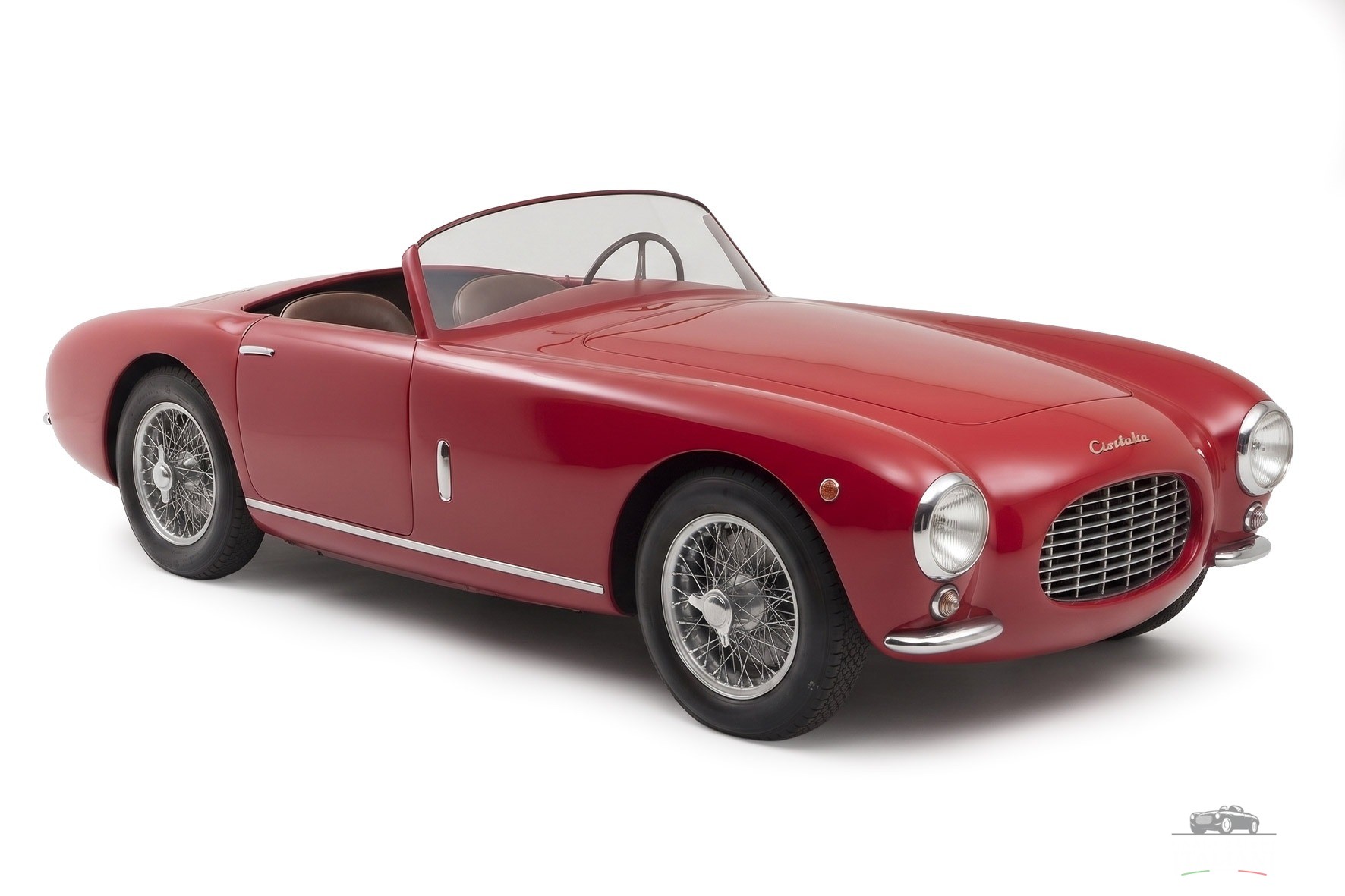
The Cisitalia 202 Spider by Frua represents a rare and significant deviation within the broader 202 series produced by Consorzio Industriale Sportiva Italia in the immediate postwar period. While the primary series was largely defined by coupé variants bodied by Stabilimenti Farina, and to a lesser extent by Vignale, a small number of chassis were delivered to independent coachbuilders for custom bodies. Among these, the spiders constructed by Pietro Frua stand apart for their distinctive formal language and artisanal execution. Constructed on the standard tubular steel chassis developed by Dante Giacosa and Giovanni Savonuzzi, the Frua-bodied Spider retained the mechanical layout of the original Cisitalia 202. This included a front-mounted, 1,089 cubic centimeter inline-four engine derived from the Fiat 1100, producing approximately 55 horsepower. Power was transmitted through a four-speed manual gearbox to the rear axle. Performance figures, though modest by contemporary sports car standards, were secondary to the vehicle’s design intent, which emphasized weight reduction, agility, and visual elegance. Pietro Frua’s contribution to the 202 Spider diverged from the prevailing design of the closed coupé. His interpretation introduced a lowered beltline, a more open cabin configuration, and delicately shaped front and rear fenders. The front fascia varied across individual builds, reflecting a hand-formed process rather than standardized production. Headlamp positioning, grille treatments, and interior fittings were executed on a per-commission basis. Rear deck proportions were typically abbreviated, emphasizing the car’s compact wheelbase and agile silhouette. The number of Frua-bodied 202 Spiders produced is not definitively recorded but is generally believed to be fewer than ten. Among the known examples, chassis #089 and chassis #122 have appeared in period documentation and subsequent concours events. Ownership history for these cars includes Italian private collectors during the early 1950s and select transfers to North American collections by the late 20th century. The Cisitalia 202 Spider Frua remains emblematic of Italy’s immediate postwar coachbuilding renaissance, characterized by independent workshops, small-volume craftsmanship, and aesthetic experimentation. It reflects the transitional moment between prewar artisanal methods and the emergence of standardized, industrial design—preserved now as a scarce artifact of that brief and luminous interval.
02 / TECHNICAL IDENTITY
03 / DESIGN, BODY & SUPPLIERS
Coachbuilder / Design studio
Frua was a Turin coachbuilder founded in 1944 by Pietro Frua; its later design studio styled Maserati, Renault, Glas, AC and other European automobiles.
Explore record ↗Designer
Pietro Frua was an Italian automotive designer and coachbuilder who established his own Turin-based company and became known for elegant, individually styled bodies for European manufacturers.
Explore record ↗07 / GALLERY

THE CONVERSATION
Comments 0