
Scaglietti
Founded by Sergio Scaglietti near Ferrari in 1951, Carrozzeria Scaglietti became closely associated with the hand-built aluminium bodies of Ferrari racing and grand touring cars.
Explore record ↗
1984Coachwork by Scaglietti
THE VEHICLE AT A GLANCE
THE PEOPLE BEHIND THE CAR
Founded by Sergio Scaglietti near Ferrari in 1951, Carrozzeria Scaglietti became closely associated with the hand-built aluminium bodies of Ferrari racing and grand touring cars.
Explore record ↗Leonardo Fioravanti is an Italian automotive designer renowned for his work at Pininfarina, where he contributed to the styling of landmark Ferrari road cars.
Explore record ↗PRICE & SALES RECORD
01 / THE STORY
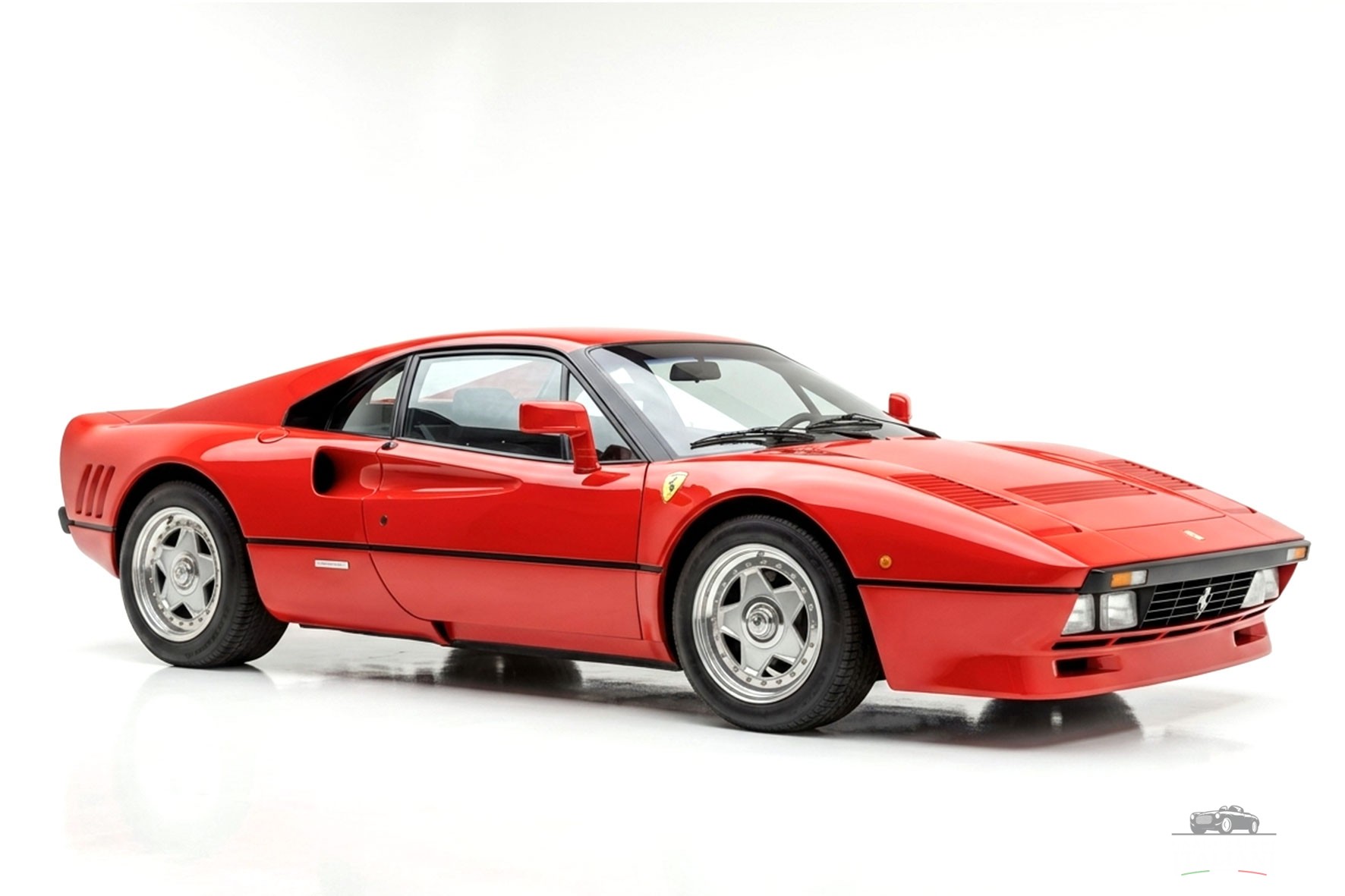
The Ferrari 288 GTO: The Ferrari F114B road-car engine and the Lancia 2.6L V8 race engine developments progressed closely, with some draughtsmen employed from Abarth to complete detail design on components for manufacture at times when the Ferrari draughtsmen were at full capacity. In order to improve overall performance, several key aspects of the original 308 vehicle layout were altered: the engine did not grow in displacement but was turbocharged, it remained mid-mounted but now longitudinally instead of transversely, the wheelbase was elongated by 200mm, the outer bodywork required modifications to maintain pleasing proportions. The Ferrari 288 GTO used water-cooled IHI turbochargers from japan compared to the KKK turbochargers used in Formula 1 due to the better materials and aerodynamic internal designs which allowed faster transient response. IHI had bought patents from Swiss manufacturer Brown Boveri (Baden) that had supplied Ferrari with the Comprex systems Some of the GTO’s styling features were first displayed on a 308 GTB design exercise by Pininfarina shown at the 1977 Geneva Auto Salon. The 288 GTO had started out as a modified version of the 308/328 to hold down costs and to build the car quickly, but little of the 308/328 was left when the Ferrari 288 GTO was finished. Fortunately Ferrari could count on customers who were loyal when it came to spending more if they could access performance and style that was unmatched, so the unplanned deviation from the original cost targets did not necessarily prove an issue. Easily noticeable differences were the GTOs bulging fender flares, larger front/rear spoilers, large “flag-style” outside mirrors and four driving lights at the far sides of the grille. Retained from the original 250 GTO were slanted air vents, put in the GTO’s rear fenders to cool the brakes, as well as the rear wing’s design, borrowed from the 250 GTO’s original wing. The Ferrari 288 GTO also had wider body panels than the 308’s because they had to cover much larger Goodyear tires mounted on racing wheels. The suspension’s height could be set higher for road use and lower for racing on tracks. Bodywork material was new and lighter for better acceleration and handling. The Ferrari 288 GTO’s weight was 2,555 lb (1,159 kg), compared to 3,085–3,350 lb (1,399–1,520 kg) for the 308/328. Steel was used just for the doors because major body panels were made from molded fiberglass. Kevlar was used for the hood, and the roof was made from Kevlar and carbon fiber. Materazzi felt that with the latest road speed limits and stricter fines, it was increasingly hard for clients to really prove the potential of cars with a high performance. Ferrari asked what was his proposal, to which he suggested returning to racing in the GT class, something which had been interrupted after the 512 BB LM. The overall permission to modify the GTO road car into the Evoluzione for a racing programme however had to be ratified by Eugenio Alzati. He permitted it on conditions that the engineers interested in the project work outside of the Monday to Friday timetable (which was dedicated for development of 328 and other models). The lessons learnt during the development of the engine for the Lancia LC2 could be applied to the racing version of the Ferrari 288 GTO, such as the carefully engineered conicity of the intake plenums to ensure accurately balanced air flow and pressure to each cylinder and the setup of the turbochargers to produce in excess of 650 bhp. The GTO Evoluzione included all the necessary modifications (bodywork, chassis, safety systems) to comply with the FIA regulations which permitted 20 cars per year to be specifically built for rally or track racing. Due to multiple deaths and the inherent danger involved with group B rally racing, the Group B Circuit series was suspended at the end of 1986. As a result, the GTO Evo never raced. All GTO road cars came in a stock red color, except one which was black. All GTO Evo cars came in red colour. Like any Ferrari car, the low production numbers for the Ferrari 288 GTO were intended to give an exclusive product for the enthusiast buyer. The number of GTO’s produced did indeed fit in the minimum requirement of 200 required by the FIA and in fact the factory produced 70 more plus a couple extra to please the Agnelli family, an F1 driver or anybody else who the Commendatore predicted might insist on a last minute purchase option. Although the production car test team headed by Dario Benuzzi did not include any of the Formula 1 drivers, Michele Alboreto occasionally had involvement in giving feedback on cars such as the Ferrari 288 GTO, and later the 328 Turbo and F40. In particular he agreed with Enzo Ferrari’s return to a breed of cars which were much more fiery, describing the GTO as “cattiva” (angry) and praising its low engine centre of gravity compared to the Testarossa.
02 / TECHNICAL IDENTITY
Become a Pro member to see the full details in this section.
Membership is not available yet.
View membership options03 / DESIGN, BODY & SUPPLIERS
Coachbuilder / Design studio
Founded by Sergio Scaglietti near Ferrari in 1951, Carrozzeria Scaglietti became closely associated with the hand-built aluminium bodies of Ferrari racing and grand touring cars.
Explore record ↗Designer
Leonardo Fioravanti is an Italian automotive designer renowned for his work at Pininfarina, where he contributed to the styling of landmark Ferrari road cars.
Explore record ↗04 / CHRONOLOGY
05 / PEOPLE, COLLECTIONS & MUSEUMS
06 / MARKET & PRICE HISTORY
EUR · 2 recorded sales
RECORDED SALES
EUR
Each point is a completed sale with its own date, in chronological order. Dates are positioned by calendar time, with approximate placement when only a year or month is documented. The connecting line shows observed sales prices in this currency, not an appreciation index: transactions may concern different chassis and specifications. Factory prices and unsold estimates are excluded.
USD · 1 recorded sale
RECORDED SALES
USD
Each point is a completed sale with its own date, in chronological order. Dates are positioned by calendar time, with approximate placement when only a year or month is documented. The connecting line shows observed sales prices in this currency, not an appreciation index: transactions may concern different chassis and specifications. Factory prices and unsold estimates are excluded.
Sign in to see the details of each sale on the chart.
Become a Pro member to explore the full price and sale history.
Membership is not available yet.
View membership optionsMarket observations describe documented transactions, estimates or offers. They are not themselves a current valuation of the vehicle.
07 / CHASSIS REGISTER
1 recorded sale · 2026
1 recorded sale
1 recorded sale · 2017
View full chassis history · Pro membership
08 / GALLERY
THE CONVERSATION
Comments 0