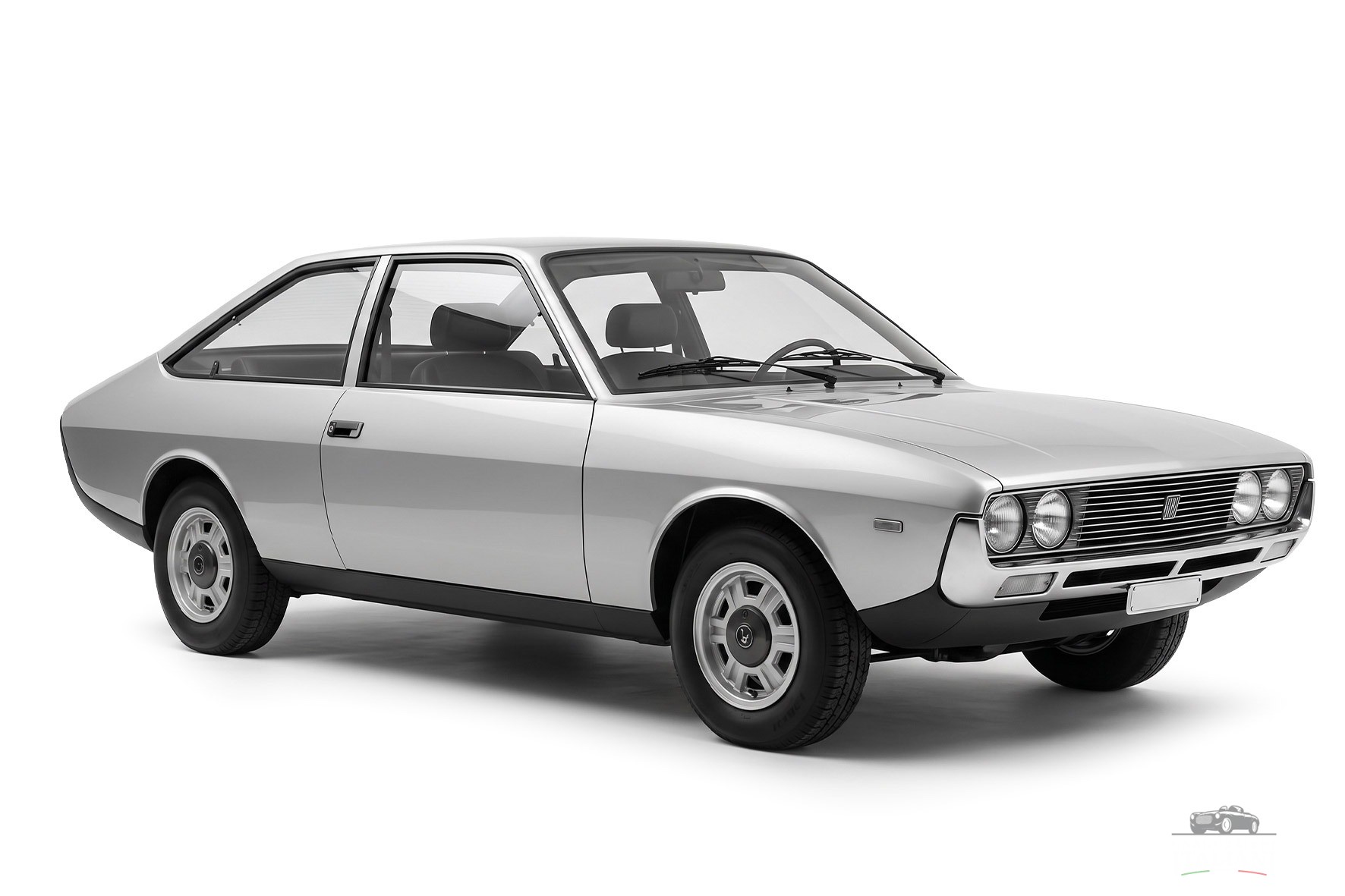
The Fiat 124 S Coupé proposal developed by Bertone in 1972 belongs to the little-documented alternatives considered during the evolution of Fiat’s established 124 Sport Coupé. A retrospective published by Motor.ru in October 2019 identifies the Bertone study and illustrates its sharply defined, angular styling. The project was not adopted for the production car, and it should be distinguished from the regular Fiat 124 Sport Coupé and from the coachbuilt variants offered by other Italian firms.
A proposal during the 1972 model revision
Fiat had introduced the production 124 Sport Coupé at Geneva in 1967, with styling developed by its own Centro Stile. The model underwent successive revisions, including a third series introduced in 1972. Bertone’s study therefore appeared several years after the original production coupé, rather than competing for the initial 1967 design commission. Its squared-off surfaces and crisp profile reflected the changing visual language of the early 1970s. Motor.ru compares its proportions with the Lamborghini Jarama, another Bertone creation, but this resemblance is not proof that the two projects shared a platform or that Marcello Gandini personally designed the Fiat proposal.
The same retrospective suggests that the roof geometry may indicate an adaptation of a production Fiat 124 Sport Coupé bodyshell, perhaps intended as an alternative restyling. This remains a hypothesis. No inspected Bertone build record, Fiat development order or chassis documentation has yet established the construction method, the existence of a running prototype or the number of physical models made. Consequently, the production coupé’s engine specifications, dimensions and chassis numbers cannot be assigned to this study.
Its place within the Fiat 124 family
The wider Fiat 124 family also gave rise to distinct coachbuilt interpretations, including the Moretti 124 Berlinetta and the Vignale Eveline, as well as the Pininfarina-styled 124 Sport Spider. These are parallel members of the model family, not proven derivatives of Bertone’s 1972 proposal. The surviving published evidence establishes an identifiable Bertone styling project, but leaves its individual designer, precise technical specification, exhibition history and subsequent fate unresolved.


THE CONVERSATION
Comments 0