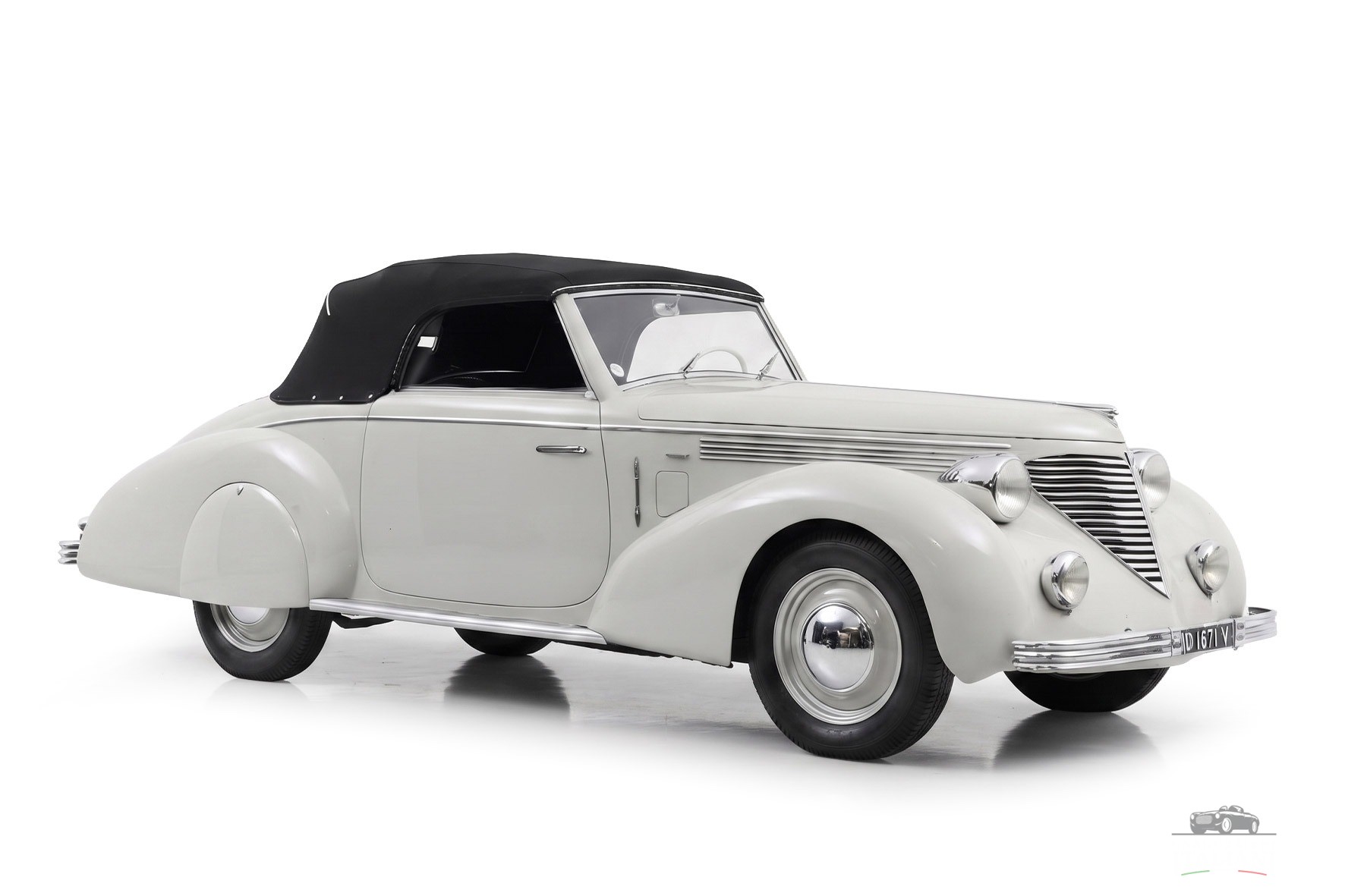
The Fiat 508 C Balilla Cabriolet attributed to Carrozzeria Bertone belongs to the coachbuilder’s pre-war work on Fiat’s small-car chassis. Introduced in 1937, the Fiat 508C—also known as the Nuova Balilla 1100—represented a substantial mechanical development of the earlier 508 Balilla. Bertone was already active in this field: the historical account maintained by Istoreto records its work on the Nuova Balilla in 1937, following the firm’s move to Corso Peschiera in Turin and its earlier Balilla projects.
A Fiat chassis for special coachwork
The 508C provided an attractive basis for independent coachbuilders because it combined a compact frame with updated running gear. Its standard mechanical specification included a 1,089 cc inline-four engine, independent front suspension and a wheelbase of approximately 2,420 mm. These are specifications of the Fiat 508C platform, not measurements or performance figures established for an individual Bertone-bodied car. In particular, the higher output associated with certain competition versions of the 508C must not be assigned to this cabriolet without evidence of its actual engine configuration.
The Bertone Cabriolet is recorded in the historical listing as a 1938 open-bodied version, described as a compact two-seat interpretation of the Fiat. Its coachwork should be understood within the contemporary demand for special bodies that distinguished a privately commissioned car from Fiat’s regular catalogue. A surviving 1937 photograph of a Fiat 508C cabriolet in the Castello Sforzesco photographic archive demonstrates that open versions of the new model were already present at the time, although that photograph has not been identified as a Bertone creation and cannot be used as evidence of this specific design.
Bertone’s pre-war programme
The Cabriolet followed other Bertone treatments of the Balilla family, including the distinct Balilla della Signora of 1934. It should also be distinguished from the earlier Fiat 508 Balilla Berlina by Bertone, whose exact pre-508C subseries remains under investigation. These links place the car within a wider body of Turin coachbuilding work without implying that the cars shared a single chassis or identical body design.
Mario Revelli di Beaumont worked with Giovanni Bertone during the 1930s, as documented by his biographical record, but the available evidence does not establish him as the individual designer of this particular Cabriolet. Nor has an individual chassis number, original registration, body number, production total, ownership chain or chassis-specific auction result been verified. The 1938 identification and Bertone attribution are retained as the working record, while those unresolved details remain open to further archival research.


THE CONVERSATION
Comments 0