
Fiat Carrozzerie Speciali
Fiat's Turin-based in-house specialist coachbuilding department, encompassing the Vetture Speciali and later Officine Lingotto activities.
Explore record ↗
1931Coachwork by Fiat Carrozzerie Speciali
THE VEHICLE AT A GLANCE
THE PEOPLE BEHIND THE CAR
Fiat's Turin-based in-house specialist coachbuilding department, encompassing the Vetture Speciali and later Officine Lingotto activities.
Explore record ↗01 / THE STORY
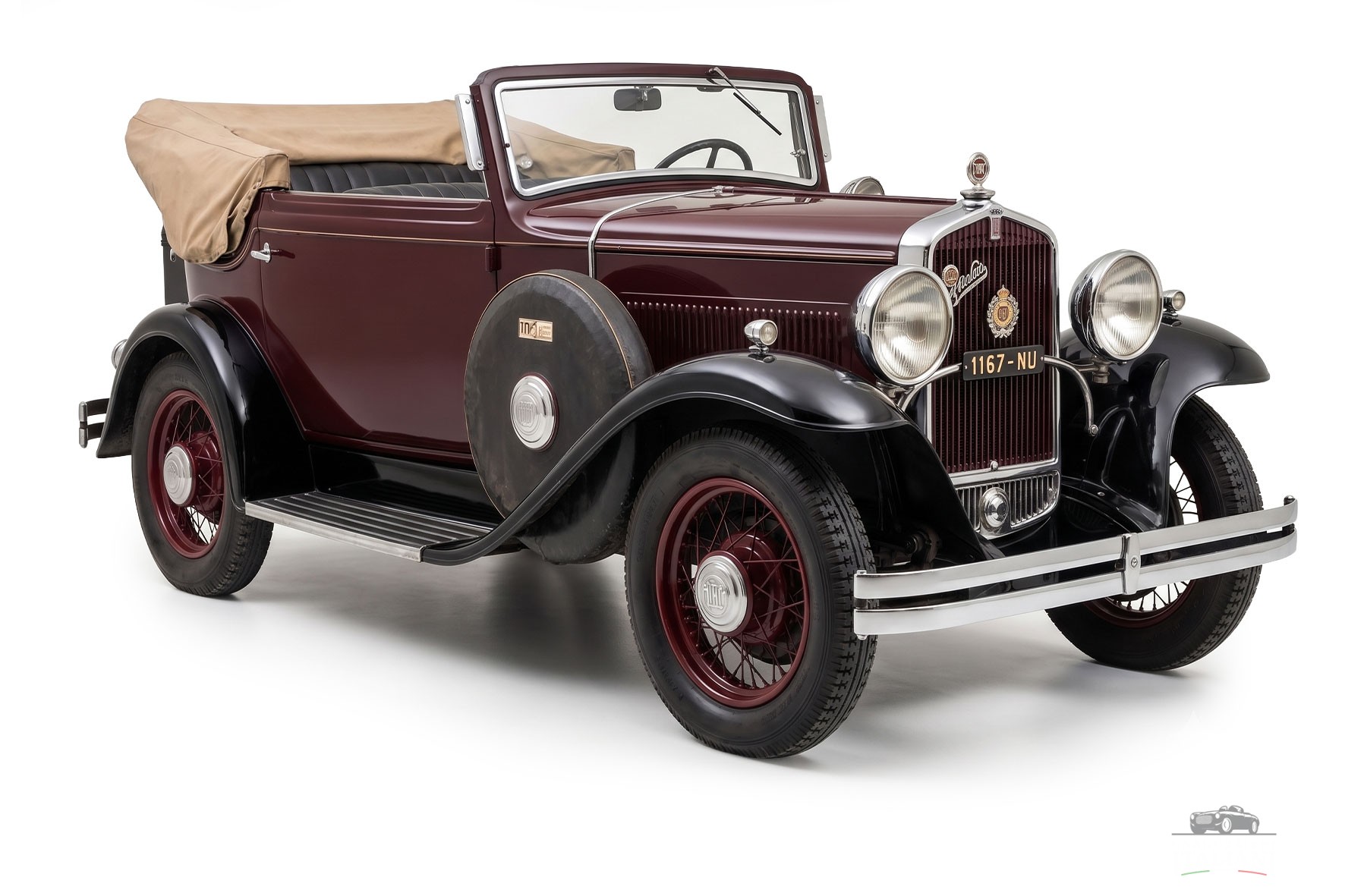
The Fiat 522 Cabriolet Royale by Carrozzerie Speciali was an exclusive open version of the Fiat 522, produced between 1931 and 1933. The bodywork was built by Carrozzerie Speciali, Fiat’s in-house coachbuilding department in Turin, which operated under the direction of Rodolfo Schaeffer. The Fiat 522 was a medium-high range model and derived from the earlier Fiat 520, the first Fiat equipped with a six-cylinder engine. It was presented in 1931 at the 4th Milan Motor Show and was offered in three main chassis versions: 522 C with short wheelbase, 522 L with long wheelbase, and 522 S Sport, introduced at the 1932 Geneva Motor Show with an intermediate wheelbase and a more powerful engine. The 522 used a 2,516 cc inline six-cylinder side-valve engine. Standard versions produced around 52 hp, while the 522 S developed approximately 65 hp. Drive was to the rear wheels through a four-speed manual gearbox, with synchromesh on third and fourth gears. The model was also the first Italian car equipped with dual-circuit hydraulic brakes. Top speed varied according to version: about 95 km/h for the 522 L, 105 km/h for the 522 C, and 115 km/h for the 522 S. The Cabriolet Royale was one of the most elegant bodies available on the 522 chassis. It was a top-of-the-range convertible, built in limited numbers with refined trim and formal proportions. Around 400 examples of this body type are believed to have been produced. Today, only four surviving examples are known. One Fiat 522 Cabriolet Royale by Carrozzerie Speciali was shown at the 1932 Concorso d’Eleganza in Stresa. The same car was later displayed at the 2025 event in Mantova, confirming its survival and historical relevance. The Fiat 522 was available with several body styles, including two- and four-door saloons, torpedo, cabriolet and coupé versions. Total production reached 7,360 units, including 4,706 examples of the 522 C, 1,922 of the 522 L, and 722 of the 522 S. The 522 also saw limited competition use. At the 1933 Mille Miglia, a Fiat 522 driven by Pietro Ferrero and Renzo Monaco finished 41st overall. Carrozzerie Speciali played an important role in Fiat’s prewar coachbuilding activity. The department originated from Fiat’s internal bodywork operations and was based in via Madama Cristina in Turin. In 1925, it became known as Carrozzerie Speciali and gradually became an integrated part of Fiat. It remained active for decades and later worked on important models such as the Fiat 8V and Fiat 1100 S.
02 / TECHNICAL IDENTITY
03 / DESIGN, BODY & SUPPLIERS
Coachbuilder / Design studio
Fiat's Turin-based in-house specialist coachbuilding department, encompassing the Vetture Speciali and later Officine Lingotto activities.
Explore record ↗04 / CHRONOLOGY
06 / CHASSIS REGISTER
07 / GALLERY
THE CONVERSATION
Comments 0