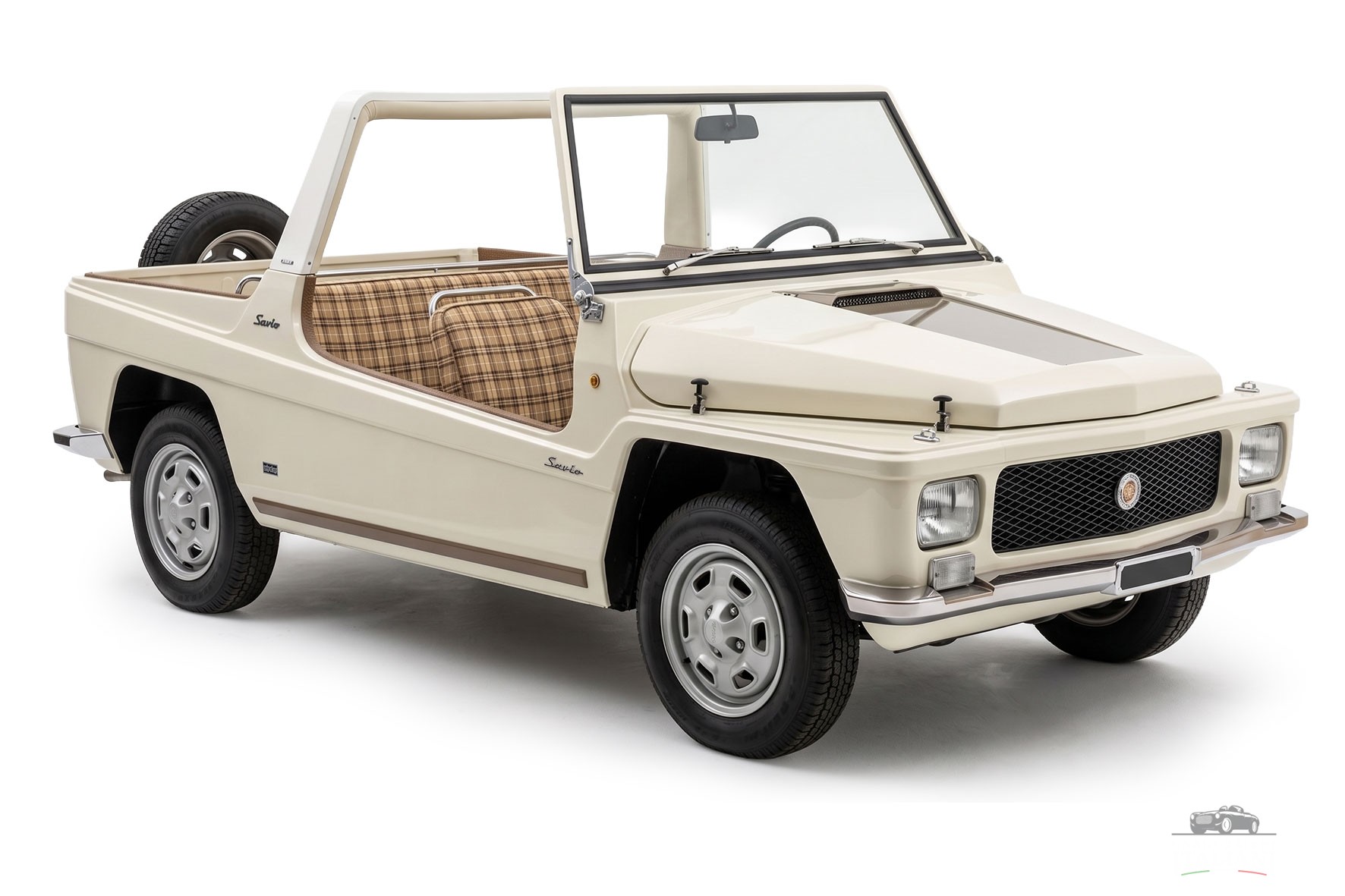

Savio
Carrozzeria Savio was a Turin coachbuilder founded by Antonio and Giuseppe Savio, known for bespoke bodies and later specialist vehicles on Fiat and other Italian chassis.
Explore record ↗
1971Coachwork by Savio
THE VEHICLE AT A GLANCE
THE PEOPLE BEHIND THE CAR
Carrozzeria Savio was a Turin coachbuilder founded by Antonio and Giuseppe Savio, known for bespoke bodies and later specialist vehicles on Fiat and other Italian chassis.
Explore record ↗01 / THE STORY
The Fiat 127 Albarella was a coachbuilt leisure vehicle developed in the early 1970s by Carrozzeria Savio, based on the mechanical underpinnings of the Fiat 127. It was named after Albarella, a private island in the Venetian lagoon, suggesting its intended use as a utility and recreational automobile in resort or coastal environments. The model conformed to the spiaggina typology, a category of lightweight, open-air vehicles adapted from standard production platforms for beachside and short-range use. The base Fiat 127, introduced in 1971, featured a transverse front-mounted 903 cubic centimeter inline-four engine with a front-wheel-drive layout. The Albarella retained this mechanical configuration. The engine produced approximately 47 horsepower, paired with a four-speed manual gearbox. These specifications allowed modest performance consistent with the vehicle’s utilitarian and leisure-focused role. The transformation undertaken by Savio replaced the standard steel roof and side structures with an open configuration, incorporating minimal doors and a folding soft-top. The bodywork was simplified to reduce weight and increase exposure to the surrounding environment. Interior appointments were likewise altered, with a focus on durability and resistance to moisture, including the use of plastic and vinyl surfaces. Seating was reduced in number or simplified, depending on the version. The vehicle’s purpose was not oriented toward passenger comfort over long distances but rather functional use in controlled, warm-weather environments. Production numbers of the Fiat 127 Albarella remain undocumented, though it is understood to have been produced in limited quantities. It did not receive support as a factory-backed special model and was marketed independently by the coachbuilder. Distribution was likely concentrated in the Italian domestic market and possibly select Mediterranean resort areas. The Fiat 127 Albarella exists as an illustrative example of Italian coachbuilding practice during the postwar period, in which industrial vehicles were adapted through localized craftsmanship for seasonal and regional use. It belongs to a lineage of spiaggina vehicles that includes more prominent examples such as the Fiat 600 Jolly. The Albarella’s significance lies in its embodiment of design values rooted in climate, geography, and informal use rather than standard automotive utility.
02 / TECHNICAL IDENTITY
03 / DESIGN, BODY & SUPPLIERS
Coachbuilder / Design studio
Carrozzeria Savio was a Turin coachbuilder founded by Antonio and Giuseppe Savio, known for bespoke bodies and later specialist vehicles on Fiat and other Italian chassis.
Explore record ↗04 / CHRONOLOGY
07 / GALLERY
THE CONVERSATION
Comments 0