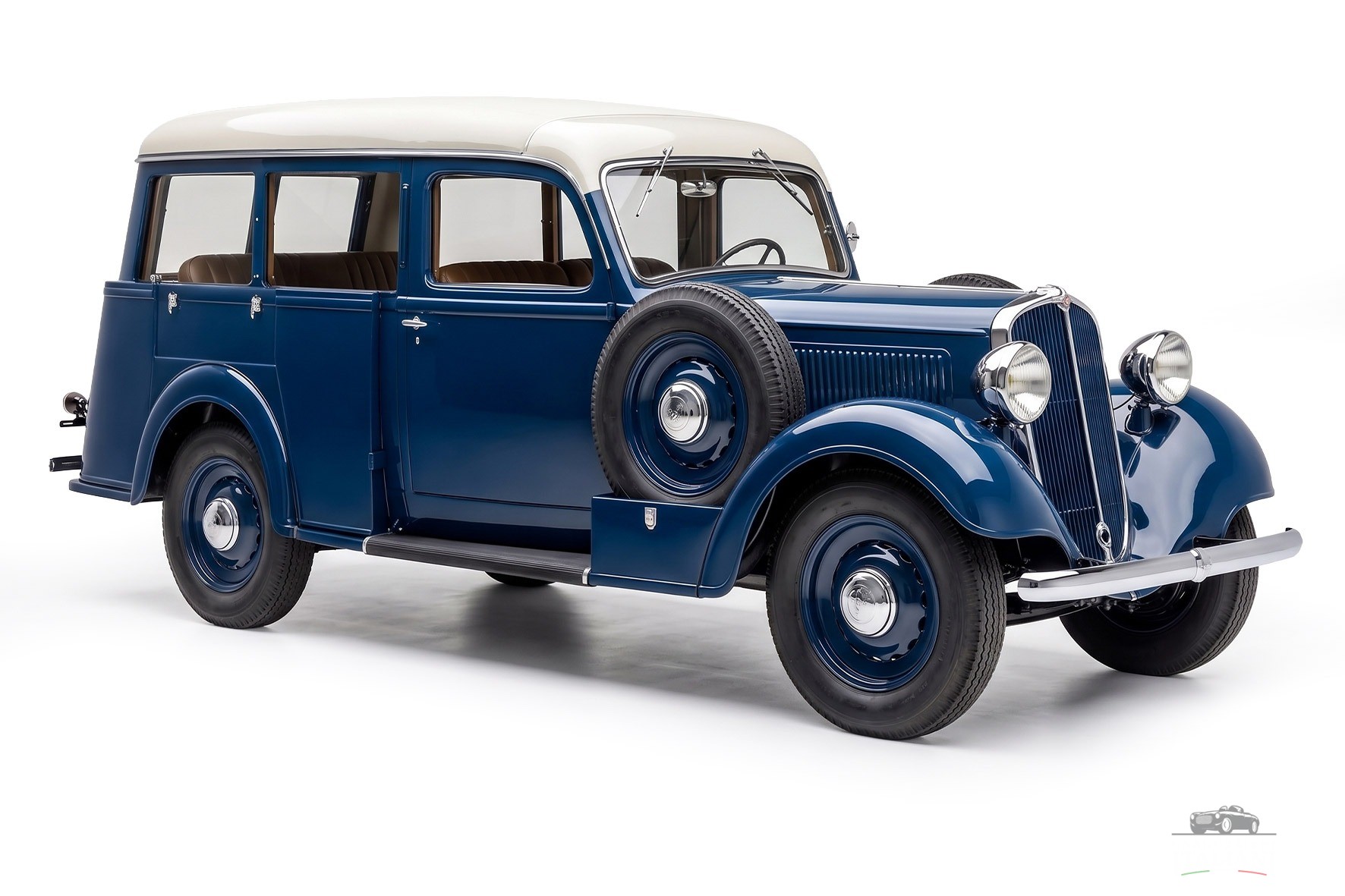
Among the most interesting pre-war creations by Carrozzeria Savio was the so-called Box Body built on the Fiat 518 Ardita chassis. The design is linked to Mario Revelli di Beaumont and is often considered an unusually early attempt at creating a multi-purpose vehicle, decades before terms such as SUV, crossover, or off-road station wagon became common. The car combined the mechanical base of a conventional Fiat passenger chassis with a tall, practical body designed for mixed use. Its proportions were very different from the elegant saloons and coupés normally associated with coachbuilding in the 1930s. The front retained the formal appearance of the Fiat 518, with separate wings, upright grille, external spare wheel and traditional bonnet line. Behind it, however, Savio created a large enclosed passenger and cargo compartment with a high roof, wide side windows and a long, almost rectangular rear body. The result was a vehicle with clear functional priorities. It offered generous interior space, good visibility and easier access than a normal saloon, while still keeping the robust character of the Fiat Ardita chassis. The rear section had the appearance of a practical estate or light transport vehicle, but with more refinement than a simple commercial van. This combination of passenger comfort, load capacity and rough-road usefulness makes the Savio Box Body especially notable. It was not an off-road vehicle in the modern sense, but it anticipated the idea of a car that could serve several roles at once: family transport, utility vehicle, estate car and leisure machine. For Savio, the project showed a willingness to experiment beyond conventional coachbuilt luxury. For Revelli di Beaumont, it reflected a broader interest in practical, rational vehicle design. The Fiat 518 Ardita Box Body remains one of those rare pre-war Italian designs that feels surprisingly modern in concept, even if it was built in the language and construction methods of its own time.



THE CONVERSATION
Comments 0