
Stabilimenti Farina
Stabilimenti Farina was a leading Turin coachbuilder established by Giovanni Carlo Farina, training generations of craftsmen while creating bespoke bodies for major Italian marques.
Explore record ↗
1912Coachwork by Stabilimenti Farina
THE VEHICLE AT A GLANCE
THE PEOPLE BEHIND THE CAR
Stabilimenti Farina was a leading Turin coachbuilder established by Giovanni Carlo Farina, training generations of craftsmen while creating bespoke bodies for major Italian marques.
Explore record ↗Italian coachbuilder and design director (1893–1966) who founded Carrozzeria Pinin Farina in Turin in 1930 and guided its early aerodynamic and industrial development.
Explore record ↗01 / THE STORY
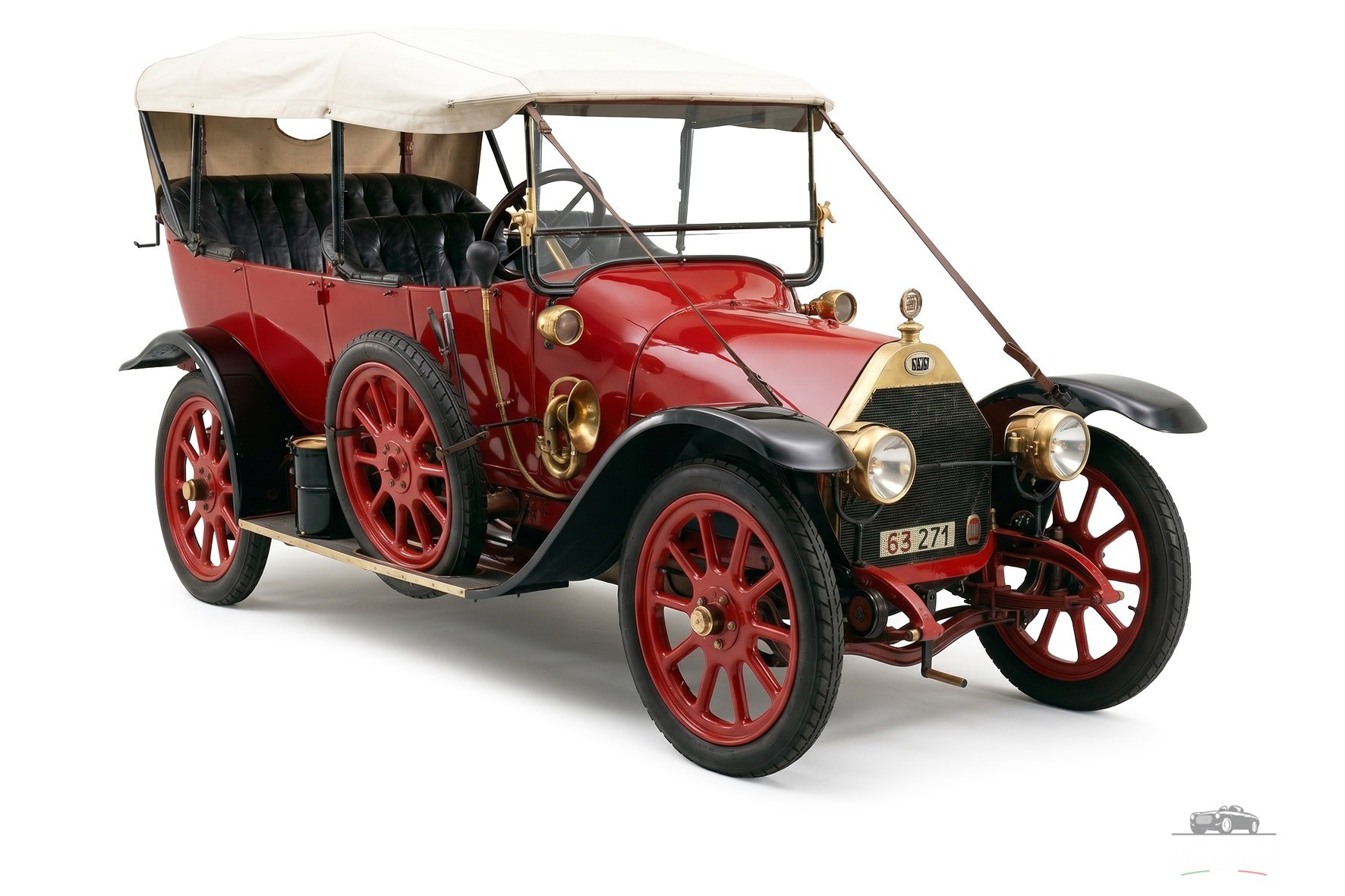
The Fiat Tipo Zero, designed by Battista “Pinin” Farina, holds a special place in automotive history as one of the earliest examples of his work. This model owes its “Zero” designation to Fiat’s founder, Giovanni Agnelli, who envisioned it as the rebirth of Fiat. At Stabilimenti Farina, Battista was given the opportunity by Agnelli—who was dissatisfied with Fiat’s Centro Stile proposal—to create a design for the Tipo Zero. When asked if he preferred his design to Fiat’s proposal, Farina confidently responded, “I prefer this one because I designed it.” His boldness won him the commission, marking a significant milestone in his illustrious career. The Tipo Zero was sold in both torpedo and spider configurations, initially priced at 8,000 lire, later reduced to 6,900 lire, roughly equivalent to 27,000 euros in 2012. It was equipped with a 1.9-liter engine producing about 15 hp, enabling it to reach speeds of up to 70 km/h. The car’s fuel efficiency was approximately 5.1 km per liter. In the range of models that Fiat developed by the end of the first decade of the 20th century, which included types from “1” to “6” with engine displacements ranging from nearly 2 to over 7 liters, there was a clear need for a smaller, more economical model. Hence, the Tipo Zero was introduced. Despite its relatively affordable price, equivalent to that of an apartment at the time, it was still beyond the reach of the middle class, making it far from a popular car. In 1915, the Tipo Zero was updated to include an electrical system, but production ceased shortly thereafter as Fiat shifted to wartime manufacturing due to Italy’s involvement in World War I. Over 2,000 units of the Tipo Zero were produced, making it the first Italian car to be produced in series and establishing it as the progenitor of Fiat’s utilitarian vehicles. The Fiat Tipo Zero not only represents an important chapter in Fiat’s history but also marks the beginning of Battista Farina’s legendary career in automotive design, setting the stage for his future successes and the creation of Pininfarina, a name synonymous with elegance and innovation in car design.
02 / TECHNICAL IDENTITY
03 / DESIGN, BODY & SUPPLIERS
Coachbuilder / Design studio
Stabilimenti Farina was a leading Turin coachbuilder established by Giovanni Carlo Farina, training generations of craftsmen while creating bespoke bodies for major Italian marques.
Explore record ↗Attributed designer
Italian coachbuilder and design director (1893–1966) who founded Carrozzeria Pinin Farina in Turin in 1930 and guided its early aerodynamic and industrial development.
Explore record ↗04 / CHRONOLOGY
07 / GALLERY
08 / PERIOD ARCHIVE
Become a Pro member to see the full details in this section.
Membership is not available yet.
View membership options
THE CONVERSATION
Comments 0